Southeast Asia Waterproofing Chemicals Market Analysis, Growth, Trends & Forecast Report, 2033 | UnivDatos
Posted by Ahasan Ali
Filed in Other 371 views
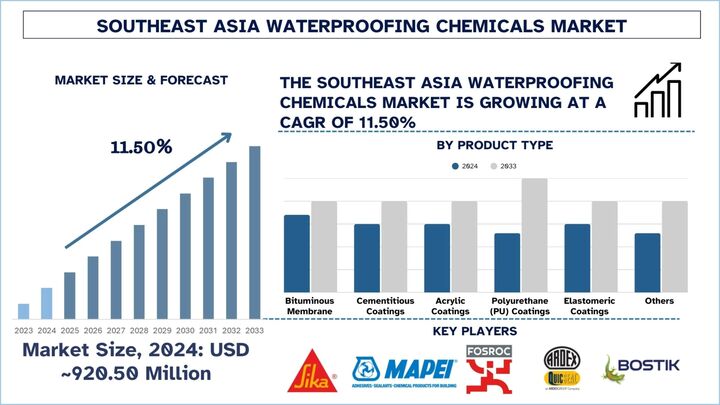
According to a new report by UnivDatos, the Southeast Asia Waterproofing Chemicals Market is expected to reach USD Million in 2033 by growing at a CAGR of 11.50% during the forecast period (2025- 2033F). The rising urbanization and infrastructure development are major factors fuelling the market. The heavy rainfall and damp weather conditions render waterproofing for structural protection optional. Also, the surge in demand for foreign direct investment and government-funded infrastructure programs is being driven by both residential and commercial construction activity. In addition, stricter building quality specifications, strategic Initiatives such as partnerships, expansions, mergers, and acquisitions, and a shift toward economic aspects of the building life cycle are pushing developers to prefer high-performance waterproofing systems over low-cost ones.
For example, on February 10, 2025, Saint-Gobain completed the acquisition of FOSROC, a leading global construction chemicals player with a strong geographic footprint in India, the Middle East, and Asia-Pacific in particular. FOSROC provides a wide range of technical solutions for the construction industry, including admixtures and additives for concrete and cement, adhesives and sealants, waterproofing solutions, concrete repair solutions, and flooring.
Driver: Rapid Urbanization and Infrastructure Development
The main driver of growth in the waterproofing chemicals market in Southeast Asia is the rapid urbanization witnessed in the region, as the rising urban population drives demand in residential, commercial, and mixed-use development. Indonesia, Vietnam, and the Philippines governments are spending a lot on transport corridors, airports, ports, and public utilities, which generate long-term demand for durable waterproofing systems. Major infrastructure developments need long-life moisture protection as it guarantees the stability of the structure and lowers the maintenance expenses. Also, the high density of cities leads to the necessity to use high-tech waterproofing of the roof, basement, and facades. The ongoing building pipeline is specifically helpful in volume expansion and long-term market development throughout the region. The Asian Development Bank (ADB) projects USD 7.1 trillion annual infrastructure investment in Asia over 20 years to address various challenges. In 2024, Foreign Direct Investment (FDI) into Southeast Asia had been robust as a general trend, with a weakening in 2023 in Asian emerging economies, with ASEAN members recording USD 224 billion in 2022. These inflows are expected to pick up in 2024 and beyond, according to the Organisation for Economic Co-operation and Development (OECD).
Segments that transform the industry
- Based on product type, the market is segmented into bituminous membrane, cementitious coatings, acrylic coatings, polyurethane (PU) coatings, elastomeric coatings, and others. Among these, the cementitious coatings waterproofing chemicals market is expected to grow at a significant CAGR during the forecast period (2025-2033). This is because it is economical, easy to use, and adhesive to common concrete substrates in Southeast Asia. Their use in residential and infrastructure projects is also very high, as they perform well in wet conditions, basements, and water-holding structures. This segment is fueling the market due to the establishment of mid-income housing and civic infrastructure projects, with developers shifting focus to low-cost yet cost-effective waterproofing solutions. For instance, on January 16, 2025, Sika opened two state-of-the-art plants in Singapore and in Xi'an, Northwest China. The newly built plant in Singapore specializes in the production of mortars, while the Xi'an facility manufactures a full range of Sika products, including tile adhesives, cementitious waterproofing, and flooring solutions. With both plants, Sika will be able to respond better to local market demands while significantly reducing logistical distances.
Access sample report (including graphs, charts, and figures): https://univdatos.com/reports/southeast-asia-waterproofing-chemicals-market?popup=report-enquiry
Region that transforms the industry
- Malaysia is expected to grow at a significant CAGR during the forecast period (2025-2033). Malaysia is becoming a rapidly developing market, driven by higher investment in commercial buildings, industrial zones, and residential-commercial projects. The use of high-performance waterproofing systems is accelerating adoption due to increased enforcement of building standards and quality compliance. The steady increase in demand is being supported by infrastructure modernization projects, such as transport modernization and upgrades to public utilities. The shift towards green-certified and sustainable construction is also driving the use of sophisticated, environmentally compliant formulations. For example, in January 2025, Oriental Yuhong achieved a major milestone with the successful launch of trial production at its brand-new Malaysia production base. This facility represents a key step in the company’s Southeast Asian expansion, offering advanced water-based coatings, mortars, and other premium building materials. Equipped with state-of-the-art technology and cutting-edge production lines, the facility is designed to deliver high-quality, efficient solutions to support the local construction industries in Malaysia and Singapore. This move underscores Oriental Yuhong’s unwavering commitment to innovation, quality, and sustainability in the building materials sector.
Key Offerings of the Report
Market Size, Trends, & Forecast by Revenue | 2025−2033.
Market Dynamics – Leading Trends, Growth Drivers, Restraints, and Investment Opportunities
Market Segmentation – A detailed analysis of By Product Type, By End Use Industry, by Country
Competitive Landscape – Top Key Vendors and Other Prominent Vendors
Related Report:-
Electrical Steel Market: Current Analysis and Forecast (2024-2032)
Green Steel Market: Current Analysis and Forecast (2023-2030)
Automotive Steel Wheels Market: Current Analysis and Forecast (2022-2030)
Contact Us:
UnivDatos
Contact Number - +1 978 733 0253
Email - contact@univdatos.com
Website - www.univdatos.com
Linkedin- https://www.linkedin.com/company/univ-datos-market-insight/mycompany/