What to Wear to a Black-Tie Optional Event: A Man's Decision Guide
Posted by Alberto Nardino
282 views
SEO Title: What to Wear to a Black-Tie Optional Event: A Man's Decision Guide
Meta Title: Black-Tie Optional: Men's Formal Suits & Style Guide
Meta Description: Not sure what to wear to a black-tie optional event? This guide helps men choose between mens formal suits and tuxedos and get the decision right every time.
Excerpt: "Black-tie optional" sounds like a simple invitation. In practice, it leaves most men stuck between overdressing and underdressing, unsure whether to reach for a tuxedo or a suit. This guide gives you a clear framework for making that call based on the event, your role, the venue, and what actually looks right in the room.
What to Wear to a Black-Tie Optional Event: A Man's Decision Guide
Three words on an invitation cause more confusion than almost anything else in men's dressing: "black-tie optional."
Optional compared to what, exactly? Optional for whom? And if you show up in a suit while everyone else is in a tuxedo or arrive in a tuxedo while the room is dressed in suits which outcome is worse?
These aren't trivial questions. How you dress at a formal event shapes the first impression you make before you've said a single word. Getting it noticeably wrong in a formal setting is the kind of thing people remember, even when they're too polite to mention it.
Mens formal suits and tuxedos both have a place at black-tie optional events. The decision between them isn't arbitrary it's based on specific factors that, once you understand them, make the right call obvious every time.
This guide walks you through the complete decision framework: what "black-tie optional" actually means, when to choose a tuxedo versus a suit, what each option should look like, how to style both correctly, and the specific mistakes that make men stand out for the wrong reasons at formal events.
By the end, you'll have a clear answer for every black-tie optional invitation that lands in front of you and the confidence to walk into the room knowing you've made the right call.
What "Black-Tie Optional" Actually Means
The phrase exists because hosts want to signal formal intent without creating a strict dress code that excludes guests who don't own tuxedos.
It translates to: a tuxedo is appropriate and welcome, but a dark, well-fitted formal suit is equally acceptable.
What it does not mean:
- Any suit you own
- Business casual
- A blazer and trousers
- Smart casual with a tie
"Optional" modifies "black tie" not "formal." The event is still a formal occasion. The invitation is extending permission for formal suits as an alternative to tuxedos, not permission to dress down from formal attire entirely.
That distinction matters. Men who interpret "optional" as permission to dress at their usual professional level almost always underdress for the room. The baseline at a black-tie optional event is elevated. Your starting point should be your most formal suit not your everyday office suit, regardless of how well it fits.
The Two Paths: Tuxedo or Formal Suit
Once you understand the event's actual formality level, the decision narrows to two clear options.
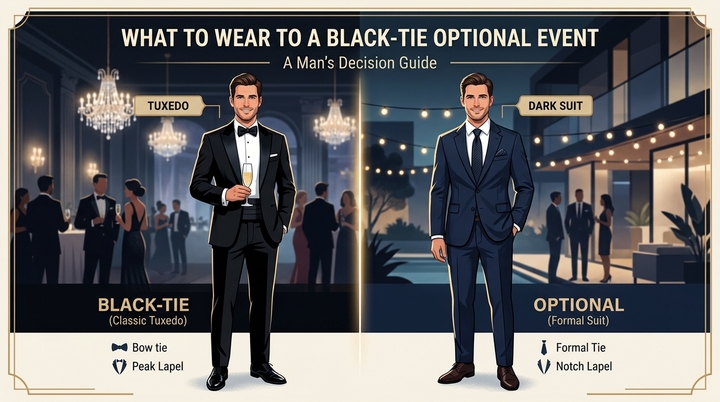
Path 1: A tuxedo. Always correct at a black-tie optional event. If you own one that fits well, wearing it removes any remaining uncertainty about whether you're dressed appropriately.
Path 2: A dark formal suit. Equally appropriate when chosen and worn correctly. The suit must be formal in color, fabric, and fit not simply professional or business-ready.
Neither path is wrong. What matters is executing whichever path you choose at the right level of formality.
When to Choose a Tuxedo at a Black-Tie Optional Event
A tuxedo is the stronger choice in several specific situations and knowing them helps you make a more deliberate decision.
You're the host or a member of the wedding party. When the event centers on you as a groom, a host, or a key member of the formal party a tuxedo signals that you've treated the occasion with full seriousness. A suit in that role, while technically acceptable, reads as slightly underdressed compared to the occasion's importance.
The venue is distinctly formal. Grand ballrooms, historic estates, upscale hotels, and formal banquet spaces carry a visual weight that suits a tuxedo better than a dark suit. When the room itself communicates formality, matching it with a tuxedo feels natural rather than excessive.
The event is scheduled for the evening. Tuxedos are evening garments by tradition and construction. A black-tie optional event beginning at 7 PM or later is the natural home for formal evening wear including men tuxedos and dinner jackets.
The majority of guests will likely wear tuxedos. If you know the crowd, the host, or the social context well enough to know that most men will be in tuxedos, a suit however sharp positions you as the exception rather than the standard. In formal social settings, that exception isn't always a compliment.
You own a tuxedo that fits correctly. If you have access to a well-fitted tuxedo, wearing it removes uncertainty. A correctly fitted tuxedo worn with appropriate accessories is always the right answer at a black-tie optional event.
When a Formal Suit Is the Right Call
There are equally valid reasons to choose a mens formal suit over a tuxedo at the same event.
The event leans toward the less formal end of black-tie optional. Not all formal events carry the same visual weight. A charity dinner in a hotel function room operates differently from a gala at an art museum. Read the specific event, not just the dress code language.
The event takes place during the day. Tuxedos are evening garments. Any formal event before 6 PM belongs to the suit regardless of the dress code. Morning dress or a dark formal suit is always more appropriate than a tuxedo at daytime occasions.
You don't own a tuxedo and rental isn't practical. A well-fitted, high-quality formal suit worn with appropriate accessories is considerably better than a poorly fitted rental tuxedo. The fit of the garment matters more than the category of the garment.
Your role is guest rather than host. As a guest at a black-tie optional event, a dark formal suit in navy or charcoal signals that you've dressed seriously without requiring you to match the formality level of the hosts or wedding party.
You want versatility beyond this one event. A quality mens formal suit in charcoal or navy serves multiple occasions board meetings, weddings, formal dinners, and professional events in a way a tuxedo doesn't. If the investment needs to work across multiple contexts, the suit delivers more overall value.
Choosing the Right Formal Suit for a Black-Tie Optional Event
Not every suit qualifies as formal wear. The distinction matters at this occasion level.
Color comes first. Charcoal and dark navy are the correct choices for black-tie optional events. Charcoal reads as authoritative and traditionally formal it's the closest a suit gets to matching the visual gravity of a black tuxedo. Navy reads as elegant and refined particularly in fine wool, where it holds depth under formal event lighting.
Medium grey, tan, and lighter blues don't belong at black-tie optional events. They read as business casual or smart casual regardless of how well they fit the color alone signals insufficient formality for the occasion.
Fabric quality becomes visible at formal events. Under the lighting of a ballroom or upscale venue, fabric quality is apparent in a way it isn't in everyday professional settings. A fine wool suit Super 100s or better drapes cleanly, holds its shape through a long evening, and photographs clearly. Synthetic fabrics reflect light differently and can look noticeably less refined in formal settings.
Fit is the factor that elevates or undermines everything else. A modern slim or tailored fit correct at the shoulders, fitted through the chest, clean at the trouser break turns a quality suit into formal wear. The same suit in a boxy or oversized cut looks professional at best, regardless of the occasion.
For a professionally curated selection of mens formal suits appropriate for black-tie optional events and formal occasions, prioritize retailers who provide detailed fabric composition and accurate size charts alongside the product listing.
How to Style a Formal Suit at a Black-Tie Optional Event
Choosing the right suit is only half the decision. How you style it determines whether it reads as formal wear or merely as your best professional outfit.
Shirt. A plain white dress shirt is the only correct choice at this formality level. Light blue works at the less formal end of black-tie optional events. No patterns, no textures, no novelty prints. The shirt needs to be the simplest element in the outfit.
Tie. A silk tie in a solid dark color burgundy, deep navy, forest green, or charcoal reads as formal and considered. A subtle woven pattern in the same color family works equally well. Avoid loud patterns, novelty prints, and polyester ties regardless of how they look in a shop.
Pocket square. A white linen or white silk pocket square with a clean fold completes the formal suit look. A pocket square in a matching tie color is optional. No pocket square at a black-tie optional event is a visible omission in a room where most people are wearing one.
Shoes. Black leather Oxford shoes are the strongest choice alongside a charcoal or dark formal suit. Dark brown leather Oxfords work with navy. Suede and casual leather are too relaxed for this formality level. Clean, polished leather is the only appropriate category.
Watch. A dress watch with a leather strap thin case, simple dial suits the occasion. Oversized sport watches create visual inconsistency with formal wear.
Tuxedo Styling for Black-Tie Optional Events
If you've chosen the tuxedo path, the same principle applies: the styling needs to match the garment's formality level.
Dinner jacket color. Black is the traditional standard and always correct. Midnight navy is a refined and photographically distinct alternative in event lighting, it holds a richness that pure black sometimes loses. White tuxedos specifically a white dinner jacket with black formal trousers are a warm-weather and destination-event option. They're appropriate at summer galas and resort events, not at traditional winter formal occasions.
For wedding contexts. Wedding tuxedos at black-tie optional ceremonies follow the same rules as any formal tuxedo occasion, with the additional consideration of connecting visually to the bridal party's aesthetic. Grooms typically coordinate with the wedding planner or photographer on which color direction photographs best against the bridal gown.
Bow tie. Self-tied, always. A properly tied bow tie has a subtle natural asymmetry that a pre-tied bow tie doesn't and anyone who knows formal dressing will notice the difference.
Formal shirt. A pleated-front or bib-front formal dress shirt with covered buttons. A standard dress shirt with a tuxedo is a visible substitution that undermines the formality of the jacket.
Shoes. Black patent leather Oxford shoes are traditional for black tie. Black leather dress shoes work equally well for most occasions. Brown shoes with a black tuxedo are inconsistent with formal dressing conventions this combination should be avoided entirely.
The Role Question: How Your Position at the Event Changes the Decision
One variable that most men overlook is their specific role at the event.
Groom at a black-tie optional wedding. The wedding suits and tuxedos question for grooms leans toward a tuxedo when the venue is formal and the event is evening. A wedding tuxedo signals the highest formality level and photographs with exceptional clarity against most ceremony backgrounds.
Wedding guest. A dark formal suit is entirely appropriate unless the hosts have specifically indicated tuxedos for all guests. Reading the invitation language carefully matters here "black-tie optional" from a wedding host often carries an implicit expectation that male guests in the wedding party will wear tuxedos.
Host or event organizer. Match or exceed the highest formality level you're encouraging guests to reach. If the invitation says black-tie optional, the host wearing a formal suit sends a mixed signal to guests who arrive in tuxedos.
General guest at a gala or fundraiser. Either option is appropriate. Make the decision based on venue formality, event timing, and what you know about the crowd.
Common Mistakes Men Make at Black-Tie Optional Events
Treating "optional" as "casual." The event is still formally designated. A business suit, a blazer and trousers, or a smart-casual outfit is underdressed regardless of how polished it looks in other settings.
Wearing a well-fitted suit in the wrong color. A medium grey or tan suit at a black-tie optional event doesn't become formal because it fits well. Color communicates formality level independently of fit.
Renting a tuxedo without checking the fit. Rental tuxedos frequently fit poorly at the shoulders and through the chest. A suit you own that fits correctly will always outperform a rental tuxedo that doesn't. If you're renting, visit the shop early enough to request adjustments.
Using a pre-knotted bow tie. It's always visible. Self-tied bow ties take less than fifteen minutes to learn and make an immediate difference in how the overall look reads.
Ignoring shoe formality. Casual leather shoes, suede, or any non-Oxford style creates a visual drop in formality that undermines the rest of the outfit at this occasion level.
Over-accessorizing alongside formal wear. A tuxedo is already making a strong visual statement. A pocket square, a watch, and optional cufflinks are enough. Layering additional jewelry, novelty accessories, or statement pieces competes with the garment rather than completing it.
FAQ: Black-Tie Optional Events What Men Ask Most
Q: Is it better to overdress or underdress at a black-tie optional event?
When in doubt, lean toward a tuxedo. Overdressing at a formal event is recoverable you look like you took the occasion seriously. Underdressing in a room full of tuxedos is conspicuous in a way that's harder to ignore.
Q: Can I wear a navy suit to a black-tie optional event?
Yes if it's dark navy in fine wool, fitted correctly, and styled with a white shirt, silk tie, and black or dark brown Oxford shoes. A navy suit that reads as professional rather than formal is not sufficient for this occasion level.
Q: What makes a suit "formal" rather than just professional?
Color, fabric quality, and fit combined. Dark charcoal or navy in fine wool, fitted through the chest and clean at the trouser break, styled with a white shirt and silk tie. When all three elements align at the right level, the suit reads as formal wear.
Q: Are white tuxedos appropriate at black-tie optional events?
White dinner jackets are a warm-weather and destination-event option appropriate at summer galas, resort weddings, and tropical formal events. They're not a substitute for a black tuxedo at traditional indoor formal occasions in cooler months.
Q: Should a wedding guest wear a tuxedo or suit to a black-tie optional wedding?
A dark formal suit in charcoal or navy is appropriate for most wedding guests at black-tie optional ceremonies. Tuxedos are typically reserved for the groom and wedding party unless the hosts specify otherwise.
Q: Can I wear a long tie with a tuxedo at a black-tie optional event?
Technically yes, but a bow tie is the traditional and expected choice. A long tie with a tuxedo reads as a casual substitution in formal company most people who understand formal dressing will notice.
Q: How much should I spend on a suit for formal events?
A quality formal suit in fine wool typically costs between $300 and $700. At this occasion level, fabric quality is visible avoid synthetic blends for black-tie optional events. The investment is justified by how the suit photographs and holds up through a long evening.
Q: What's the easiest way to tell if my suit qualifies as formal wear?
Ask three questions: Is it dark navy or charcoal? Is it fine wool or wool blend? Does it fit correctly at the shoulders and chest? If all three answers are yes and you style it with a white shirt, silk tie, and leather Oxford shoes, it qualifies.
Conclusion
"Black-tie optional" isn't an invitation to dress however you like it's an invitation to make a deliberate choice between two correct options at the same high formality level.
Mens formal suits in dark charcoal or navy, worn with the right shirt, tie, and shoes, meet the dress code with precision and give you a versatile garment that serves multiple future occasions. A well-fitted tuxedo meets the same dress code with maximum formality and zero ambiguity.
Both paths are right. What's wrong is choosing something that falls below either of them a mid-range business suit in the wrong color, a casual shirt, the wrong shoes, or any interpretation of "optional" that treats this as anything less than a formal occasion.
Read the event. Know your role. Choose accordingly. Then wear whichever you choose with the confidence of someone who made an informed decision rather than a guess.
For a curated selection of mens formal suits, wedding suits, tuxedos, and formal wear built around quality fabric and precise fit, visit Mensusa.