Expanding CRM Usability: How Salesforce Experts Design Scalable Integrations
Posted by Albert Rio
470 views
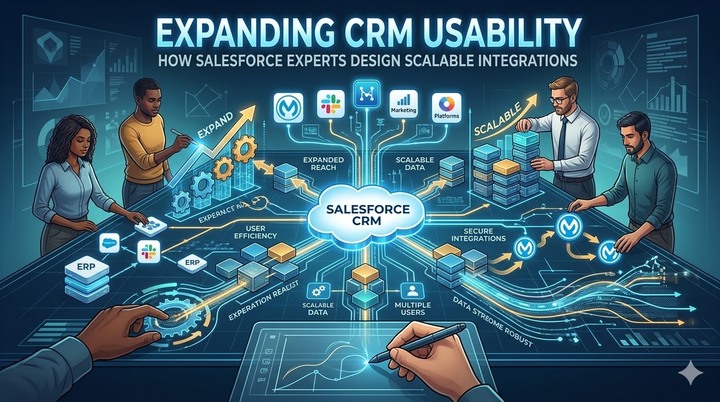
Salesforce serves as the world's leading AI customer relationship management platform, bringing together people, AI agents, data, and applications to help businesses forge stronger customer connections. For enterprises managing complex operations across multiple departments and systems, this unified approach addresses a fundamental challenge: disconnected tools that fail to communicate create data gaps and operational inefficiency.
Data silos represent more than a technical inconvenience for growing businesses. Sales teams cannot access marketing data. Support teams lack visibility into order histories. Finance operates without insight into upcoming deals. Each integration choice creates ripple effects across governance, performance, and AI readiness. When applications fail to work together, this deepens data silos and increases workflow inefficiencies.
Interoperability becomes essential for this reason. Salesforce application integration connects the CRM with other critical business systems, enabling seamless data exchange and automated workflows. The absence of integration forces teams to work in silos, creating inconsistent data and missed opportunities.
Salesforce Integration Partners: Ensuring CRM interoperability
Salesforce integration partners are professional firms that help businesses in connecting their Salesforce environment with functional applications and systems. The integration partners fill the void between technological and business requirements, enabling enterprises to expand their CRM investment through smooth system connections. The integration partner's expertise comprises implementation, customization, and integration, aligning the platform with certain organizational objectives and processes.
Integration partners manage consultative work to develop, configure, implement, and optimize Salesforce environments. The consultants possess certified expertise in implementing solutions and offering tailored guidance based on business requirements, market demands, and regional considerations. The consultants possess integration pattern recognition expertise from previous projects, architectural judgment, and delivery discipline that minimize implementation errors.
The integration consultants manage data migration during the transition from Salesforce to other systems and ensure integrity, security, and minimal disruption. Experts handle Salesforce application integration with standard platforms like ERP software, marketing tools, and customer service portals. Salesforce integration consultants begin the process by assessing current systems, understanding business requirements, and discovering integration points before developing a roadmap that aligns with operational objectives.
Salesforce integration services deliver measurable implementation advantages:
-
Organizations using experienced integration consultants achieve faster project delivery compared to internal teams.
-
Salesforce consultants leverage proven integration frameworks, best practices, and knowledge of recurring integration patterns.
-
Internal administrators may require extended timelines for enabling integration, whereas consultants often enable connections in minimal duration.
-
Salesforce experts forecast pitfalls such as Salesforce governor limits, API versioning issues, and scalability challenges.
-
Experts incorporate rigorous quality assurance through extensive testing frameworks, data validation processes, and business continuity measures, eliminating implementation failures.
Implementing Salesforce integrations necessitates advanced technical expertise beyond standard platform knowledge. Salesforce integration consultants manage technical complexities from deploying APIs to ensuring robust data synchronization across platforms.
Key Ways Salesforce Integration Services Providers Design Scalable Integrations
Incorporation of scalable Salesforce application integrations necessitate strategic architectural choices that ensure balanced CRM growth and performance. The integration partners implement methodologies to ensure connections remain responsive as transaction volumes and business requirements expand.
1. Adopting API-Led Integration Architecture
Integrations using APIs comprise three distinct layers, each functioning as a certain purpose. The API mechanisms connect straight within systems like databases, ERPs, or CRMs, consolidating datasets that was previously siloed while eliminating record disruptions. Salesforce consultants use process APIs to orchestrate and process data from diverse System APIs, generating reusable business logic through data transformation, aggregation, and enrichment.
This layered approach enables departments to repurpose functional APIs, minimize duplication, and accelerate development. The modular architecture APIs enable enterprises to adapt to new opportunities, while developers can discover and process APIs easily, minimizing dependencies on central IT. Organizations achieve faster development cycles by reusing existing APIs to quickly roll out new features.
2. Leveraging Middleware for Decoupled Integration
The integration consultants utilize a middleware layer to manage interactions between Salesforce and other applications. This layer manages message routing, protocol conversion, and data transformation without necessitating direct links between systems. The middleware layer takes away complexity between integrated systems, leading to fewer people involved and less time spent developing and maintaining solutions. It manages data transformation and validation, eliminating data corruption, and guaranteeing all systems update with recent information.
3. Implementing Asynchronous Data Processing
The asynchronous processing approach enables Salesforce to transfer information to another system without any request or feedback mechanisms. This processing improves CRM scalability by enabling higher limits per context, with requests functioning their own threads behind the scenes, so users can continue to function as tasks execute in the background. This approach is valuable for Salesforce chatbot integration.
Asynchronous processes run independently, allowing tasks to complete without keeping users waiting. Since these processes run in the background, users do not wait for completion, improving page load times and overall system performance.
4. Using Scalable Data Integration Strategies
The zero copy integration architecture enables retrieval and analysis of data stored across diverse systems under minimal moving, copying, or reformatting efforts. Data virtualization generates a virtual layer functioning as a single access point, extracting information from diverse systems in real time, when required. This approach minimizes storage expenses and avoids the challenge of constant synchronization.
Batch synchronization manages huge volumes of data in planned intervals rather than in real time, minimizing system strain and ensuring consistent updates without impacting daily operations.
5. Building Reusable Integration Components
The consultants use APIs to turn integrations into modular building blocks that departments across organizations can reuse for analytics, automation, AI initiatives, and user experiences. Rather than redesigning integrations for every new project, reusable APIs are effective for integrations. Reusable integrations for Salesforce architecture save organizations from redesigning solutions every time the business operations expand.
Key Aspects That Salesforce Integration Consultants Focus On
The integration consultant’s expertise extends beyond architectural scalability to encompass operational reliability, security governance, and business enablement. Salesforce integration services address multiple technical and business dimensions simultaneously.
-
Achieving Reliability and Fault Tolerance
Reliable solutions operate effectively and dependably, providing consistent performance as businesses scale. Error handling allows callers to manage exceptions through displayed messages or logged actions requiring intervention. Recovery strategies prevent committing to Salesforce until successful responses confirm completion. Idempotent capabilities guarantee repeated invocations to remain safe, preventing duplicate records and transaction reprocessing issues.
-
Prioritizing Data Security and Compliance
The external calls to the Salesforce system must maintain confidentiality, integrity, and availability. The bi-directional SSL with certificates ensures client and server authenticity. Salesforce consultants implement encryption, access controls, and authentication mechanisms to protect sensitive information during transactions. The encryption controls regulated data, while audit trails monitor modifications and ensure compliance with data standard requirements.
-
Supporting Business Process Automation
Through Salesforce application integration, enterprises can enable workflow automation and eliminate repetitive task management. Autonomous data transfers are executed between Salesforce and other enterprise applications, eliminating manual error risks. Departments can automate repetitive processes, including report generation, approval workflows, and email sequences, enabling workforce to focus on strategic work.
-
Managing Data Transformation and Mapping
Data mapping aligns fields from source systems with corresponding Salesforce fields, maintaining information quality during transfers. Transformation rules manage format conversions, value aggregations, and schema adjustments, guaranteeing clean data flows across integrated systems.
-
Implementing Integration Monitoring Mechanisms
Salesforce consultants implement event monitoring capabilities to provide transparency into system performance and user behavior. Smart monitoring frameworks discover threats, track performance metrics, and enable automated security policies. Strategic integration health checks audit active connections, review permissions, and validate configuration mechanisms.
Final Words
The key role of Salesforce integration partners is to transform fragmented business systems into a central operational ecosystem. The integration partner's expertise extends beyond simple platform connections to scalable architecture establishment, security governance, and process automation. The collaboration with experienced integration consultants enables enterprises to leverage proven frameworks and technical capabilities that internal departments struggle to make use of. The integration consultants ensure enterprises that they benefit from a robust CRM infrastructure and achieve continuous growth.