When Does Your Business Need Digital Marketing Services?
Posted by ThinkDone LTD
139 views
Introduction
Most businesses do not suddenly decide they need outside marketing help. The need usually becomes clear gradually: campaigns become harder to manage, different channels stop working together, internal teams run out of time, or marketing activity continues without a clear sense of what should happen next.
That is when digital marketing services can become useful.
The right time to seek professional support is not simply when your business wants more traffic or sales. It is when a lack of strategy, specialist skills, capacity or coordination is beginning to hold your marketing back.
Your Marketing Activity Has No Clear Direction
Being active online is not the same as having a marketing strategy.
A business might post on social media, publish occasional content, run paid campaigns, and make SEO changes without having a clear plan connecting those activities.
When every channel operates separately, it becomes difficult to know what deserves more attention and what is simply consuming resources.
A stronger marketing approach starts with the business objective and then determines which channels can realistically contribute to it.
For example, increasing qualified enquiries may require a different mix of SEO, content and paid advertising than building awareness for a new business.
If your team regularly asks, “What should we do next?” without having a clear framework for answering that question, outside expertise may help bring structure to the decision.
ThinkDone has also explored why digital marketing campaigns struggle without a clear strategy, which is an important consideration before simply adding more channels or increasing activity.
Your Team Is Doing Too Many Things at Once
Small internal teams often become responsible for almost every aspect of digital marketing.
One person may be managing social media, updating the website, checking paid campaigns, writing content, reviewing analytics, and coordinating external suppliers.
The problem is not necessarily a lack of effort. It is that each channel requires enough attention to be managed properly.
When people are constantly switching between tasks, important work can become reactive. Content gets published because a deadline is approaching. Campaigns are checked only when something goes wrong. SEO tasks remain unfinished because more urgent requests appear.
External support can be useful when marketing priorities are clear but the internal team does not have enough capacity to execute them consistently.
The goal should not be to outsource everything automatically. It should be to identify which activities require skills or time that your existing team cannot reasonably provide.
You Cannot Tell Which Marketing Activities Are Actually Working
Marketing becomes difficult to improve when reporting is fragmented.
Your social channels may show engagement, the website may be receiving traffic and paid campaigns may be generating clicks, but those numbers do not automatically explain whether marketing is helping the business achieve its objectives.
The important questions are usually more practical.
Which channels are bringing the right audience? Which campaigns are contributing to enquiries or sales? Where are potential customers dropping out? Which activity deserves further investment?
If your team collects data but struggles to turn it into decisions, the problem may be less about having analytics and more about knowing how to interpret them.
This is one situation where a digital marketing consultant can be useful. The role should not simply be to produce another report. It should help the business connect marketing activity with objectives and decide what needs to change.
Your Business Has Outgrown Its Original Marketing Approach
A marketing setup that worked for a small business may become less effective as the company grows.
Early-stage marketing might rely heavily on referrals, occasional social media activity or one successful acquisition channel. As the business expands, the audience may become broader, competition may increase and more channels may need to work together.
This creates new questions.
Should the company invest more heavily in search? Is paid advertising now appropriate? Does the website support the campaigns being planned? Is content targeting the right stages of the buying journey?
Growth often increases marketing complexity before a business has the internal structure to manage it.
Professional support can help at this stage by identifying which channels genuinely deserve investment rather than encouraging the business to become active everywhere at once.
You Are Spending More but Still Guessing What to Do Next
Increasing marketing spend should usually increase the need for clarity.
If a business is investing more in advertising, content, SEO or social media but decisions still depend largely on assumptions, that additional spend can make an existing strategic problem more expensive.
Before increasing budgets further, the business should understand what it is trying to achieve and why particular channels have been selected.
This does not require perfect attribution or certainty around every decision. Marketing rarely provides that.
It does require enough evidence and structure to explain why money is being allocated to one activity instead of another.
Digital marketing consulting can be particularly relevant when the business already has people capable of executing marketing tasks but needs stronger strategic direction across channels.
In that situation, the requirement may not be a fully outsourced marketing department. It may be an experienced external perspective that helps the internal team prioritise, measure and improve its existing work.
Specialist Skills Are Becoming Necessary
Digital marketing covers several disciplines, and the skills required for one channel do not automatically transfer to another.
A strong content marketer is not necessarily a paid advertising specialist. Someone experienced in social media may not have the technical knowledge required for SEO. A general marketer may understand campaign strategy while still needing specialist support with tracking or conversion optimisation.
This becomes important when a business reaches a problem that cannot be solved simply by working harder.
If organic visibility is declining, for example, publishing more social content may not address the underlying issue. If paid campaigns are generating traffic but few enquiries, increasing the advertising budget may not be the right response.
At that point, targeted specialist support can be more useful than adding more general marketing activity.
The first step is to identify the problem accurately. Then decide whether the expertise already exists internally.
Your Marketing Depends Too Heavily on One Channel
Relying heavily on one successful marketing channel can feel efficient while it continues to perform.
The risk becomes clearer when that channel slows down.
A business that depends almost entirely on paid advertising may struggle if campaign costs become difficult to sustain. A company relying primarily on organic search may be vulnerable if its visibility falls. Social media reach can also vary as platforms and audience behaviour change.
This does not mean every business needs to invest equally in every marketing channel.
Diversification should be deliberate.
External support may be useful when your business wants to understand which additional channels complement what already works rather than spreading resources across every available option.
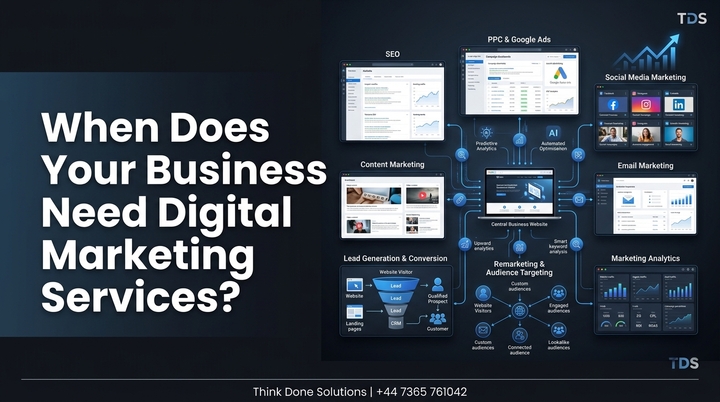
A good strategy should create connections between channels. Content may support organic search. Paid campaigns may test messages that later inform landing pages. Social media may help distribute useful content.
The goal is a marketing system, not simply a longer list of activities.
Marketing Has Become Reactive Instead of Planned
Reactive marketing often feels busy.
A competitor launches a campaign, so your team creates one. A social platform introduces a new format, so everyone rushes to use it. Traffic falls one month, so the business suddenly focuses on SEO.
The result can be constant activity without much continuity.
Some flexibility is necessary because markets, platforms, and customer behaviour change. But those adjustments should sit within a broader strategy rather than replacing one.
If your team spends most of its time responding to short-term changes, outside support may help create clearer priorities.
That gives the business a framework for deciding which opportunities deserve attention and which can safely be ignored.
When Should You Keep Digital Marketing In-House?
External support is not automatically better.
Keeping marketing in-house can work well when your team has the skills, capacity and strategic understanding required to manage the channels that matter to the business.
Internal teams also have an important advantage: they are close to the product, customers and day-to-day business.
If marketing activity is already organised, performance is understood and the team has enough time to execute the strategy, bringing in an external provider may add unnecessary complexity.
The better question is whether there is a meaningful capability gap.
That gap might involve strategy, specialist knowledge, execution capacity or simply the need for an independent perspective.
If you cannot clearly identify what outside support would solve, it may be too early to outsource.
What Should You Clarify Before Choosing Outside Support?
Before approaching an agency or consultant, define the problem you want them to help solve.
Avoid beginning with a vague objective such as “we need better marketing”.
Instead, clarify what is happening now and what needs to improve.
You might need a clearer acquisition strategy, stronger organic visibility, better coordination between channels, more consistent campaign execution or help understanding performance.
Once the problem is clearer, it becomes much easier to evaluate the type of support required.
You should also decide what remains internal.
A business may want an external team to handle strategy and specialist execution while keeping brand messaging and approvals in-house. Another company may need strategic guidance but have enough internal resources to execute the plan itself.
The arrangement should reflect the actual capability gap rather than forcing the business into a standard package.
Choosing the Right Level of Digital Marketing Support
Not every business needs the same relationship with an external provider.
Some businesses need focused advice on strategy. Others need specialist help with one channel. Growing organisations may need ongoing coordination across SEO, content, paid advertising and social media.
Think about the level of responsibility you want outside support to take.
If your internal team can execute campaigns but needs stronger direction, consulting support may be enough.
If the challenge is lack of capacity or specialist expertise, a broader service relationship may make more sense.
When your business reaches that stage, ThinkDone Solutions' digital marketing support covers strategy alongside areas such as SEO, content, social media and paid advertising.
The important point is to choose support around the problem that actually exists.
Conclusion
Your business is likely ready for digital marketing services when marketing has become too complex, fragmented or time-consuming to manage effectively with the resources you currently have.
The clearest warning signs are not simply disappointing results. There are deeper operational problems: no clear strategy, too many responsibilities sitting with too few people, difficulty interpreting performance, growing dependence on specialist skills or uncertainty about where marketing investment should go next.
External help should solve one or more of those problems.
If your internal team already has the strategy, expertise and capacity required, keeping marketing in-house may still be the right choice. If meaningful gaps are beginning to limit progress, professional support can provide the structure or expertise needed to move forward.
Start by identifying the gap first. Then choose the level of outside support that directly addresses it.
Frequently Asked Questions
Does a small business need professional digital marketing support?
Not automatically. A small business may manage marketing effectively in-house if it has clear priorities and enough expertise to execute them. Outside support becomes more useful when limited time, specialist knowledge, or unclear strategy begins restricting progress.
Should you hire a consultant or a digital marketing agency?
It depends on the problem. A consultant may suit a business that needs strategic direction while retaining execution internally. Broader agency support may be more appropriate when the business also needs ongoing specialist execution across multiple channels.
Should a business outsource all of its digital marketing?
Usually, there is no need to outsource everything by default. Keep activities in-house where your team has strong knowledge and capability, then use external support for specific gaps in expertise, capacity or strategic direction.