Growth-as-a-Service Explained: Aligning Strategy, Marketing, and Technology for Scale
Posted by Ishita Saga
Filed in Technology 153 views
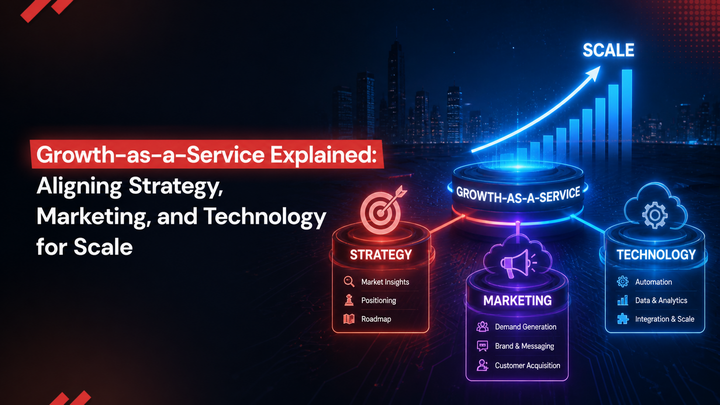
Enterprise scalability is not about increasing the budget for advertisements or launching additional ad campaigns. There are many businesses that do not scale because of poor integration of the business strategy, marketing processes, and technological systems.
Here is where the concept of Growth-as-a-Service comes in to make this possible. It takes a step beyond thinking of growth as something that happens only once, instead offering a sustainable solution by integrating strategy, implementation, and tools into a single, scalable framework.
Organizations that use this model are more capable of adapting to changes in the market, optimizing performance, and attaining sustainable integrated digital growth.
What is Growth-as-a-Service?
GaaS is a goal-oriented and outsourcing approach that merges strategy, marketing delivery, and technology in one seamless process. Rather than individualized campaigns, it concentrates on continuous development and helps businesses grow through informed decision-making and integrated efforts.
GaaS does not follow a deliverable-centric approach like conventional marketing; rather, it is outcome-driven, such as acquiring new customers, activating and retaining them. As a result, it functions as a growth team, ensuring everything is revenue-driven and optimized accordingly.
Key Characteristics
-
Performance-focused: Tied to measurable results
-
Continuous approach: Ongoing optimization, not one-time efforts
-
Integrated execution: Strategy, marketing, and tech work together
-
Scalable model: Grows with your business
Core Components
-
Fractional leadership: Strategic guidance without full-time cost
-
Multi-channel execution: Unified efforts across platforms
-
Tech integration: Aligned marketing technology stack
-
Continuous testing: Regular optimization for better results
The Core Pillars of Growth-as-a-Service
1. Growth Strategy Alignment
A coherent strategy is essential in the process of growth. Lack of alignment will result in a failure of even the most effective campaigns.
Important considerations:
-
Establishing quantifiable business objectives
-
Determining target groups and customer journeys
-
Ensuring marketing activities are aligned with business goals
-
Setting key performance indicators (KPIs)
Effective growth strategy alignment guarantees all activities to drive business results.
2. Marketing Execution with Scalable Systems
Execution is when the strategy gets implemented. But a manual approach can hinder scalability.
This is why companies are looking into scalable marketing systems that:
-
Can automate processes
-
Can manage campaigns through multiple channels
-
Can ensure consistency in messaging across channels
Such systems help organizations concentrate more on optimizing their strategies rather than repeating them.
3. Marketing Technology Stack Integration
Technology is an essential factor in today’s growth plans. An effective marketing technology stack helps integrate all the different tools and technologies into a cohesive process.
The following elements are some of the most popular:
-
Customer Relationship Management (CRM) tools for managing customer data
-
Marketing automation tools
-
Analytics and reporting tools
-
Customer engagement and personalization tools
Once successfully implemented, these tools will allow us to have a complete picture of our performance and make decisions more efficiently.
Traditional Growth vs Growth-as-a-Service
|
Aspect |
Traditional Approach |
Growth-as-a-Service Approach |
|
Strategy |
One-time planning |
Continuous optimization |
|
Execution |
Siloed teams |
Integrated workflows |
|
Technology |
Disconnected tools |
Unified tech stack |
|
Decision-Making |
Assumption-based |
Data-driven |
|
Scalability |
Limited |
Built for scale |
|
Performance Tracking |
Periodic |
Real-time and iterative |
How Growth-as-a-Service Drives Integrated Digital Growth
The real impact of growth-as-a-service (GaaS) comes from its ability to combine multiple aspects of growing a business.
1. Data-driven decision making
Real-time data allows companies to see which activities are working, reducing risk, and increasing efficiency.
2. Ongoing experimentation
GaaS encourages the experimenting of new channels, ideas and strategies. This creates a more flexible and learning-oriented business.
3. Quick time to market
Integrated systems enable faster creation of marketing campaigns and enable testing to give a competitive advantage.
4. Improved Customer Experience
Seamlessly integrating strategy with technology allows businesses to provide consistent, personalized experiences across channels.
The Role of Growth Consulting Services in GaaS
Traditional growth consulting companies deal with planning, but Growth as a Service takes it a step further by providing services beyond planning to implementation and optimization.
Typical activities of a GaaS company include:
-
Planning and optimizing growth strategies
-
Setting up and scaling marketing systems
-
Incorporating the entire marketing technology stack
-
Monitoring and optimizing marketing campaigns
Such an approach guarantees that firms not only strategize but also execute growth plans.
Why Businesses Are Adopting Growth-as-a-Service
GaaS is gaining popularity among businesses because it solves problems:
-
Disparate systems: GaaS provides a unified approach to tools and processes
-
Campaign inefficiencies: Continuous improvement enhances effectiveness
-
Scalability problems: Scalability is built into the system
-
Poor integration: Integrates strategy, implementation and technology
Growth-as-a-Service addresses these problems and enables stable and reliable growth.
When Should You Consider Growth-as-a-Service?
Growth-as-a-Service is particularly valuable for:
-
New businesses that want to establish themselves quickly
-
Small organizations that seek to create tasks more convenient
-
Corporations that wish for their teams to collaborate together more effectively
GaaS is an excellent way to obtain superior results, simplify processes more manageable, and establish specific targets for growth.
Building a Scalable Growth Engine
Growth-as-a-Service will be successfully implemented if the firm ensures that:
-
Team members are aligned towards a common goal
-
Marketing technologies are appropriately used
-
Processes are automated and optimized
-
Performance is analyzed and improved upon
In other words, Growth-as-a-Service converts growth into a system rather than a collection of discrete efforts.
Concluding Thoughts
In today's digital economy, growth is more than just ideas, it's about alignment, execution and technology. Growth-as-a-Service integrates these factors into a holistic solution that delivers integrated, scalable growth.
By prioritizing growth strategy alignment, scalable marketing systems and a robust marketing technology stack, companies can enable integrated digital growth.
Rather than concentrating on short-term gains, GaaS allows firms to create a growth machine that adapts to market changes and provides long-term value.