How to Use Stableford Scoring to Play Better Golf Every Weeken?
Posted by ParTee Of18
Filed in Sports 348 views
Most weekend golfers dread one thing more than anything else on the golf course - the scorecard.
Not because they play badly. But because traditional stroke play turns every small mistake into a permanent number that follows you for all 18 holes. One lost ball, one chunked iron, one three-putt and suddenly your entire round feels ruined before the turn.
But here is the truth that experienced club golfers already know. The format you choose matters just as much as the clubs in your bag. And for weekend golfers who want to genuinely enjoy the game, Stableford Scoring is simply the smarter choice.
This blog will walk you through exactly how Stableford Scoring works, why it brings out better golf in ordinary players, and how pairing it with a good golf score tracker app can completely change your experience on the course.
The Problem with Traditional Stroke Play for Weekend Golfers
Before we talk about Stableford Scoring, it helps to understand why stroke play can be so damaging to your enjoyment of the game.
In stroke play, every single shot you hit is counted and added to your total. Miss a short putt? That is one more stroke. Take three shots to get out of a bunker? All three go on the card. By the time you reach the 18th green, your score is a complete record of every mistake you made that day.
For professional golfers, that level of accountability is the whole point. They are paid to handle that pressure.
For a weekend golfer who just wants to enjoy a Saturday morning on the course with friends? That pressure is unnecessary and often makes the game feel more like work than leisure.
This is the gap that Stableford Scoring was designed to fill.
What Is Stableford Scoring and How Does It Work?
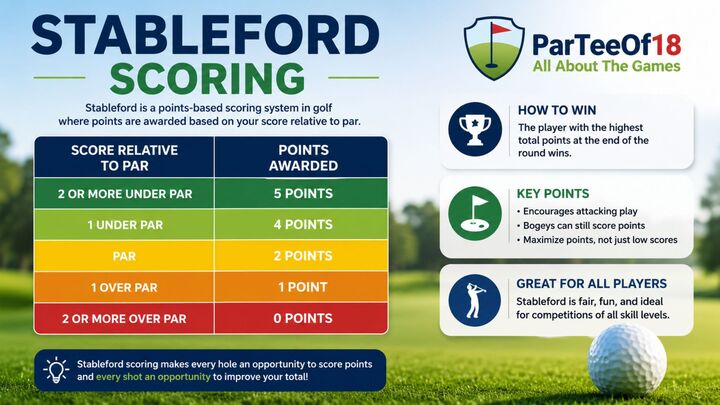
Stableford Scoring is a points-based golf format where your score on each hole is converted into points rather than recorded as raw strokes. You earn points based on how your score compares to par, and at the end of the round the player with the most points wins.
The format was created by Dr. Frank Barney Gorton Stableford in 1931. He designed it specifically to encourage faster play and to stop golfers from having their enjoyment ruined by a few bad holes. Nearly a century later, his system is more popular than ever.
Here is the standard Stableford points breakdown:
-
Double bogey or worse - 0 points
-
Bogey - 1 point
-
Par - 2 points
-
Birdie - 3 points
-
Eagle - 4 points
-
Albatross - 5 points
The target for a round played to your handicap is 36 points. That means 2 points per hole across all 18. Score above 36 and you have beaten your handicap. Score below and there is room to improve.
Simple, clear, and motivating from start to finish.
Why Stableford Scoring Brings Out Better Golf in Weekend Players?
Here is something that might surprise you. Many golfers actually play better under Stableford Scoring than they do in stroke play - even though the format is considered more relaxed.
The reason is psychology.
In stroke play, fear drives most decisions. Golfers lay up when they should attack. They aim for the middle of greens instead of going at pins. They play defensively because every extra shot hurts. That defensive mindset actually leads to worse golf because you stop trusting your swing and start steering the ball.
In Stableford Scoring, the fear is removed. When you know that a bad hole only costs you 0 points and nothing more, your body relaxes. Your swing becomes freer. You start making the aggressive plays that your practice swing always looks like but your real swing rarely does.
You stop playing not to lose and start playing to win.
That mental shift alone is worth trying Stableford Scoring for.
The Pick-Up Rule - One of Golf's Best Kept Secrets
One of the most underrated aspects of Stableford Scoring is the pick-up rule.
In stroke play, you must hole out on every hole. No matter how many shots you have taken, you keep going until the ball is in the cup. This is where rounds slow down, tempers rise, and frustration peaks.
In Stableford Scoring, once it is mathematically impossible for you to score any points on a hole, you simply pick up your ball and move to the next tee. No shame, no drama, no wasted time.
This does two important things.
First, it speeds up the round significantly. Groups using Stableford Scoring almost always finish faster than groups playing stroke play. That faster pace keeps energy levels up and makes the whole outing more enjoyable for everyone.
Second, it protects your mental game. Walking away from a bad hole without recording a double-digit score means you never carry that emotional weight to the next tee. You arrive at every new hole with a clear head and fresh focus.
How Handicaps Make Stableford Scoring Even Better?
Stableford Scoring and the golf handicap system were practically made for each other.
When you play Stableford with handicap strokes applied, your gross score on designated holes is reduced before the points are calculated. A golfer with a 15 handicap receives 15 strokes distributed across the 18 holes according to the course's stroke index. On those holes, even a bogey could convert to a par for points purposes - earning 2 points instead of 1
What does this mean in practice?
It means that a 22-handicapper can sit in the same group as a 4-handicapper and have a genuine, fair competition. Both players are essentially being scored against their own expected performance level. The 22-handicapper is not just making up the numbers - they are a real contender.
This fairness is what makes Stableford Scoring the dominant format for:
-
Club monthly medals
-
Society golf days
-
Corporate golf events
-
Charity fundraiser rounds
-
Mixed-ability group games between friends
No other format creates this level of inclusive competition as naturally and effortlessly as Stableford Scoring.
Pairing Stableford Scoring with a Golf Score Tracker App
One challenge that some golfers face when they first try Stableford Scoring is keeping track of the points correctly during the round - especially when handicap strokes are involved.
Which holes do you receive your strokes on? Did that net par earn you 2 points or 3? What is the group leader's total after 12 holes?
This is exactly why a golf score tracker app has become an essential companion for Stableford rounds.
A good golf score tracker app takes all the mental arithmetic out of the equation. You enter your gross score on each hole and the app instantly converts it to net Stableford points - with your handicap strokes already factored in. No maths, no confusion, no arguments at the 19th hole about who actually won.
Here is what the best golf score tracker apps offer for Stableford players:
-
Automatic Stableford points conversion after each hole
-
Handicap stroke indicator on every hole before you play
-
Live group leaderboard updated in real time
-
Round history so you can track your scoring trends
-
Course GPS and yardage tools to help club selection
-
Offline mode for courses with no mobile signal
If you are new to Stableford Scoring, a golf score tracker app is genuinely the fastest way to get comfortable with the format. You learn how the points work by seeing them calculated live, hole by hole, rather than having to memorise the table before you go out.
Popular apps worth trying include Hole19, Golfshot, and The Grint. All three support Stableford Scoring with handicap integration and group play features built in.
Course Strategy for Stableford Scoring - Playing the Format, Not Just the Holes
One thing that separates good Stableford players from great ones is understanding that Stableford Scoring rewards a specific type of strategy - and that strategy is different from stroke play.
On your handicap holes - play safely. The holes where you receive extra strokes are your best opportunities to earn solid points with minimal risk. A bogey on a stroke index 1 hole might actually earn you 2 net points after your handicap stroke is applied. Do not throw those points away by gambling on low-percentage shots.
On the short par 3s - be aggressive. Short par 3s are where birdies happen for average golfers. A birdie earns you 3 points - one full point more than a par. Over 18 holes, those extra points from well-played short holes make a significant difference to your total.
On par 5s - go for it when the risk is manageable. Par 5s are scoring opportunities. If you can reach the green in two with a realistic chance of making birdie or eagle, the Stableford points reward justifies the attempt. Unlike stroke play, the cost of failure is limited.
Forget the last bad hole immediately. This is the most important piece of Stableford strategy. The format only works in your favour if you actually use the mental reset it offers. Carrying frustration from hole to hole wastes the biggest advantage Stableford Scoring gives you.
Conclusion
Stableford Scoring was invented because someone understood something fundamental about golf - that the game should be enjoyable, not punishing.
More than 90 years later, that philosophy holds up perfectly. For weekend golfers who want to play with less stress, more confidence, and a real chance of competing regardless of their handicap, Stableford Scoring remains the best format available.
Add a golf score tracker app to handle the points and handicap calculations automatically, apply the course strategy outlined in this blog, and you have everything you need to make your next round one of the most enjoyable you have ever played.
Tee it up, trust your swing, and let the points take care of themselves.
Frequently Asked Questions About Stableford Scoring
1. Is Stableford Scoring easier than stroke play?
It is not easier in terms of the golf itself - you still have to hit good shots. But it is significantly less stressful because bad holes do not accumulate the way they do in stroke play. For most recreational golfers, that reduced pressure actually leads to better overall performance.
2. What happens if two players finish with the same Stableford points total?
In most club competitions, a countback system is used to break ties. The player with the higher Stableford points total on the back nine wins. If still tied, the last six holes are compared, then the last three, and finally the 18th hole alone.
3. Can I use my full handicap in Stableford Scoring?
Yes. In standard Stableford competitions, your full playing handicap is applied. This is different from some other formats where handicap allowances are reduced. A golf score tracker app will apply your full handicap automatically when you set up a Stableford round.
4. How many points should I aim for in a good Stableford round?
36 points is the benchmark for a round played to your handicap. Scoring 38-42 points is a strong round. Anything above 42 is exceptional. Using a golf score tracker app to monitor your points across multiple rounds will show you your personal average and help you set realistic improvement targets.