3 Wood vs 5 Wood Off the Tee Which Performs Better for Different Golfers?
Posted by ParTee Of18
Filed in Sports 387 views
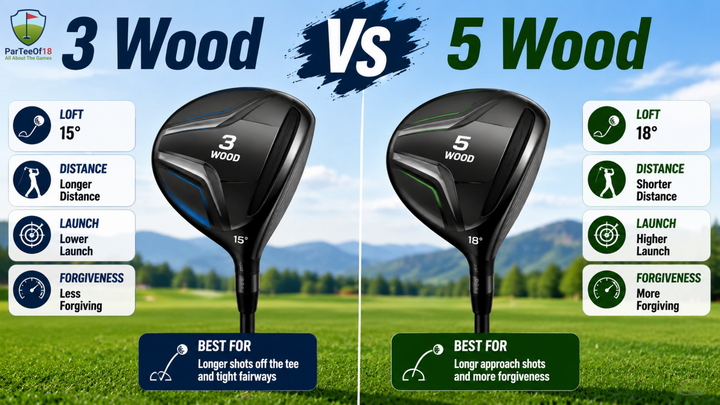
Choosing the right club off the tee can have a major impact on your round. While drivers usually get most of the attention, many golfers rely on fairway woods when they need a combination of distance and control. Among these options, the choice between a 3-wood and a 5-wood often sparks debate.
Both clubs have earned a place in countless golf bags, but they serve slightly different purposes. Understanding how each performs from the tee box can help you select the club that matches your game and leads to better results on the course.
Why Golfers Use Fairway Woods Off the Tee?
There are plenty of situations where a fairway wood makes more sense than a driver. Narrow fairways, strategic hazards, and difficult weather conditions often require greater control than a driver can provide.
Fairway woods offer:
-
Increased accuracy compared to a driver
-
More confidence on tight holes
-
Versatility in various playing conditions
-
Consistent ball striking for many golfers
The challenge is deciding which fairway wood provides the greatest advantage when standing on the tee.
Loft Differences and Their Impact
The main distinction between these clubs is loft.
A typical 3-wood has around 15 degrees of loft, while a 5-wood usually ranges from 18 to 19 degrees. Those few extra degrees significantly influence ball flight and overall performance.
Higher loft generally means:
-
Easier launch
-
Higher trajectory
-
More carry distance
-
Greater forgiveness
Lower loft typically provides:
-
Reduced spin
-
Lower flight
-
More rollout
-
Longer total distance
These characteristics create different strengths for each club.
When Distance Is the Priority?
Many golfers choose a fairway wood because they want reliable distance without sacrificing control.
In the 3 Wood vs 5 Wood comparison, the 3-wood usually wins the distance battle. Its lower loft generates a stronger, flatter trajectory that can produce impressive yardage, especially on firm fairways.
Players with higher swing speeds often see the biggest benefit. They can create enough speed to maximize carry while taking advantage of additional rollout after landing.
For golfers who want to attack long holes or position themselves closer to the green, the 3-wood is often the preferred choice.
Why Some Golfers Hit a 5-Wood Better?
Distance alone does not determine success off the tee.
Many recreational golfers discover that they hit a 5-wood more consistently. The added loft helps get the ball airborne quickly and reduces the likelihood of weak or thin shots.
The benefits include:
-
Better launch conditions
-
More consistent contact
-
Increased confidence at address
-
Improved carry on mishits
A golfer who struggles to strike a 3-wood solidly may actually achieve better overall results with a 5-wood, even if the club produces slightly less distance.
Accuracy Can Change Everything
Golf is often a game of positioning rather than pure power.
Missing a fairway by a few yards can create difficult recovery shots, while a shorter but accurate tee shot can lead to easier approaches and more birdie opportunities.
The 5-wood often provides an advantage in this area because the higher loft helps minimize side spin. As a result, shots tend to stay closer to the intended target line.
Golfers who value consistency frequently choose a 5-wood on holes where accuracy is more important than maximum yardage.
Matching the Club to Your Swing Speed
Swing speed plays a major role in determining which club performs better.
Faster Swing Speeds
Golfers with above-average swing speed generally benefit from a 3-wood because they can generate enough launch and ball speed to maximize distance.
Moderate Swing Speeds
Players in the middle range may perform well with either club depending on their ball-striking ability and course strategy.
Slower Swing Speeds
Golfers with slower swing speeds often achieve better results with a 5-wood. The additional loft helps optimize launch conditions and increase carry distance.
Performance on Different Types of Holes
Not every tee shot requires the same strategy.
Long Par 4s
A 3-wood can provide valuable extra distance, helping golfers reach the green with a shorter approach shot.
Tight Fairways
A 5-wood may be the smarter option when accuracy is critical and hazards punish wayward drives.
Risk-Reward Holes
Golfers often choose a 3-wood when they need additional yardage to reach a favorable position.
Strategic Layouts
A 5-wood can help players lay up to ideal distances and avoid trouble areas.
Understanding the hole design often matters more than simply choosing the longest club available.
Confidence Matters More Than Many Golfers Realize
Equipment decisions are not purely technical.
The confidence you feel when standing over the ball can directly influence your swing and shot outcome.
Some golfers love the look of a 3-wood and trust it completely. Others feel more comfortable knowing a 5-wood offers extra forgiveness and launch assistance.
When confidence increases, tension decreases, and better swings often follow.
Using Data to Make the Right Choice
Instead of relying on assumptions, golfers should evaluate actual performance.
Tracking statistics over several rounds can reveal which club contributes more effectively to scoring.
A quality golf scoring app allows players to monitor:
-
Fairways hit
-
Average driving distance
-
Miss patterns
-
Scoring performance after tee shots
By reviewing this information, golfers can identify trends and determine whether distance or accuracy provides the greater advantage.
A golf scoring app can also help compare performance across different courses and playing conditions, making club selection decisions more objective.
Building a Smarter Course Strategy
The best golfers understand that club selection is part of course management.
Rather than automatically reaching for the same club on every hole, successful players evaluate:
-
Hole length
-
Fairway width
-
Wind direction
-
Hazard locations
-
Desired approach distance
Sometimes the extra yards from a 3-wood are valuable. Other times, the consistency of a 5-wood creates a better scoring opportunity.
Smart decisions often save more strokes than raw power.
Final Thoughts
The debate over which fairway wood performs better off the tee does not have a single answer.
A 3-wood is usually the better option for golfers seeking maximum distance and a stronger ball flight. It rewards confident swings and solid contact.
A 5-wood, however, offers greater forgiveness, higher launch, and improved consistency. For many players, those qualities lead to more fairways hit and fewer costly mistakes.
The ideal choice depends on your swing characteristics, course strategy, and personal comfort level. By testing both clubs and tracking real performance data, you can determine which one helps you play your best golf.
FAQ
1. Does a 3-wood always go farther than a 5-wood?
In most cases, yes. The lower loft typically produces more total distance, although individual results vary.
2. Why do some golfers prefer a 5-wood off the tee?
The higher loft makes the club easier to launch and often improves consistency and accuracy.
3. Is a 5-wood more forgiving than a 3-wood?
Yes. The added loft generally makes a 5-wood more forgiving on off-center strikes.
4. Can low-handicap golfers use a 5-wood?
Absolutely. Many skilled golfers carry a 5-wood because of its versatility and reliability.