How EFEM Integration Improves Semiconductor Equipment Efficiency
Posted by Kensington Laboratories
Filed in Music 28 views
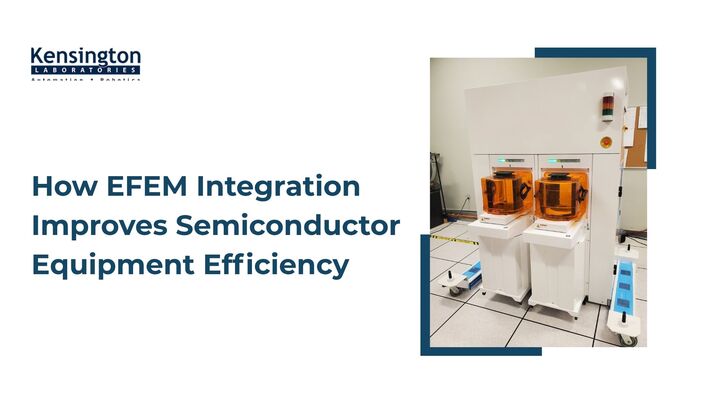
Modern semiconductor fabrication leaves zero margin for airborne contamination or mechanical transfer delays. As node dimensions push deeper into sub-nanometer scales, moving 300mm silicon wafers safely from transport carriers into process tools requires a tightly controlled, ultra-clean interface.
Integrating a dedicated EFEM serves as the central bridge between automated material handling systems (AMHS) and internal processing chambers. By isolating substrates within an ISO Class 1 mini-environment, tool builders can maintain pristine conditions right up to the moment of processing.
Seamless EFEM integration simplifies complex handoffs, helping chipmakers maximize tool uptime while protecting valuable wafer yields.
What Drives Performance in Modern EFEM Systems?
An Equipment Front-End Module combines several critical sub-systems into a compact enclosure. Instead of relying on open cleanroom air, these modules maintain localized laminar airflow and positive pressure to keep microscopic particles away from exposed silicon surfaces.
Key components working together inside the EFEM module include-
-
Load Ports- Unload FOUPs (Front Opening Unified Pods) cleanly and align wafer cassettes.
-
Atmospheric Robots- Rapidly transfer substrates using precise multi-axis motion.
-
Wafer Pre-Aligners- Detect notch positions and correct orientation errors on the fly.
-
Fan Filter Units (FFUs)- Maintain continuous HEPA/ULPA filtration across the transfer envelope.
Operational Advantages of Modular Front-End Automation
Adopting standardized front-end automation allows equipment manufacturers to optimize both physical footprint and software control loops.
By coordinating load ports and internal robotics, high-speed wafer handling automation reduces total cycle times between cassette docks and process chamber load locks.
This level of hardware coordination improves overall semiconductor equipment integration, helping fab managers maintain consistent wafer throughput across high-volume production lines.
Concluding Thoughts
Maximizing tool availability starts at the front end. Implementing smart EFEM integration provides the environmental protection, transfer speed, and motion accuracy needed to keep modern fabs running smoothly. When designing high-throughput process tools, choosing reliable, modular EFEM systems ensures long-term yield retention and seamless integration into modern automated cleanrooms.