AI Agent Development Services: Powering Autonomous Enterprise Workflows
Posted by Christine Shepherd
Filed in Technology 333 views
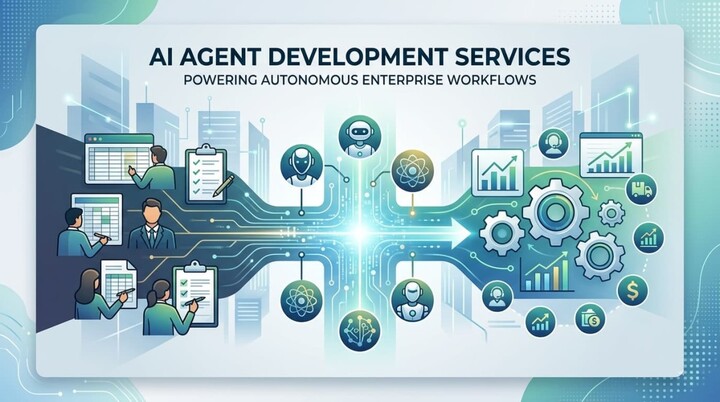
For decades, technology has helped employees work faster. Reporting tools organized data, automation handled repetitive steps, and AI models helped with predictions.
Yet through all of this progress, a human was always required to stay in the loop. Someone still had to move data between systems, trigger the next step in a process, review alerts, or decide what happens next.
Now that layer of manual coordination is starting to shrink. Not because companies suddenly hired more people, but because software itself is beginning to take on the role.
Enter AI agents.
These are not simple automation scripts. They observe systems, analyze context, decide what action makes sense, and execute tasks across multiple platforms. In other words, they operate more like digital team members than traditional software tools.
That shift explains why enterprises are increasingly exploring AI agent development services. Companies don’t want prototypes or experiments. They need production-grade systems that run critical parts of the business.
The message from analysts is becoming clear: enterprise workflows are entering an autonomous phase. And organizations investing in custom AI agent development services today are preparing for that shift.
Understanding AI Agents in a Business Context
The term “AI agent” gets used frequently right now, sometimes without much clarity.
So, it's helpful to take a step back and understand what is meant by agents when we talk about them in the enterprise world.
An AI agent is software designed to pursue a goal while interacting with its environment. It can gather information, reason through possible actions, and then execute tasks using connected systems or tools.
Traditional automation works differently. It follows fixed instructions: if condition A happens, perform action B.
AI agents behave in a more adaptive way. They interpret context, retrieve information, and adjust decisions based on new inputs.
That flexibility allows them to operate across complex business environments.
For example, an AI agent could:
- Monitor operational data and trigger alerts when unusual patterns appear
- Process incoming customer service requests and resolve common cases automatically
- Analyze supply chain disruptions and recommend adjustments
- Gather data from CRM systems and generate sales insights before meetings
The key difference is autonomy.
Instead of waiting for a human to initiate each step, the agent manages the workflow itself.
Since enterprise environments are rarely simple, many organizations work with an experienced AI agent development company to design agents that integrate smoothly with existing systems.
Why Enterprises Are Taking AI Agents Seriously
Interest in AI agents did not appear overnight. Several trends have been building toward this moment for years.
Recently, those trends have started to intersect. The result is a surge in enterprise experimentation and investment.
Data Growth Is Overwhelming Human Teams
Organizations generate more data than ever before. This includes transactions, user interactions, operational logs, customer feedback, and supply chain updates. The list grows every year.
Monitoring this information manually is no longer practical. AI agents can continuously observe streams of data, interpret context, and respond when something important occurs.
Generative AI Has Improved Reasoning Capabilities
Large language models introduced something new to enterprise software: contextual reasoning.
Systems can now interpret written instructions, analyze documents, and understand complex requests. That capability makes autonomous agents far more practical.
Microsoft CEO Satya Nadella recently summarized the transition this way:
"We are moving from a world of copilots to a world of autonomous agents."
Copilots assist, and agents act. That difference signals a shift from AI as a supportive assistant to AI as an active participant in enterprise workflows.
Companies Are Looking for Operational Efficiency
The economy is forcing enterprises to be more productive with existing assets. Hiring is not the answer to productivity problems.
Digital workers, including AI agents, offer another option.
Once deployed, they operate continuously. They can monitor workflows around the clock and execute tasks instantly when conditions are met.
This is one reason why demand for AI agent development solutions is accelerating across industries.
Real Enterprise Use Cases for AI Agents
Many organizations still associate AI with analytics dashboards or predictive models.
Agents expand the possibilities. They turn insights into action.
Here are a few areas where businesses are already experimenting with agent-driven workflows:
I. Customer Support Operations
Customer service teams handle large volumes of repetitive questions about account updates, password resets, and order tracking.
AI agents can handle these requests automatically by retrieving answers from knowledge bases or internal systems.
Human agents remain essential for complex cases, but the overall workload drops significantly.
II. IT Operations and System Monitoring
Modern infrastructure is flooded with alerts. While some need urgent attention, others could be false alarms.
AI agents can help filter these alerts and identify the causes. They can also initiate automatic fixes for these issues.
This shortens incident response times and reduces operational stress for IT teams.
III. Financial Monitoring and Compliance
Finance departments must review transactions carefully for risk or regulatory concerns.
AI agents can analyze patterns in large transaction datasets and send alerts for potential issues.
That reduces manual oversight while improving detection speed.
IV. Revenue and Sales Operations
Sales teams often spend hours collecting data before meetings. The data includes pipeline status, recent customer activity, and contract history.
AI agents can gather that information automatically and generate a briefing before the conversation even begins.
This small improvement, when multiplied across hundreds of meetings, results in significant time savings.
What AI Agent Development Services Typically Involve
Building useful AI agents requires careful planning.
Connecting a language model to a few APIs is rarely enough for enterprise environments. That is why organizations often partner with an AI agent development agency experienced in enterprise architecture.
Most AI agent development services follow several key stages:
1. Workflow Identification
The process begins with identifying workflows that would benefit from intelligent automation.
Not all tasks are appropriate for AI agents. Consultants generally look for tasks with a high volume of data, repetitive decisions, or coordination across several systems.
2. Architecture Design
Agents must interact with enterprise tools securely. This means designing an architecture that connects agents with APIs, databases, internal applications, and analytics platforms.
Security and compliance are important factors in this regard.
3. Knowledge Integration
Agents often rely on enterprise knowledge sources. These can include documentation, internal policies, operational databases, and historical records.
Modern implementations frequently use retrieval-augmented generation to ensure the agent works with accurate information.
4. Tool and System Integration
Agents must have the capability to perform actions. This involves integrations with systems like CRM, ticketing systems, analytics platforms, and messaging platforms.
Without this step, agents remain passive assistants rather than active participants in workflows.
5. Continuous Monitoring
Deployment is only the beginning.
Organizations need to monitor agents, fine-tune prompts, retrain models, and adjust workflows. For many businesses, this becomes a long-term relationship with a respected AI agent development company.
The Emergence of Autonomous Enterprise Workflows
Individual AI agents are powerful. But the real transformation begins when multiple agents work together. This is where enterprise workflows start to change dramatically.
Consider a supply chain scenario: one agent monitors inventory levels across warehouses. When supplies drop below a threshold, another agent evaluates demand forecasts.
If replenishment is needed, a third agent initiates a purchase order with suppliers. There are no manual interventions or delays. The process runs continuously in the background.
Research from PwC suggests that AI technologies could contribute up to $15.7 trillion to the global economy by 2030.
A significant portion of that value will come from intelligent workflow automation. That is exactly where custom AI agent development services are focused. They help enterprises design coordinated networks of agents that manage operational processes end-to-end.
Looking Ahead
Enterprise software is evolving. Applications once built to store information are gradually learning to act on it.
That shift changes how work gets done. AI agents will not replace human expertise. Strategy, creativity, and leadership still belong to people. But many routine processes can move into the background, handled quietly by software that observes, reasons, and executes tasks on its own.
Organizations that invest early in AI agent development solutions are positioning themselves for that future. They will move faster and respond to information sooner. They'll also operate with workflows that adapt automatically as conditions change.
The technology is still maturing, but one thing is already clear:
Autonomous enterprise workflows are no longer theoretical. They are being built right now.