Not All Portable Compressed Air Dryers Are Built for the Same Job
Posted by Air & Vacuum Process Inc
217 views
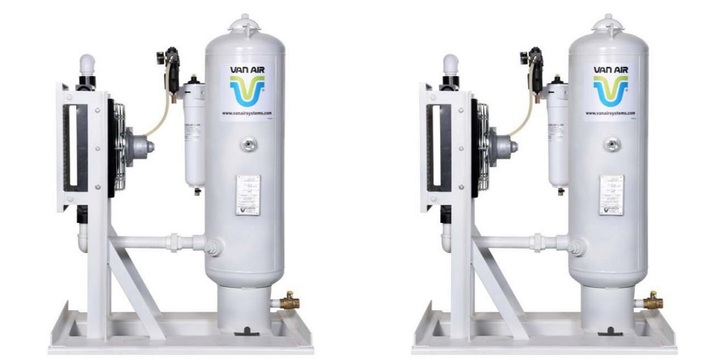
Picking between portable compressed air dryers gets complicated fast when the specs don't match the application. Most buyers zero in on airflow first, and that makes sense. If the dryer can't keep up with the compressor, nothing downstream works properly. But flow rate and dew point don't always move in the same direction, and the units built for high-volume jobs aren't the same ones built for the driest possible output. Knowing which problem you're actually solving makes all the difference.
High Volume Calls for a Different Kind of Portable Compressed Air Dryer
For field work like running air tools, stationary blasting, painting, shipbuilding, and general production, a single-stage deliquescent system covers the volume side well. The Van Air Systems Dry Pak PRO handles up to 185 SCFM at 250 PSIG, enough to keep a 185 CFM diesel compressor fully supplied without restriction. It comes skid-mounted with a sight window so operators can monitor desiccant levels in the field.
These units use Dry-O-Lite desiccant in a single vessel. As compressed air passes through, the desiccant absorbs moisture and dissolves in the process. No regeneration cycle, no moving parts, no power draw. That combination makes portable compressed air dryers of this type practical industrial portable air dryers on job sites where running electricity is inconvenient or flat-out impossible. The system includes an aftercooler with air motor, an F200-265 filter, and a regulator lubricator, covering what's needed for compressed air drying systems designed around portability and volume.
Moisture removal for air tools, blasting rigs, and general shop work doesn't require more than a single-stage unit at this flow rate.
Getting the Air Drier Means Rethinking Which Portable Compressed Air Dryers You Use
Some applications can't work with the dew point a single-stage deliquescent dryer delivers. Instrument air, critical coating work, and equipment sensitive to trace moisture need something lower. A refrigerated air dryer mobile unit can help, but refrigerated systems require power and often don't hit the dew points that a two-stage desiccant system can reach under demanding conditions.
Two-stage units work by running two vessels in series. The Dry Pak PRO DUO, one of the more practical dry air package solutions available at this size, loads Dry-O-Lite desiccant in the first vessel to strip out the bulk of the moisture. That pre-dried air then passes through a second vessel packed with 10BF desiccant. Pre-drying also reduces how quickly the 10BF exhausts, stretching the effective service life of the more specialized desiccant.
At 100 PSIG with inlet temperatures up to 250°F, portable compressed air dryers configured this way reach a pressure dew point as low as 29°F with no power required. That's a level of dryness most refrigerated systems don't match, and it makes a two-stage setup the right pick for a point of use air dryer application where moisture at the delivery point causes real problems.
The flow ceiling sits at 50 SCFM, noticeably lower than the single-stage PRO. For a desiccant air dryer portable enough to move between locations and precise enough for instrument air or fine finishing work, the tradeoff makes sense. Fifty SCFM feeds a specific piece of equipment or a tight work area without issue.
The Right Portable Compressed Air Dryers Come Down to Two Questions
What's the required flow rate, and how dry does the air actually need to be? High-flow, general-use work fits the single-stage profile. Applications where moisture at the point of delivery creates quality or equipment problems fit the two-stage profile.
Air compressor dryer rental programs carry both types, so teams can access the right configuration without purchasing outright. For anyone comparing portable compressed air dryers and trying to match specs to a real application, Air & Vacuum Process Inc. stocks both single-stage and two-stage Van Air Systems units, with detailed specs and team support to work through the specifics before committing to a purchase.
For more information about Silent Air Compressors and Compressed Air And Gas Filters Please visit: Air & Vacuum Process Inc.