Taj Mahal Aur Usse Aage — Golden Triangle Tour Packages Ka Saccha Safar
Posted by Taj mahal day tour
Filed in Other 232 views
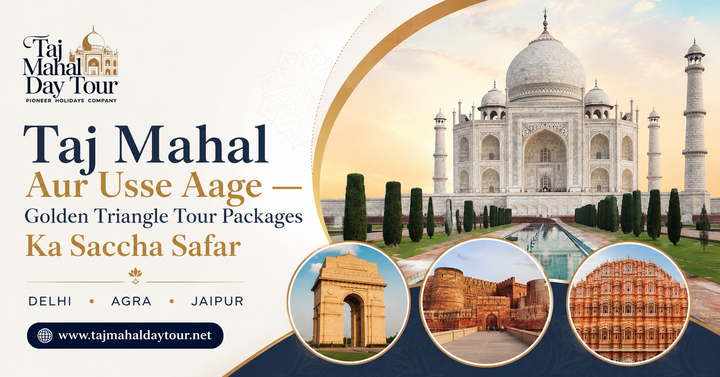
I still remember standing in the queue at the Taj Mahal's east gate at 6:15 in the morning. My shoes were wet from the dew on the grass. My chai was already cold. And then, through the main arch of the gateway, I saw it for the first time — the white dome floating in the pale morning light. No photo had ever prepared me for that moment. Nothing could.
That morning was part of my own trip through what most people call the Golden Triangle — Delhi, Agra, and Jaipur. I had booked one of the Golden Triangle Tour Packages after months of reading about it online, asking friends, and second-guessing myself. Looking back now, I can say with full honesty: it was the best travel decision I ever made. And the Taj Mahal was only one piece of it.
What Is the Golden Triangle, Actually?
If you look at a map of North India, draw a line from Delhi to Agra, then from Agra to Jaipur, and then back to Delhi — you get a triangle. That is where the name comes from. Three cities, each with its own personality, each with its own history, and together they tell the story of India in a way that nothing else can.
Delhi is the heartbeat — loud, complex, full of layers going back thousands of years. Agra is the emotion — home to the Taj Mahal, built by an emperor who refused to let grief be forgotten. Jaipur is the colour — a pink city of forts, bazaars, and stories that feel like they belong in old paintings.
Most Golden Triangle Tour Packages cover this circuit in five to seven days. Some people stretch it to ten days if they want more breathing room. Either way, it works perfectly as a first trip to India or as a deeper return for someone who has been before.
Day One and Two: Delhi — The City That Swallows You Whole
I arrived in Delhi on an evening flight. The drive from the airport already told me I was somewhere different. The roads were wide, then suddenly narrow. There were auto-rickshaws weaving between buses. Street lights caught the smoke from roadside food stalls. I was tired but alert in a way that only new cities can make you feel.
The next morning I went to Old Delhi first. Chandni Chowk is not a place you walk through — it is a place that walks through you. The lanes are barely wide enough for two people side by side. Cycle-rickshaws push through gaps that seem impossible. There are shops selling only one thing — only ribbons, only spices, only wedding cards. The smell of frying jalebis followed me for three blocks.
I visited Jama Masjid, which is one of the largest mosques in India. I climbed the minaret and looked out over the rooftops of Old Delhi and felt the size of the city in a completely new way. Then I went to Red Fort, where the Mughal emperors once lived. The red sandstone walls are thick enough to walk along the top of. Inside, there are gardens, marble palaces, and the kind of quiet that surprises you in a city this noisy outside.
In the evening, I went to Humayun's Tomb — which many people call the building that inspired the Taj Mahal. Standing there, I started to understand something about the Mughal style: symmetry, gardens divided by water channels, white inlay on red stone. It felt like preparation for what was coming in Agra.
Day Three: Agra — The Day the Taj Mahal Stopped Me in My Tracks
I took an early morning train from Delhi to Agra. The journey takes about two hours on the express train, and it cuts through the flat plains of Uttar Pradesh in the early light. When I arrived, my guide from tajmahaldaytour.net was already waiting at the station. That small detail mattered more than I expected — arriving in a new city and having someone there, ready, made the whole day feel more relaxed.
We went straight to the Taj Mahal.
I have tried to describe what it feels like to walk through the main gateway and see the Taj for the first time. I am not sure I can do it properly. The building is further away than you expect. It sits at the far end of a long reflecting pool. The white marble catches the early morning light in a way that makes it look almost alive — like it is glowing from inside.
Shah Jahan built the Taj Mahal in the 17th century as a tomb for his wife Mumtaz Mahal, who died during childbirth. It took around 22 years and 20,000 workers to build. The detail in the marble is astonishing — flowers and calligraphy carved so finely that they look like they were embroidered rather than chiselled. The inlay work uses semi-precious stones: lapis lazuli, carnelian, malachite, mother of pearl.
I sat on the bench near the reflecting pool for a long time. Tourists were moving all around me, taking photos, talking in many languages. But somehow the Taj Mahal manages to feel personal no matter how many people are there. That is the strange power of it.
After the Taj, we went to Agra Fort — another massive Mughal structure, also made of red sandstone. From one of the towers inside the fort, you can see the Taj Mahal in the distance, across the Yamuna River. They say Shah Jahan, after his son imprisoned him in the fort, spent his final years looking at the Taj from that tower. I stood at the same window and understood something about grief that I do not think I could have understood from a book.
Day Four and Five: Jaipur — Colour, Chaos, and the Pink City
The drive from Agra to Jaipur passes through Fatehpur Sikri, a ghost city built by Emperor Akbar and abandoned after only a few decades. It is one of those places that feels genuinely mysterious — a complete city of sandstone palaces, mosques, and courtyards, perfectly preserved and almost empty. We stopped for an hour and walked through the Buland Darwaza, the great gate, and the palace complex inside. It was one of the unexpected highlights of the whole trip.
Jaipur is different from both Delhi and Agra in a way that takes you by surprise. Where Delhi is overwhelming and Agra is emotional, Jaipur is almost cheerful. The old city is painted in shades of terracotta and dusty pink — which is why it is called the Pink City. The wide roads of the old walled city, the painted havelis, the bazaars selling blue pottery and block-printed fabrics — it all feels like a set design, except that it is completely real and people live and work there.
Amber Fort is the centrepiece of Jaipur. It sits on a hill above a lake, and the approach to it — either by walking up the ramp or by jeep — gives you a view of the fortifications spreading across the hillside like something from a fantasy novel. Inside, there is a hall of mirrors called Sheesh Mahal where the ceiling and walls are covered with tiny mirror mosaic. One candle, they say, would light the whole room. I did not see a candle, but I believed it.
The Hawa Mahal — the Palace of Winds — is the image that most people associate with Jaipur. It is a five-storey facade of 953 small windows, each with a carved stone screen, designed so that the women of the royal household could watch the street below without being seen. From the outside it looks like a honeycomb. From the inside, the breeze comes through every window and the sound of the street filters up in a kind of gentle noise.
I spent an evening in the bazaars near Johari Bazaar, buying nothing in particular but looking at everything. A man was printing fabric by hand using a carved wooden block, one stamp at a time. A woman was stringing jasmine flowers into garlands. Children were chasing each other through the lanes. I bought a small blue ceramic pot that I did not need, just because I wanted to carry something of the city home with me.
Why Golden Triangle Tour Packages Make Sense
Travelling independently between Delhi, Agra, and Jaipur is possible, but it takes a lot of planning — train bookings, hotel searches, city navigation, monument entry tickets, local guides. Golden Triangle Tour Packages take all of that off your plate. The logistics are handled. Your driver knows where to go. Your guide knows the stories. You can spend your energy on actually being in the place, rather than managing the mechanics of getting there.
For first-time visitors to India especially, this structure is genuinely helpful. India is magnificent, but it can also be disorienting. Having a framework — a car, a schedule, a person who knows what time the Taj Mahal opens and where to get the best breakfast near Agra Fort — lets you be present rather than stressed.
tajmahaldaytour.net is one of the companies offering these packages, and what stood out to me was how flexible the itinerary felt despite being organised. Nothing felt rushed. There was time to sit, to wander, to just look. That balance is harder to achieve than it sounds.
Small Things I Want You to Know Before You Go
The Taj Mahal is closed on Fridays. Plan accordingly. Most Golden Triangle Tour Packages account for this, but confirm before you book.
Early morning is the best time to visit the Taj. The light is softer. The crowds are smaller. The air in Agra can get hazy by midday.
Carry cash for small purchases. Many of the street vendors and small shops in the bazaars still work in cash. ATMs are available but can get busy.
Drink bottled water throughout. This is not about being overly cautious — it is just practical advice for anyone's stomach adjusting to a new environment.
The drive between the three cities is itself worth your attention. The flat plains, the roadside dhabas, the sudden appearance of a temple or a ruined fort by the highway — the journey between destinations is part of the story.
Do not over-schedule Jaipur. It is the kind of city where wandering slowly is better than checking off monuments. Give yourself at least one unplanned afternoon just to walk.
FAQs About Golden Triangle Tour Packages
Q: How many days do I need for the Golden Triangle?
A: Most people find five to seven days comfortable. Five days gives you a good overview. Seven days allows for slower exploration, extra sites, and rest. If you have ten days, you can add Fatehpur Sikri, Ranthambore, or Pushkar without feeling rushed.
Q: What is the best time of year to do the Golden Triangle?
A: October to March is the most comfortable period. The weather is cooler and dry, and the monuments are pleasant to visit without heat exhaustion. December and January can be cold, especially in the evenings. April to June is very hot — not impossible, but demanding. July to September is monsoon season, which brings lush greenery but also heavy rain and humidity.
Q: Is the Taj Mahal worth visiting even if I have seen it in photos a hundred times?
A: Yes. Without any hesitation. Nothing prepares you for the actual scale, the detail of the marble inlay, and the emotional weight of the place. It is one of those rare things that exceeds expectations rather than falling short of them.
Q: Can I do the Golden Triangle by myself without a tour package?
A: You can. But it requires significant planning — booking trains well in advance (some routes sell out weeks ahead), researching hotels, arranging local guides at each site, and navigating cities without local support. Golden Triangle Tour Packages simplify all of this and are often comparable in cost when you add up individual expenses.
Q: What should I wear when visiting the monuments?
A: Comfortable clothes that cover your shoulders and knees are recommended, especially for mosques and religious sites. At the Taj Mahal, you will need to remove your shoes before entering the inner mausoleum — wear shoes that slip on and off easily. A scarf or stole is useful to carry.
Q: Is it safe to travel through the Golden Triangle?
A: Yes. The Golden Triangle is one of the most visited tourist circuits in Asia. The cities are well-connected, the major monuments have proper visitor management, and there is a strong hospitality infrastructure throughout the route. As with any travel, general awareness and common sense apply.
Q: Can I combine the Golden Triangle with other destinations?
A: Absolutely. Many travellers extend their trip to include Varanasi, Ranthambore National Park for tiger safaris, Udaipur, or Mumbai. tajmahaldaytour.net and other operators offer extended packages that build on the Golden Triangle base.
Q: What is the best way to get between Delhi, Agra, and Jaipur?
A: By car with a driver is the most flexible option and is standard in most Golden Triangle Tour Packages. Trains are also excellent — the Gatimaan Express between Delhi and Agra is fast and scenic. Buses are available but slower. A combination of train and car is common depending on the itinerary.
Q: Do I need to pre-book tickets for the Taj Mahal?
A: Online booking is available and recommended, especially during peak season (October to February) when queues at the ticket counter can be long. Some tour packages include entry tickets as part of the arrangement — confirm this when booking.
Q: Is there vegetarian food available throughout the route?
A: India has one of the best vegetarian food cultures in the world, and the Golden Triangle cities are no exception. Every restaurant — from street stalls to hotel dining — will have vegetarian options. Even if you are not vegetarian, trying the local vegetarian food is something I would strongly recommend.
There is a specific kind of tiredness that comes at the end of a good journey. Not the tiredness of exhaustion, but the tiredness of having been fully present somewhere new. I felt it on the train back to Delhi from Jaipur, watching the countryside go dark outside the window, my phone full of photos that I knew would never quite capture what I had actually seen.
The Taj Mahal is real. So is everything around it. Come and see for yourself.