HDMI Cable Buying Guide: How to Choose the Right Cable for Your Setup
Posted by sf cable
Filed in Technology 173 views
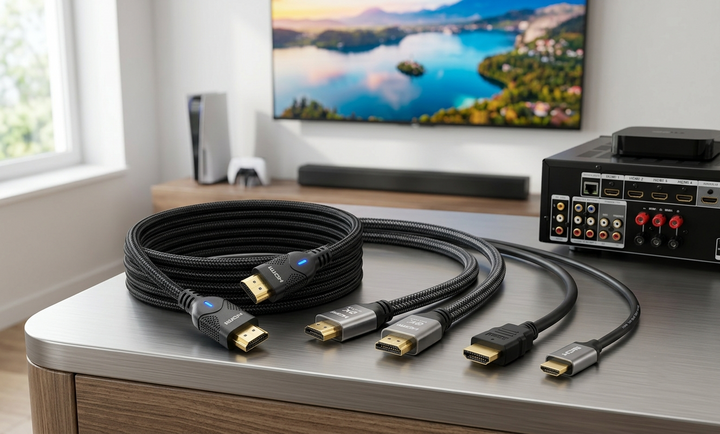
Simply head to any electronics section or do some Internet shopping, and you'll see dozens of HDMI cables in a variety of prices, from a few dollars to a lot more. While they are almost alike, the differences between them can have an impact on how your new TV, gaming console or home theater works as it should. The key to selecting the best HDMI cable is not to spend extra money, but to ensure that the cable is suitable for the task at hand. This guide has made all the information available for your purchase, before you buy.
So what is an HDMI Cable?
HDMI or High-Definition Multimedia Interface is a video and audio interface that uses one cable to connect devices. Rather than having to use separate cables for picture and sound, a single HDMI cable will connect a source device such as a streaming box, gaming console or laptop to a display or receiver. The aim of a HDMI cable is not to sound or appear better, it's to be able to reliably transport the signal you need.
This is where things get confusing for most buyers. HDMI cables aren't rated by brand prestige or price they're categorized by bandwidth and performance tier. It is the knowledge of these categories that really leads to a correct choice.
HDMI to DVI Cables and Adapters
If you need to connect a newer HDMI device to an older display with a DVI port, an HDMI to DVI connection can provide a practical solution. An HDMI to DVI adapter can connect devices with different port types, while an HDMI to DVI cable provides a direct connection between compatible HDMI and DVI devices. A DVI HDMI cable is useful for connecting older monitors, projectors, and other displays to modern HDMI-equipped devices when the required video connection is supported.
Types of HDMI Cables Explained
The data transmission rate, or data transfer speed, is expressed as the amount of data carried per second (gigabits per second or Gbps), and there are four commonly recognized categories of HDMI cable in terms of data transmission rate:
Normal HDMI Cable
- Can only achieve up to 1080i or 720p resolution at a bandwidth of approximately 5 Gbps.
- It's a bit old for modern, but could be perfect for older equipment.
High-Speed HDMI Cable
- Supports 1080p and can support 4K at lower refresh rates (up to 30Hz), bandwidth of approximately 10 Gbps.
Premium High-Speed HDMI Cable
- At approximately 18 Gbps, for 4K video at 60Hz, and supports HDR.
- Meets the needs of most common uses.
Ultra High-Speed HDMI Cable
- The current top tier with up to 48 Gbps, 8K at 60Hz, 4K at up to 120Hz and all of the features of HDMI 2.1 including VRR and eARC.
It's not just about purchasing the highest level of cable available, it's about the matching. The picture will be limited by the Standard cable connected to a 4K HDR TV, and the Ultra High-Speed cable will offer no improvement over a basic 1080p TV.
HDMI Cable Certification: What Those Labels Actually Mean
If you don't see the four speed categories, you'll typically find certifications such as "Premium Certified" or "Ultra Certified" on the cables. The labels are not simply a manufacturer's own performance claims they are the result of independent testing done by the HDMI organization.
Cable with the Premium HDMI Cable Certified label has been tested for performance in accordance with the Premium High-Speed specifications, including the consistent performance of 4K and HDR. The Ultra High-Speed HDMI Cable Certified designation means the cable is tested for the complete 48Gbps that is necessary for the 8K resolution and advanced HDMI 2.1 features.
These certifications are important as the categories represent the maximum possible performance, but not all HDMI cables with the same category will deliver the same performance. Two cables can be marked as "Ultra High-Speed" on the packaging, but only one can have the official certificate indicating that the cable has been independently tested to meet the specification. While uncertified cables may not be necessarily unreliable, it does provide a reassuring level of certainty over a self-reported speed rating.
Every certified cable also contains a unique QR code or authentication feature which can be compared to the HDMI Licensing Administrator's database to ensure that the cable is a genuine certified cable and not a mislabelled or fake version. This can be helpful when shopping on third party marketplaces, as there is a higher risk of mislabelling than if shopped directly from the retailer.
HDMI 2.1 vs. HDMI 2.0
For basic HDR, 4K resolutions at 60Hz are still the predominant standard and sufficient for conventional viewing.
With HDMI 2.1, 4K can be supported at 120Hz, 8K supported at 60Hz, Dynamic HDR, VRR and eARC for Dolby Atmos and similar audio formats.
A caution: An "HDMI 2.1" that's not always meant to indicate that all of the features in the specification are being supported. Don't assume the version number is sufficient; look for particular features.
Understanding Resolution and Refresh Rate
Resolution is the amount of pixels that are shown (1080p, 4K, 8K).
Refresh Rate: The number of times the image updates in a single second (HZ) – the higher the refresh rate the smoother the motion, particularly in gaming and sports.
The basics of ARC and eARC, and why they are important for audio.
With ARC, a single HDMI cable can deliver audio from TV to soundbar or receiver, eliminating the need for an audio cable.
The full uncompressed format, such as Dolby Atmos, is supported by eARC which is part of HDMI 2.1.
For audio equipment with eARC support, a High Speed or Ultra High Speed cable will provide true benefits to you.
Does Cable Length Affect Performance?
Yes, somewhat. On longer runs, signal degradation becomes more an issue, especially for high bandwidth 4K/8K signals. Standard length for living rooms is not a problem, but if installing in wall, check for a CL2 or CL3 rating, which indicates that the cable is rated for fire-safety applications in wall.
Do High-Quality HDMI Cables Make a Difference?
Typically, no; analog signals have a variety of subtle differences in quality, while digital signals either do or do not. If a cable has the bandwidth and certification requirements of your system, a low cost cable will do the same as a high cost cable. A better build quality will contribute to durability and protection on long runs, but for most connections, speed tier will be the more important factor than price.
Final Thoughts
Choosing the right HDMI cable comes down to understanding what your devices are capable of and matching that to the appropriate cable tier. A cable that meets your actual technical needs will deliver the same picture and sound quality as one costing several times more the goal is compatibility, not extravagance.