2 Critical Elements of Any Battle Ready Sword
Posted by True Swords
Filed in Business 243 views
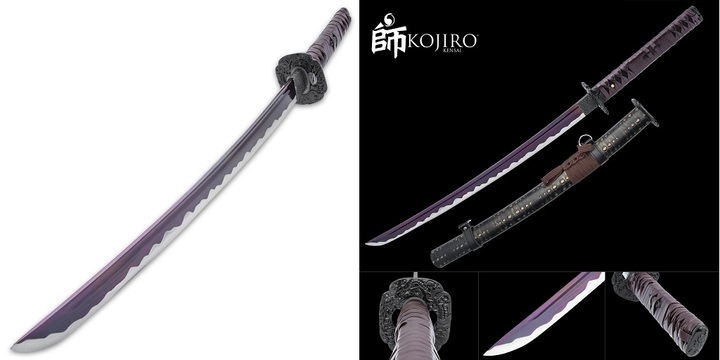
It doesn’t matter if you are looking at a katana or a grosse messer. If it’s labeled as a “battle ready sword”, it’s going to be in possession of these two elements.
Those two things are a proper temper and a full tang.
Here’s what to know.
What Temper Means
Temper is like heat treatment with respect to knives, but more involved here. With a knife, heat treatment basically means how hard the steel is.
A harder steel can hold an edge longer. That’s relevant here, but the tempering process is much more critical with a sword than it is with a knife.
A sword cannot simply “be hard”. If it is when it is struck into a target, the edge will chip or the entire blade will snap.
Rather, swords are not just heat treated, they are tempered, and they are often differentially tempered, as in the case of Japanese swords, where the edge is hardened and the spine is allowed to remain softer.
This gives a battle ready sword an edge hard and durable enough not to deform on contact, but blade stock that is physically resilient enough to withstand live use.
In many cases, temper is not just about steel that is hard enough to maintain an edge and durable enough to withstand the rigors of live use. It is also about the ability of a sword to flex without taking a permanent set.
A properly tempered battle ready sword will be so heat-treated that when the blade is flexed, it can bend to a certain point without being permanently damaged. When the load is released the blade will flex back to true.
This is critical because swords that are not properly tempered will either shatter or bend when stressed, and neither is preferable .
And a Full Tang
A battle ready sword must also necessarily be made with a full tang or it could not be fairly called battle ready.
Just how wide a full tang is, and how far through the hilt it travels, depends on the sword pattern and the smith, but one thing is certain; it must be at minimum a third the width of the stock and it must be integral with it.
Cheap, low-quality swords, often pejoratively referred to as wallhangers, are made with tangs that are small, thin, and sometimes spot-welded onto the base of the blade. These are called “rat-tail” tangs and they have no structural integrity whatsoever.
As you might justifiably imagine, when a sword with a rat-tail tang is struck against a target, more often than not it will fail at that point. Even if it doesn’t fail the first time around, it is only a matter of time until it does.
Therefore, any battle ready sword will be made with a full tang that is integral with the blade stock, not welded on.
Why This Is Critical
Both of these features mentioned here are critical for battle ready swords. A proper temper prevents the blade from chipping, rolling, snapping or shattering; it also prevents it from taking a set when it is stressed.
As for a full tang, this lends a certain degree of structural strength and integrity to the sword, regardless of the pattern, that would be impossible without it.
Explore Battle Ready Swords and Weapons
In the market for a real, battle ready sword or other weapon for your collection? Check out what’s in stock online at True Swords. They have one of the internet’s largest assortment of battle ready swords and weapons, including anime swords and film replicas. Visit their website and get in touch with them for more information.
For More Information About Bleach Bankai Sword and Wakizashi Katana Please Visit: True Swords.