Why Distribution Grid Upgrades Are Critical to Europe’s Energy Transition
Posted by Swapna Supekar
Filed in Other 17 views
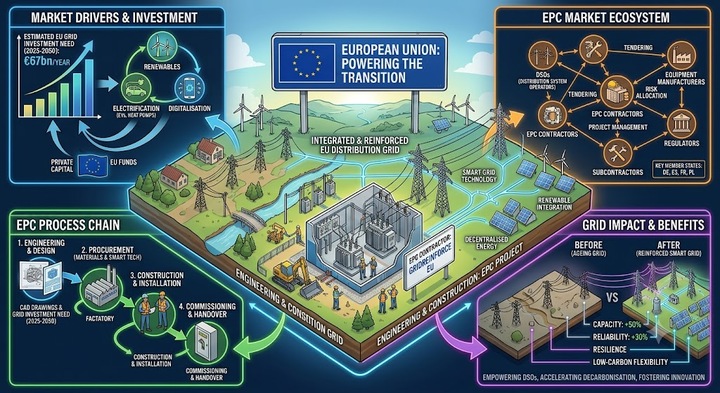
Europe’s energy transition is creating a new investment challenge beneath the level of transmission networks: distribution infrastructure must absorb rapid changes in electricity demand and generation. Local grids are becoming more active, interconnected, and technology intensive. This transformation is creating opportunities for EPC contractors capable of designing and delivering reinforcement programs that combine capacity expansion with operational resilience.
The EU Distribution Grid Reinforcement EPC Market Size is influenced by several structural forces. Electrification of transportation and heating is increasing electricity consumption, while distributed solar and batteries are changing how power moves through local networks. Data centers, logistics facilities, industrial sites, and other high-demand customers can add concentrated loads. Together, these trends can accelerate the need for transformers, feeders, substations, switchgear, protection, and control upgrades.
Distribution reinforcement starts with understanding where constraints exist. Utilities assess transformer loading, cable capacity, voltage performance, fault levels, power quality, and available connection capacity. Forecasting is particularly important because assets installed today may need to serve higher demand for decades. Engineering teams must therefore consider multiple scenarios rather than designing only for current operating conditions.
Electric mobility is one major source of localized pressure. A fast-charging station can require substantial connection capacity, while commercial fleets may concentrate charging at depots. Residential electric vehicles create a more distributed pattern of demand. Each situation requires different engineering responses. Reinforcement may include transformer replacement, new feeders, substation extensions, protection changes, or additional monitoring.
Building electrification creates another demand pattern. Heat pumps can raise winter electricity requirements, while electric cooking and other appliances contribute to household load. Commercial electrification can increase peak demand. Network planners must understand these changes at feeder level because national electricity statistics cannot reveal individual local constraints.
Distributed renewable generation also affects reinforcement priorities. Solar generation can produce high daytime flows, sometimes exceeding local consumption. This may cause reverse flows and voltage-management challenges. In areas with significant renewable connections, utilities may need larger conductors, upgraded transformers, voltage regulation, protection adjustments, and enhanced monitoring. Battery storage can complement these investments but does not remove every physical constraint.
Procurement strategies are also changing. Utilities and EPC companies increasingly need visibility into equipment availability, manufacturing capacity, technical certification, and delivery schedules. Standardized specifications can simplify repeat projects and support framework procurement. At the same time, local conditions require customized solutions, making engineering flexibility essential.
Construction is performed in environments where electricity service must remain reliable. Outages may need careful sequencing, and temporary arrangements can be required. Underground works introduce additional risks involving existing utilities, excavation, road access, environmental requirements, and reinstatement. Effective site management is therefore essential to maintaining schedule and safety performance.
Digital technologies are becoming part of reinforcement planning and execution. Remote sensors, automated switching, communications, advanced protection, and asset monitoring can provide greater operational visibility. Integrating these functions with physical upgrades can improve the value of capital investment and support more responsive network management.
The business opportunity is not identical across Europe. Urban networks may need capacity upgrades in constrained corridors, while rural systems can require feeder reinforcement and renewable hosting improvements. Industrial regions may prioritize high-capacity customer connections, and areas with rapid charging deployment may focus on transformer and substation expansion. These differences create diverse EPC opportunities.
For decision-makers, understanding investment requirements, project priorities, competitive dynamics, and technology adoption can strengthen strategic planning. The EU Distribution Grid Reinforcement EPC Market Size perspective helps position distribution reinforcement within Europe’s infrastructure transformation.
Future projects will increasingly emphasize lifecycle value rather than construction alone. Utilities will seek reliable assets, predictable delivery, manageable maintenance requirements, and compatibility with future digital systems. EPC firms that combine engineering expertise, procurement discipline, construction control, and commissioning capability can become important partners as Europe builds distribution networks capable of supporting electrification and efficient project delivery across regions.