Europe’s Hydrogen Economy: The Road from Project Announcements to Operations
Posted by Swapna Supekar
Filed in Other 42 views
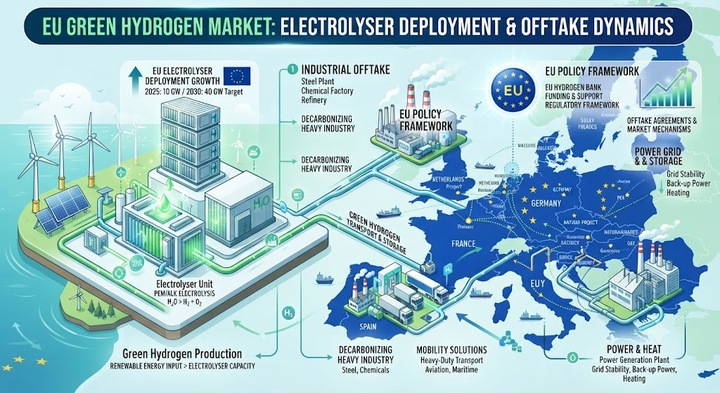
How the EU Green Hydrogen Market Is Building a Bankable Supply Chain
The development of European green hydrogen is creating a supply chain that extends well beyond electrolyser manufacturing. The EU green hydrogen market connects renewable power developers, grid operators, equipment suppliers, EPC contractors, hydrogen producers, storage providers, pipeline operators, ports, industrial customers, certifiers, and financial institutions. Each link can influence project timing, cost, and commercial reliability.
Electrolysers are visible components, but the surrounding balance of plant can determine whether a facility performs as expected. Developers must coordinate water treatment, compression, cooling, power electronics, controls, oxygen handling, hydrogen purification, storage, and connections to downstream users. Engineering decisions made early can affect efficiency, maintenance requirements, flexibility, and expansion options later.
Supply chain resilience is becoming particularly important as projects move toward larger industrial configurations. Equipment procurement requires attention to manufacturing capacity, delivery schedules, spare parts, service capabilities, warranties, and performance guarantees. A low equipment price can become less attractive if delivery delays postpone commissioning or if operating conditions fall outside warranty assumptions.
EPC integration is another critical layer. Hydrogen projects often combine renewable generation, electrical infrastructure, electrolysis, compression, storage, pipelines, and industrial interfaces. Each element may involve different contractors and approval processes. Clear responsibility for interfaces can reduce disputes and help manage schedule risk. Phased commissioning can also allow individual systems to be tested before full production begins.
Grid access can shape the entire project architecture. Connection timing affects when electrolysers can operate, while network constraints can influence production schedules and electricity costs. Some developers may use dedicated renewable generation, others may combine contracted renewable supply with grid electricity, and some may design flexible operations around available power. The commercial model must reflect the actual supply profile.
Hydrogen logistics create another layer of complexity. Pipelines can support large industrial clusters, while compressed gas transport and other distribution methods may serve smaller or more dispersed users. Storage can provide operational flexibility between production and consumption. Ports may become strategic nodes where hydrogen derivatives, industrial feedstocks, and energy products intersect.
Industrial integration is increasingly central to supply chain planning. Customers cannot always change processes instantly, so projects may need tailored delivery schedules, purity specifications, pressure requirements, storage arrangements, and backup supply. Customer-side modifications can therefore become a significant part of project development. EPC providers with industrial integration expertise may find opportunities beyond conventional plant construction.
Certification and documentation are also moving upstream. Producers need systems capable of recording electricity sourcing, renewable attributes, emissions performance, operating data, and contractual information. Strong traceability can simplify verification and improve confidence among buyers and lenders. It can also reduce repeated legal and commercial work when developers expand across multiple facilities.
Financing structures are adapting to these dependencies. Lenders can examine procurement milestones, grid agreements, construction contracts, offtake commitments, contingency provisions, and commissioning plans together rather than treating them as isolated workstreams. Investors can similarly assess whether project sponsors control enough interfaces to manage execution risk.
The supply chain will likely become more specialized as European hydrogen deployment grows. Manufacturers may focus on core equipment, while integrators provide complete systems, infrastructure companies manage networks, and industrial specialists handle customer conversion. Strategic partnerships, acquisitions, and joint ventures can help companies combine capabilities.
For stakeholders assessing the EU Green Hydrogen Market Report, the supply chain perspective offers a practical way to understand execution. Future opportunity will depend not only on technology availability, but also on coordinated procurement, reliable infrastructure, qualified integration, traceable production, and customers prepared to receive hydrogen at commercial scale.
As deployment advances, supply chain visibility will increasingly depend on verified delivery milestones, supplier reliability, integration capability, and the ability to coordinate infrastructure interfaces without delaying commercial operations at scale.