Direct Admission in MBBS: A Complete Guide for Aspiring Medical Students
Posted by doctors guardian
Filed in Music 269 views
Introduction
Choosing a career in medicine is one of the most respected and challenging decisions for students. Every year, thousands of aspirants in India aim to secure an MBBS seat, but due to intense competition in entrance examinations, many students look for alternative pathways. One such commonly discussed option is Direct Admission in MBBS. This approach is often misunderstood, so it is important to understand how it actually works, what it includes, and what students should be aware of before considering it.
What is Direct Admission in MBBS?
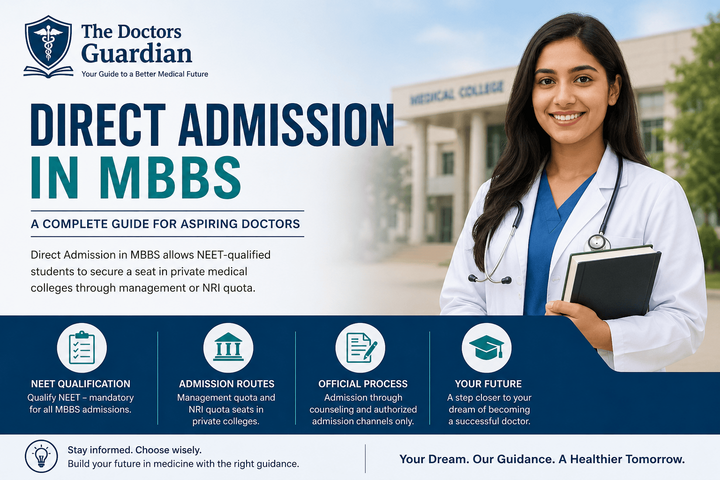
Direct Admission in MBBS generally refers to securing a seat in a medical college through management quota or NRI quota seats, rather than purely on merit-based government counseling ranks. However, it is important to clarify that admission to MBBS in India is still strictly regulated by NEET (National Eligibility cum Entrance Test). No student can get admission without qualifying NEET.
Direct admission does not mean bypassing eligibility; it means gaining admission in private medical colleges through available quota seats where cut-offs are comparatively lower than government seats.
How Does the Process Work?
After qualifying NEET, students can participate in centralized counseling conducted at the national or state level. During this process, private medical colleges offer seats under different categories such as management quota or institutional quota.
Students applying for direct admission typically:
- Qualify NEET with minimum required marks
- Apply through counseling or authorized admission channels
- Choose private colleges with available seats
- Complete documentation and fee requirements
It is important to ensure that the admission process is done only through official counseling authorities to avoid misinformation or fraudulent practices.
Eligibility Criteria
To be eligible for MBBS admission in India, students must:
- Pass 10+2 with Physics, Chemistry, Biology, and English
- Secure qualifying marks in NEET examination
- Meet age and nationality requirements set by the National Medical Commission
Without fulfilling these conditions, no student can legally be admitted to MBBS, even under management quota.
Advantages of Direct Admission in MBBS
One of the main advantages is that it provides opportunities to students who may not have scored high enough for government colleges but are still eligible and passionate about becoming doctors. It also offers access to well-equipped private medical institutions with modern infrastructure and clinical exposure.
Things to Keep in Mind
Students must be cautious and well-informed before opting for direct admission. Medical education is a long-term commitment, and financial planning is important as private college fees can be significantly higher. It is also crucial to verify the authenticity of colleges and follow official admission procedures only.
Conclusion
Direct Admission in MBBS offers an alternative pathway for NEET-qualified students to achieve their dream of becoming doctors. However, it should be approached with proper understanding, awareness, and guidance. Choosing the right college and following the correct admission process is essential for building a strong medical career. At The Doctors Guardian, we aim to provide accurate and clear information to help students make informed decisions about their future in medicine.