Building a Safer Home: How Fire Alarms, Fire Doors and Sprinklers Work Together
Posted by Fire Residential
Filed in Business 166 views
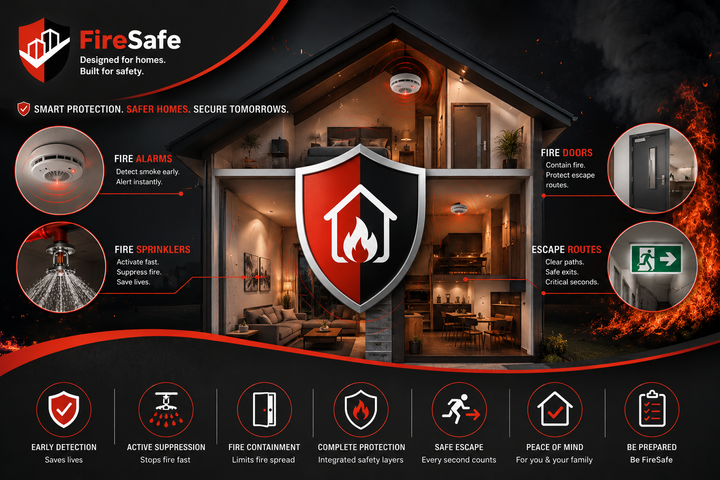
A safe home is not simply about having a smoke alarm on the ceiling. Modern residential fire protection works best when several different measures are used together, with each one performing a specific job.
For UK homeowners, understanding how fire alarms, fire doors and residential sprinklers work together can make it easier to identify gaps in a property's protection, particularly after renovations, extensions or changes to the layout.
Fire Alarms: The First Warning
Fire alarms are often the first line of defence.
Their main purpose is to detect smoke and alert people that something may be wrong. This early warning can be particularly important at night, when occupants may be asleep and unaware that a fire has started elsewhere in the home.
A working alarm gives people the opportunity to react, leave the property and contact the emergency services.
However, an alarm does not stop a fire from spreading. It tells you that there is a problem, but another form of protection is needed to help contain or control the fire itself.
Fire Doors: Creating Separation
This is where fire doors can play an important role.
A correctly specified and maintained fire door can help resist the spread of fire and smoke between areas of a property for a specified period.
For example, a protected door may help separate a room from an escape route, giving occupants more opportunity to move towards safety.
Fire doors are particularly relevant when a home has undergone alterations. Loft conversions, extensions and internal renovations can change the property's escape routes and the role that individual doors play.
A fire door should not be treated as an ordinary interior door. Its performance depends on the complete assembly, including the frame, seals, hinges and hardware, as well as correct installation and maintenance.
Sprinklers: Responding to the Fire
Residential sprinkler systems provide a different layer of protection.
While an alarm detects smoke, a sprinkler responds to heat from a developing fire. When the conditions around an individual sprinkler head reach its operating temperature, it can discharge water onto the affected area.
The purpose is to help control or suppress the fire before it develops further.
Importantly, residential sprinklers are not designed simply to activate throughout the entire property whenever a fire occurs. Individual sprinkler heads respond to local heat conditions.
This active response can be especially valuable in homes where occupants may need additional time to become aware of a fire and escape.
Why These Measures Work Better Together
The real strength comes from combining different types of protection.
Think of the sequence in simple terms:
The alarm warns you.
The fire door helps contain the fire and smoke.
The sprinkler responds to the developing fire.
Each measure addresses a different part of the problem.
This layered approach can be particularly useful in properties with open-plan layouts, loft conversions, extensions or unusual internal arrangements.
Planning Fire Protection for Your Home
There is no single fire-safety solution that suits every UK property. A modern house, period property and converted flat can all have different requirements.
If you are renovating or building, it is worth considering fire protection before the work begins. This gives you the opportunity to review alarms, escape routes, doors, compartmentation and firesafe sprinkler systems as part of one overall plan.
FireSafe Residential can help homeowners understand how different layers of residential fire protection can work together.
A safer home is not created by one product alone. It comes from thoughtful planning, appropriate equipment and regular maintenance—giving your household more warning, more protection and a better opportunity to respond when it matters most.
Original source : https://www.jumparticles.com/article/21626/