Reducing Operating Expenses (OpEx) for Tacoma Commercial Properties in 2026
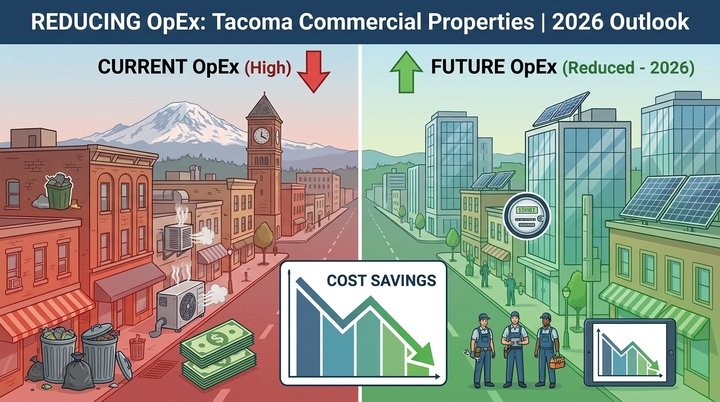
The commercial real estate market in Pierce County is navigating a complex financial landscape in 2026. On one hand, the region is experiencing sustained economic growth; the Pierce County Assessor-Treasurer recently certified an impressive $2.54 billion in new construction for the 2026 property tax roll, reflecting an 11.3% increase over the previous year. However, alongside this growth comes intense financial pressure on existing property owners. With inflation impacting vendor pricing, elevated interest rates heavily restricting refinancing options, and new state compliance mandates taking effect, safeguarding a commercial asset’s Net Operating Income (NOI) has never been more challenging.
For commercial investors and landlords, you cannot control the macroeconomic interest rates set by the Federal Reserve, nor can you easily force premium rent increases in a stabilizing market. The single most powerful, controllable lever to protect your asset's valuation and maintain a healthy capitalization rate (Cap Rate) is the aggressive reduction of Operating Expenses (OpEx). Achieving this requires shifting from passive ownership to proactive, data-driven asset oversight.
Navigating the 2026 Property Tax and Compliance Landscape
Taxes and regulatory compliance are historically the largest non-controllable operating expenses for any commercial property. Heading into 2026, Pierce County commercial property values saw an overall revaluation increase of 1.2%, with specific industrial and mid-sized warehouse sectors facing localized adjustments. While a 1.2% valuation increase might seem modest compared to residential spikes, when multiplied by local levy rates, it represents a substantial OpEx line item.
However, the most significant regulatory financial threat to Tacoma landlords in 2026 is the strict enforcement of the Washington Clean Buildings Performance Standard (CBPS). This aggressive state law mandates that commercial buildings over 50,000 square feet dramatically reduce their greenhouse gas emissions and meet strict Energy Use Intensity (EUI) targets.
Crucially, the first major compliance deadline hits on June 1, 2026, for massive commercial buildings (220,000 square feet and larger). Smaller tiers will follow in 2027 and 2028. Failing to meet these EUI targets will result in devastating financial penalties that can instantly wipe out a property’s annual cash flow. Proactive property owners are utilizing specialized management teams to execute energy audits immediately. Furthermore, sophisticated managers are successfully applying for the state’s Early Adoption Incentive Program (EAIP), which offers a one-time utility payout of $0.85 per square foot for buildings brought into compliance early. Securing this funding completely offsets the CapEx required for HVAC and lighting upgrades, permanently lowering monthly utility OpEx.
Controlling Maintenance and Vendor Costs
Routine maintenance, emergency repairs, and vendor services (landscaping, janitorial, security) constitute a massive portion of a property's operational budget. In 2026, Pierce County’s combined minimum sales tax rate sits at 8.1%, which applies to most maintenance materials and contracted services. When combined with wage inflation for skilled tradesmen, the cost of fixing a broken commercial chiller or repairing a damaged roof membrane has skyrocketed.
The Shift to Predictive Maintenance
To drastically reduce these expenses, landlords must abandon the "run-to-failure" maintenance model. Waiting for critical infrastructure to break guarantees premium emergency labor rates and business interruption claims from angry tenants.
By partnering with a specialized local firm, investors benefit from predictive maintenance protocols. These teams utilize IoT sensors and strict inspection schedules to service HVAC belts, clear roof drains before the notorious Pacific Northwest winter storms hit, and flush industrial water heaters. Spending $500 on routine, scheduled preventative care effectively prevents a $15,000 catastrophic failure, slashing the property’s annualized maintenance OpEx.
Leveraging Economies of Scale
A standalone property owner negotiating a waste management or landscaping contract in Tacoma is paying top-tier retail pricing. Professional asset managers operate differently. Because they manage millions of square feet across the South Sound, they leverage incredible economies of scale. They negotiate institutional-grade, bulk-discounted contracts with preferred local vendors. These savings—often ranging from 15% to 20% on routine services—are passed directly to the property's bottom line.
Eliminating Revenue Leakage via Precise CAM Reconciliations
When discussing OpEx reduction, one must address the financial mechanics of the commercial lease. In Triple Net (NNN) or modified gross leases, the landlord is legally entitled to pass specific operating expenses—such as property taxes, building insurance, and Common Area Maintenance (CAM)—back to the tenant pool based on their proportionate share of the building.
The reality is that millions of dollars in legitimate OpEx are absorbed by Tacoma landlords simply due to poor lease administration. If a self-managed owner fails to meticulously track a mid-year increase in municipal stormwater fees or an emergency parking lot restriping cost, and forgets to include it in the annual CAM billing, the landlord pays for it out of pocket.
Dedicated commercial managers utilize institutional real estate accounting software to track every single allowable expense down to the penny. By executing flawless, legally compliant CAM reconciliations at the end of the fiscal year, they ensure that the tenant base reimburses 100% of the permissible OpEx. This rigorous financial oversight doesn't just reduce the owner's expenses; it completely eliminates revenue leakage.
Evaluating the ROI of Professional Property Management
A common misconception among private commercial investors is that hiring a management company is an unnecessary added expense. In the Tacoma market, comprehensive management fees typically range from 8% to 12% of collected monthly rent. However, viewing this fee strictly as an expense fundamentally misunderstands the ROI of elite asset management.
Consider the cost of vacancy. Industry benchmarks—such as the Tacoma Housing Authority’s aggressive 2026 strategic goal to achieve 96% occupancy across their portfolio—highlight that minimizing downtime is critical for financial health. For a commercial landlord, a single month of vacancy on a $5,000/month retail suite, coupled with the inevitable tenant improvement (TI) allowances and broker commissions required to secure a new lease, creates a devastating financial crater.
Professional managersPaper reduce this risk by executing high-level tenant retention strategies, addressing grievances instantly, and beginning lease renewal negotiations six months prior to expiration. By maintaining full occupancy, eliminating emergency repair price-gouging, and ensuring strict energy code compliance, the management team effectively pays for itself multiple times over.
Engineering a Higher Valuation
As the commercial real estate market in Pierce County evolves throughout 2026, passive ownership is a guaranteed path to diminishing returns. With Cap Rates stabilizing and the cost of capital remaining elevated, property values are entirely dependent on the strength of the Net Operating Income.
Reducing Operating Expenses is not about cutting corners or degrading the tenant experience; it is about ruthless operational efficiency. By aggressively navigating the 2026 Washington Clean Buildings mandates, leveraging economies of scale for vendor contracts, implementing predictive maintenance, and ensuring flawless lease administration, landlords can widen their profit margins significantly. Ultimately, engaging professional commercial property management services in Tacoma isn't just about cutting daily costs—it's about aggressively reducing OpEx to maximize your Net Operating Income, ensuring your property remains a high-yield asset for decades to come.