Choosing the Right Water Softener: A Practical Guide for Better Water Quality at Home
Posted by Thomas Engel
170 views
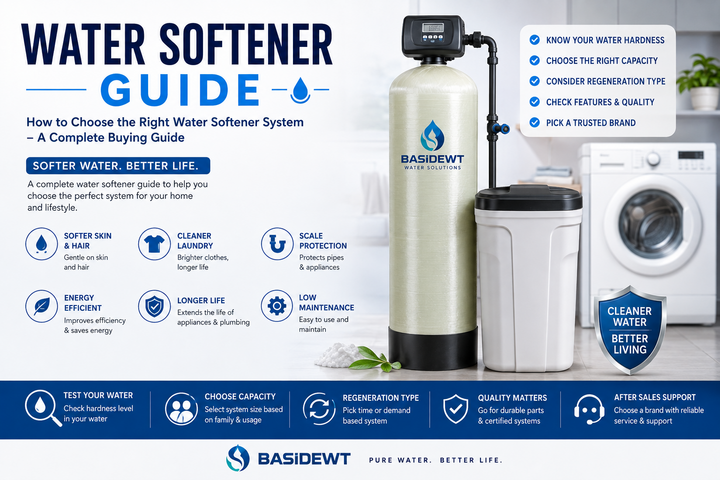
Hard water is a common household concern. It occurs when water contains elevated levels of dissolved minerals, particularly calcium and magnesium. While hard water is not necessarily a sign that water is unsafe to drink, it can create noticeable problems around the home, including mineral deposits on fixtures, reduced soap performance, scale inside plumbing, and shorter service life for some water-using appliances.
A properly selected water softener system can help reduce these effects by removing hardness minerals before they travel through the home's plumbing. However, choosing the right system is not simply a matter of buying the largest unit available. Water hardness, household water use, system capacity, regeneration method, installation requirements, and ongoing maintenance all deserve consideration.
This water softener guide explains the key factors homeowners should understand before investing in a residential water treatment system.
Understanding How Water Softeners Work
Traditional water softeners commonly use a process called ion exchange. Inside the softener is a tank containing resin beads. As hard water passes through the resin, calcium and magnesium ions are exchanged for sodium ions or, in some systems, potassium ions.
Over time, the resin becomes loaded with hardness minerals and needs to be regenerated. During regeneration, a concentrated salt solution is passed through the resin to restore its ability to exchange minerals. The system then rinses the resin before returning to normal operation.
This process is different from filtration. A standard sediment or carbon filter may remove particles, chlorine, odors, or certain other contaminants, but it does not normally remove hardness minerals. Water softening specifically addresses calcium and magnesium that contribute to scale.
There are also salt-free conditioning systems and other technologies designed to reduce scale formation without conventional ion exchange. These systems should not automatically be considered equivalent to a traditional softener because their treatment mechanisms and results can differ.
Test Water Hardness Before Choosing a System
One of the most important steps in choosing a water softener is determining the actual hardness of the incoming water. Guessing based on visible scale or the age of a plumbing system can lead to an incorrectly sized unit.
Water hardness is commonly expressed in grains per gallon (GPG) or milligrams per liter (mg/L) as calcium carbonate. A water test can provide a more reliable measurement and may also reveal other characteristics that could influence treatment decisions.
For example, a household with moderately hard water may require a very different treatment capacity from a home receiving extremely hard water. Private well water can also vary considerably from one property to another, making testing especially useful.
If the home receives municipal water, the local water supplier may publish water-quality information. However, conditions can vary by source and location, so homeowners who need precise information for equipment selection may prefer a current test of their own water.
Testing also helps identify situations where softening alone may not address the household's water treatment needs. Iron, manganese, sediment, unusual pH, or other water-quality characteristics can affect how a treatment system should be designed.
Calculate Household Demand and Softener Capacity
Once water hardness is known, the next step is estimating how much softening capacity the household needs.
A simple way to estimate daily demand is to consider the number of people living in the home and their typical water consumption. The required capacity also depends on the hardness level. A larger household using more water will generally place greater demand on the softener than a smaller household.
Water softener capacity is often expressed in grains. For example, a system rated for a certain number of grains can theoretically remove that amount of hardness between regeneration cycles, although actual usable capacity depends on operating settings and regeneration efficiency.
Buying a system that is too small can result in frequent regeneration and potentially inconsistent performance. On the other hand, choosing an unnecessarily large system can increase purchase cost and may not provide meaningful benefits.
The goal is to select a capacity that matches normal household demand while allowing the system to operate efficiently. Manufacturers and qualified water-treatment professionals can help calculate the appropriate size when household usage and water-test results are available.
Consider Regeneration and Salt Usage
Regeneration is a major part of traditional water softener operation, so homeowners should understand how the system handles it before purchasing.
Older or simpler softeners may regenerate according to a fixed schedule. More advanced demand-initiated systems monitor water usage and regenerate when the available capacity is approaching its limit. This approach can help avoid unnecessary regeneration when household water consumption changes.
Salt consumption is another practical consideration. The amount used depends on the softener's design, capacity, hardness level, household demand, and programmed settings. A system should not simply be configured to use the maximum amount of salt for every regeneration cycle.
Homeowners should compare systems based on operating efficiency rather than purchase price alone. A slightly more sophisticated system may offer better control over regeneration and ongoing resource use, depending on the application.
It's also useful to consider the physical size of the brine tank and how often it will need attention. A household with limited storage space may prefer a more compact design, while a larger home may benefit from greater capacity and longer intervals between service tasks.
For homeowners who want a more detailed breakdown of sizing, capacity, and selection factors, this water softener guide provides additional information to consider before making a purchase.
Plan the Installation Carefully
A good water softener can perform poorly if it is installed in an unsuitable location or connected incorrectly. Before purchasing equipment, identify where the main water line enters the property and determine whether there is enough space for the softener, brine tank, and required connections.
Traditional systems also need access to a suitable drain for regeneration wastewater. Depending on the installation, a nearby electrical outlet may be necessary for systems that use electronic controls.
The installation point should be protected from conditions that could damage the equipment. Excessive heat, freezing temperatures, standing water, and difficult access can create avoidable problems.
It is also important to understand the home's plumbing configuration. In many installations, certain outdoor water lines may be intentionally excluded from softening because softened water is primarily needed for indoor applications. The exact plumbing arrangement depends on the property and the homeowner's objectives.
If the plumbing is complicated, the system requires modifications to the main supply line, or local plumbing requirements apply, professional installation can help ensure the equipment is connected correctly.
Keep Up With Water Softener Maintenance
Routine maintenance is essential for reliable water softening. For salt-based systems, homeowners should monitor the brine tank and keep an appropriate supply of salt available. The tank should not be allowed to remain empty for extended periods if the household depends on softened water.
Salt can sometimes form a hardened layer or bridge inside the tank. When this happens, the system may appear to contain salt even though the brine cannot dissolve properly. Checking the tank periodically can help identify this problem before it affects regeneration.
The softener should also be inspected for leaks, unusual noises, error messages, or changes in water quality. Depending on the equipment, resin performance, control valve, injector, brine components, and other parts may require periodic servicing.
Water testing can also be useful when performance appears to change. If scale suddenly returns or the water begins behaving differently, the issue may involve incorrect settings, depleted capacity, a mechanical problem, or changes in the incoming water.
Following the manufacturer's maintenance recommendations is usually the best starting point because service intervals and procedures vary between systems.
Look Beyond the Price Tag
The purchase price is only one part of the cost of owning a water softener. Homeowners should also consider salt consumption, water use during regeneration, electricity requirements, replacement parts, maintenance, installation, and the expected service life of the equipment.
A low-cost system may be attractive initially, but it may not be the best value if it is poorly matched to the home's water demand. Similarly, paying for features that the household does not need may unnecessarily increase the budget.
When comparing products, look at the complete operating picture. Check the rated capacity, regeneration controls, warranty terms, physical dimensions, maintenance requirements, and availability of replacement components.
It can also help to think about future household needs. A system that works well for two people may become undersized if the household grows or water consumption increases substantially.
Making a Practical Choice for Your Home
Choosing a water softener becomes much easier when the decision is based on actual water conditions rather than marketing claims. Start by testing the water and identifying the hardness level. Then estimate household demand and select a system with appropriate capacity.
Next, consider how the system regenerates, how much salt and water it may use, and whether its physical requirements fit the available installation space. Finally, account for routine maintenance and long-term operating costs.
The best water softener system is not necessarily the biggest or most expensive model. It is the one that is properly matched to the home's water hardness, consumption, plumbing configuration, and maintenance expectations.
With accurate water testing, sensible sizing, and regular care, a properly selected softener can make everyday household water management easier while helping reduce the scale-related problems associated with hard water.