Custom Punch Tools vs Standard Punch Tools: Differences, Benefits, and How to Choose
Posted by Baucor Tools
Filed in Technology 220 views
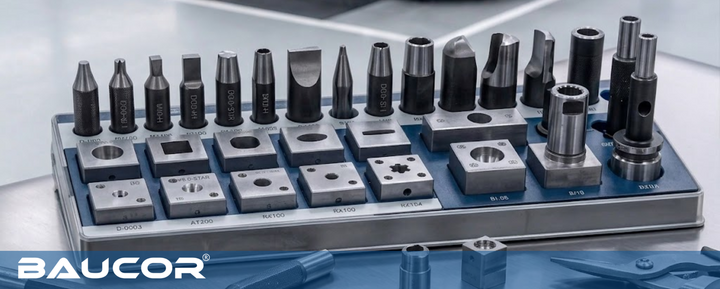
Selecting the proper custom punch tools can be crucial to the accuracy, productivity, and eventual cost of manufacture. No matter whether your business utilizes industrial hole punch, custom sheet metal punches, or punch blades, recognizing the differences between custom punch tools and standardized tools will allow manufacturers to purchase more effectively and manufacture more efficiently.
Quick Answer
A custom punch tool is designed with certain manufacturing needs in mind, and as such, has higher precision, increased efficiency, increased tool longevity, and decreased cost in manufacturing. The standard punch tool is suited for universal purposes and low volume productions, while the custom tooling provides more efficient performance in complex parts.
What is a Custom Punch Tool?
Custom punch tools are punching tools that are specially made for meeting specific production requirements. In contrast with regular punching tools available in catalogs, custom punches are made for punching certain hole configurations, certain materials thickness, production speeds, and certain tolerances.
Below are some of the industries that employ custom sheet metal punch to a great extent:
-
Automobiles manufacturing industry
-
Aerospace
-
Electrical enclosures industry
-
HVAC systems
-
Machinery
-
Medical equipment manufacturing
What Are Standard Punch Tools?
Standard punch tools are available in common shapes such as round, square, rectangular, oblong, and slot punches. A standard industrial punch will work well for most general fabrication companies and will not need custom design work.
Why Are Custom Punch Tools Better?
However, while the traditional methods serve their purpose in many cases, there are some features of the custom sheet metal punch that increase their effectiveness for manufacturers trying to obtain maximum efficiency.
1. More Accuracy
Each manufacturing process entails its own set of demands. The custom sheet metal punch is made in a way that guarantees accurate dimensions and high tolerance in manufacturing.
2. Faster Manufacturing Processes
Custom tooling usually performs a combination of different operations during one punching process.
Good engineering of a custom sheet metal punch will help save time on drilling, milling, and finishing.
3. Less Waste
Ineffective tooling causes burrs, deformation, and extra waste. Using custom punches ensures that the above issues are avoided and that savings are achieved through waste reduction.
4. High Quality of the Tool
Custom tooling uses special tool steel of high quality with proper heat treatment.
Properly designed punch blades evenly distribute the forces that appear during the process. Manufacturers usually have low replacement expenses of custom tooling since it is specially designed for particular materials.
Benefits of Standard Punch Tools
The use of conventional punching machines remains a very good option in a number of manufacturing setups.
Some of their strengths include the following:
-
Cost-effective up front
-
Available immediately
-
Easy to replace
-
Good for regular hole sizes
-
Good for prototypes and low-volume production
-
Less engineering required
For companies manufacturing standard parts, a punching machine setup may be the most cost-effective choice.
When Should You Choose a Custom Punch Tool?
A custom-made solution will be the most valuable solution in case:
-
Your components need a unique hole design
-
The production volume is high
-
Tolerances are highly important
-
The use of standard punches will involve several machining processes
-
You wish to save on the production expenses
-
The use of special materials is required
Even though a custom tooling will be initially costly for you, you can earn back your money thanks to higher efficiency and other advantages.
When Are Standard Punch Tools the Better Choice?
Standard punch tools are highly recommended if:-
The number of units to be produced is small
-
There are no unusual requirements for holes
-
Budgetary considerations take precedence
-
The product design changes often
-
The availability of the tooling becomes important
Manufacturing companies start out with standard tooling before moving on to custom-designed tooling.
How Do Custom Punch Tools Reduce Manufacturing Costs?
Although it is more expensive to begin with, in the end, the cost of ownership turns out to be much less.
A custom punch tool helps reduce manufacturing expenses because:
-
It speeds up production
-
There is less downtime
-
Material wastage is reduced
-
The cost of maintenance is lower
-
The tool lasts longer
-
Secondary machining is not required
-
Production efficiency is increased
Factors to Consider Before Choosing
Before choosing either the custom or the standard punch tool, consider the following considerations.
-
Volume of Production: A high volume of production makes it necessary to invest in custom punch tool since savings are accumulated on thousands of pieces.
-
Type of Material: Different types of materials-stainless steel, aluminum, copper, brass, and mild steel, among others are punched by the different geometries, coatings, and tool materials.
-
Precision Requirements: Where there is the need for tolerance and accuracy, custom tools come out as advantageous.
-
Maintenance of Tools: Both the standard punches and the custom punch blades have to undergo maintenance and sharpening in order to prolong their use.
-
Total Cost of Ownership: Instead of merely looking at the cost of acquisition, think about the following factors: tool life, efficiency of production, maintenance costs.
Frequently Asked Questions
1) What is a Custom Punch Tool?
Custom punch tool is a special type of punching device that is specially manufactured for specific manufacturing operations, materials, and other production parameters that are difficult to satisfy with the use of standard punch tools.
2) Do custom punch tools fit existing punch presses?
Usually yes, manufacturers are able to produce custom punch tools to fit existing press machines.
3) How long do punch tools last?
The life expectancy of the punch tool is determined by its quality, material, maintenance, production load, working conditions. High-quality custom punch tools tend to work longer due to better customization.
4) What industries benefit most from custom punch tools?
There are many industries including automotive, aerospace, construction, electronics, HVAC, industrial manufacturing etc. that will greatly benefit from the use of custom punch tools.
Final Thoughts
Selection of the right custom punch tool is dependent upon the quantity of the output, the level of precision needed, and the production objectives. Would you like to know more about the custom punch tools appropriate for your production needs? Contact us today and learn how we can assist you in attaining precision tooling.