Motorcycle Helmet Camera vs. Handlebar Mount: Which Is Better for You?
Posted by Liem Anaida
Filed in Technology 221 views
Every motorcyclist knows the feeling: you’re carving through a twisty mountain road, the engine purrs, the scenery flashes by, and you wish you could bottle that moment forever. That’s where a motorcycle action camera comes in. But once you’ve chosen your camera, you face a crucial decision that will shape every video you ever make: where to mount it.
The two most popular options are the helmet mount and the handlebar mount. Each has passionate advocates, and each dramatically changes the perspective, stability, and even the safety of your footage. In this guide, we’ll break down the pros and cons of both, help you decide which is better for your riding style, and finally recommend a camera that excels in both setups—the SJCAM SJ30.
The Helmet Mount: Immersive First-Person Perspective
What It Is
A helmet mount attaches your camera directly to your helmet—usually on the chin, the top, or the side. The goal is to capture exactly what your eyes see, turning your ride into a true first-person experience.
Pros of Helmet Mounting
1. True POV Footage
The biggest advantage of a helmet mount is perspective. When you turn your head to check a blind spot, the camera turns with you. When you lean into a corner, the camera leans too. This creates incredibly immersive video that puts the viewer right in the rider’s seat. For vloggers who talk to the camera, a chin-mounted camera is the gold standard.
2. Dynamic Shots
Because the camera moves with your head, your footage is naturally dynamic. You can look down at your gauges, glance over your shoulder at traffic, or admire a mountain peak—all in one continuous shot. No other mount can replicate this natural human movement.
3. Less Vibration
Your head acts as a natural gyroscopic stabilizer. While handlebars transmit engine vibration and road buzz directly to the camera, your neck and body absorb much of that shake. The result is often smoother footage than a handlebar mount, even without electronic stabilization.
Cons of Helmet Mounting
1. Neck Fatigue and Weight
Even a small action camera like the SJCAM SJ30 adds weight to your helmet. Over a long day of riding, that extra 50–100 grams can cause noticeable neck strain. On a sportbike with a tucked position, the problem is worse.
2. Wind Noise
A camera mounted on your helmet sits directly in the wind stream. No matter how good your microphone is, you’ll almost always get more wind noise than a handlebar-mounted camera. External wind muffs or dead cats help, but they add bulk.
3. Safety Concerns
Many experts argue that mounting anything on your helmet increases the risk of rotational injury during a crash. The mount can snag on the pavement or act as a lever, transferring force to your neck. Some track days explicitly ban helmet-mounted cameras for this reason. Additionally, the adhesive mount can fail over time, causing your expensive camera to fly off at highway speed.
4. Legal Gray Areas
In some jurisdictions, adding anything to the outside of a helmet is technically illegal because it may compromise the helmet’s certification (DOT, ECE, Snell). While enforcement is rare, it’s something to consider if you ride in strict regions like Germany or parts of the UK.
The Handlebar Mount: Stable, Safe, and Simple
What It Is
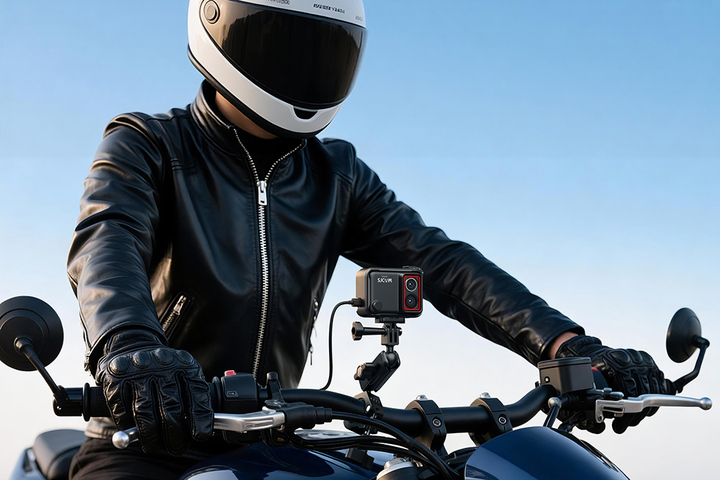
A handlebar mount clamps your camera to the handlebars, the stem, the mirror mount, or even the fuel tank. It’s the classic choice for dash-cam-style footage and long-distance touring.
Pros of Handlebar Mounting
1. Better Stability
When the camera is bolted to the bike, the footage is more predictable. You get a clean, steady shot of the road ahead that doesn’t bob around every time you glance at a sign. This is ideal for capturing scenic routes, traffic situations, or riding technique analysis.
2. No Neck Strain
The weight stays on the bike, not on your head. For all-day rides, multi-day tours, or off-road adventures, this is a massive comfort advantage. You can ride for 10 hours without feeling the camera.
3. Easier Access and Battery Life
With a handlebar mount, you can reach the camera while riding (carefully) to change batteries, swap SD cards, or start/stop recording. Helmet-mounted cameras require you to pull over and remove your helmet. Also, you can easily run a USB power cable from a battery pack strapped to the handlebar or frame, giving you unlimited recording time.
4. Safer in a Crash
No protruding objects on your helmet means less risk of snagging or rotational injury. Many track organizations and safety-conscious riders prefer handlebar mounts for this reason alone.
Cons of Handlebar Mounting
1. Vibration
The handlebar is a vibration highway. Engine thrum, road texture, and even the wind can shake the camera, especially on single-cylinder or V-twin motorcycles. High-quality image stabilization (like the EIS in the SJCAM SJ30) helps, but it’s rarely as smooth as a helmet mount.
2. Limited Perspective
The camera is fixed to the bike. When you turn your head, the camera doesn’t follow. The viewer will see the road ahead, your handlebars, and maybe a bit of your tank. It’s a less immersive, more “dashcam” style. Vloggers who want to talk to the camera often have to look down at the handlebar mount, which looks awkward on video.
3. Obstruction in the Frame
No matter how you position it, a handlebar-mounted camera will always capture some part of your bike—the bars, the windscreen, your hands. While this can look cool, it can also ruin a perfectly clean scenic shot.
Head-to-Head Comparison Table
| Factor | Helmet Mount | Handlebar Mount |
|---|---|---|
| Perspective | Immersive, first-person | Fixed, dashcam-style |
| Stability | Good (head absorbs shake) | Fair (needs good stabilization) |
| Neck Comfort | Poor on long rides | Excellent |
| Wind Noise | High (requires wind muff) | Lower (camera behind windscreen) |
| Safety | Controversial (crash risk) | Safer (no helmet alteration) |
| Battery Life | Limited (hard to charge) | Easy to USB power |
| Best For | Vlogging, canyon carving | Touring, commuting, track days |
Which Mount Is Better for You?
The answer depends entirely on how you ride and what you want to capture.
Choose a helmet mount if:
- You are a vlogger or content creator who talks to the camera.
- You ride twisty roads and want to capture lean angles and head turns.
- You prefer immersive, cinematic footage over sterile dashcam-style video.
- You ride a sportbike or naked bike where the handlebar position is low and the camera perspective is awkward.
Choose a handlebar mount if:
- You are a long-distance tourer or commuter who rides for hours.
- You prioritize safety and don’t want to modify your helmet.
- You want to record 4K footage for hours using external power.
- You ride off-road or on bumpy roads where helmet weight is a liability.
- You need to capture evidence for insurance purposes (like a dashcam).
The hybrid approach: Many riders own two mounts. They use the handlebar mount for daily commuting and long tours, and swap to the helmet mount for weekend canyon rides or vlogging sessions. This gives you the best of both worlds.
Why the SJCAM SJ30 Is the Perfect Camera for Both Mounts
Now that you know which mount fits your style, you need a motorcycle action camera that can deliver high-quality footage in either position. The SJCAM SJ30 is an excellent choice for several reasons.
1. Compact and Lightweight
The SJ30 is one of the smallest 4K action cameras on the market. At just 56 grams, it’s barely noticeable on a helmet mount, reducing neck fatigue. On a handlebar mount, its small size means it doesn’t block your view or look obtrusive.
2. Excellent Electronic Image Stabilization (EIS)
Handlebar vibration is the enemy of smooth footage, but the SJ30’s 6-axis gyro stabilization works surprisingly well. It smooths out the high-frequency buzz of a single-cylinder engine and the jolts of rough pavement. When mounted on a helmet, the stabilization further polishes the natural head movement into buttery-smooth video.
3. 4K at 30fps and 1080p at 60fps
You get crisp, detailed footage that captures the beauty of your ride. The wide-angle lens (up to 170° gives you a generous field of view—perfect for both the immersive helmet perspective and the wide road view from the handlebars.
4. Loop Recording and G-Sensor
For handlebar-mounted riders who use the SJ30 as a dashcam, the loop recording feature continuously overwrites old footage, and the G-sensor automatically locks the current file when it detects a bump or crash. This is a lifesaver for insurance evidence.
5. Long Battery Life and USB Charging
The SJ30 runs for about 90 minutes on a single battery at 4K. But because it supports USB charging while recording, you can plug it into a power bank mounted on your handlebars and record all day. On a helmet mount, you can swap batteries in seconds thanks to the easy-access side compartment.
6. Rugged Build
The SJ30 is splash-proof (IP65) and comes with a waterproof housing (up to 30 meters). Whether you ride in rain, dust, or mud, this camera will keep recording. The included mounting kit has both adhesive pads for helmets and a universal clamp for handlebars, so you can try both mounts out of the box.
7. Consumer-Friendly Price
The SJCAM SJ30 delivers 90% of the performance of a GoPro Hero 11 at half the price. If you’re building your first motorcycle action camera setup, this is a low-risk, high-reward investment.
Final Verdict
There is no single “right” mount. Helmet mounts give you passion and perspective; handlebar mounts give you comfort and practicality. The best approach is to understand your riding style and choose accordingly.
But no matter which mount you pick, the camera you choose matters. The SJCAM SJ30 is lightweight enough for a helmet, stable enough for handlebars, and tough enough for any road condition. It’s the perfect companion for capturing every twist, turn, and adventure.
Ready to start recording? Pick up an SJCAM SJ30 today, grab a helmet mount for the weekends and a handlebar mount for the daily commute, and never miss a moment of the ride.