Choosing the Right Three-Phase Bridge Rectifier Without Overspending on Capacity
Posted by Insel Rectifiers
Filed in Business 280 views
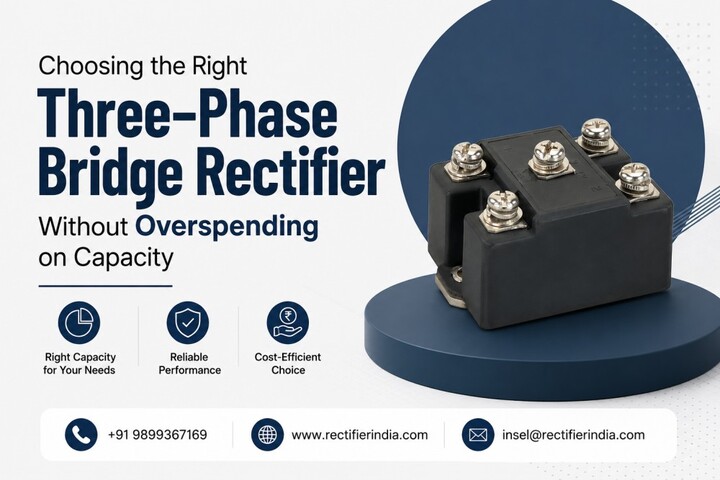
Ripple is usually what kills single-phase for high-load jobs. Not current capacity, not efficiency. Ripple. Once that becomes the bottleneck, three-phase stops are no longer optional.
Why Three-Phase Wins for Heavy Loads
Two conduction periods per cycle for single-phase. Six for three-phase. That's the entire reason a three-phase full-wave rectifier gives you a cleaner output — more conduction events per cycle means less gap for ripple to build up in. Filtering downstream shrinks accordingly. Smaller caps, less heat from the filter stage, too, which people forget to factor in.
Priced these into plating lines, welding gear, battery chargers, over a good chunk of years now. Same mistake, every time, no matter the client. Someone reads a diode's current rating off a spec sheet, decides it's fine, and orders it. The panel goes in somewhere with bad ventilation. Summer hits, ambient temp goes past 40, and suddenly that "fine" number wasn't accounting for real-world heat at all.
Sizing Comes Down to More Than Current
Forward current gets the attention in most conversations I have with customers. Junction temperature tolerance actually decides whether something lasts. Insel Rectifiers runs a decent spread of current ratings on the three-phase diode bridge rectifier side, and sizing calls basically always start with the same question — what's continuous, not what's the peak on the nameplate.
People mix those two up constantly. A motor might sit at 200A steady but spike to 350 on startup. The bridge needs to survive that spike, not just the resting number. Skip that, and you get slow degradation, invisible for months, until one day it isn't.
Thermal mass matters more than most spec sheets suggest. Not enough heat sink behind the bridge, and thermal cycling gets rougher on every load swing — that cycling wears the junction down faster than steady current ever would. Airflow ties into the same issue. Seal a panel up tight, no ventilation, and a correctly sized bridge quietly becomes an undersized one within a season, nothing about the load itself having changed.
PIV and Reverse Voltage
Rule I've used for years — PIV somewhere between 1.5- and 2-times peak AC input. Push toward the top end if the supply's dirty or throws transients. Clean regulated power can get away with less margin, but industrial supply rarely behaves that well. Cut the margin too thin and you get diode failures that look random for months until someone finally connects it back to a voltage spike nobody planned around.
Six diodes, standard full-wave setup, that's most jobs. Higher current sometimes calls for paralleled diode pairs instead, splitting the load. Deliberate choice, though, not a default — paralleled diodes need close matching or the current sharing goes lopsided fast, and that just moves the failure point to a different spot in the bridge.
Get the Load Profile Before Quoting
Duty cycle changes everything. A bridge right for a continuous battery charger is either overkill or genuinely risky on an intermittent welding job pulling the same average number. Ask for the real load profile before quoting. Saves a return shipment later. Learned that one the hard way, early on, on a job that should've gone smoother than it did.
FAQs
What's the main advantage of a three-phase full-wave rectifier over a single-phase?
Lower ripple, more power handling for the same physical size. Comes down to six conduction periods per cycle instead of two.
How do I figure out the current rating I need for a diode bridge?
Continuous load plus surge margin for startup. Nameplate peak by itself isn't the full picture.
Does ambient temperature really matter that much for rectifier lifespan?
A lot, actually. Ratings assume a baseline temperature, and every degree above that cuts into safe operating current.
Can a three-phase diode bridge rectifier be repaired, or is it full replacement after failure?
Mostly replacement of sealed units. Older open-frame designs sometimes allow individual diode swaps.
Should I always go for the highest PIV rating available, just to be safe?
Not really worth it if the job doesn't need it — just adds cost. Match PIV to the actual voltage environment instead.