Can Uterine Polyps Cause Miscarriage?
Posted by Naveen Naveen
197 views
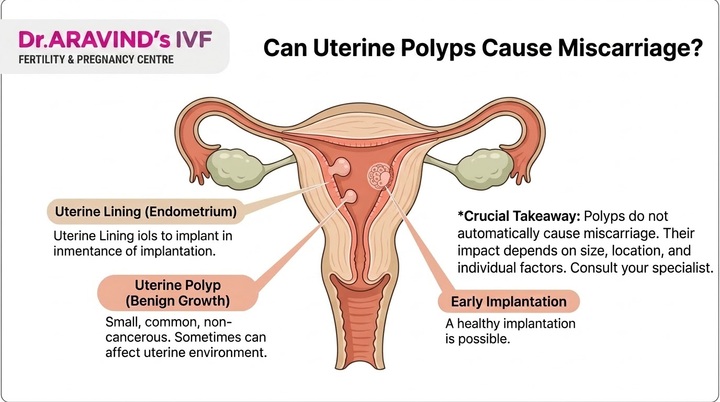
A positive pregnancy test followed by bleeding can be frightening, especially if you have already been told that you have Uterine Polyps. Naturally, many women wonder whether the growth inside the uterus could affect an early pregnancy or increase the chance of miscarriage.
The answer is not always straightforward. Polyps may affect the uterine environment in some women, but having one does not mean that a miscarriage will happen. Other factors are often involved, and the size, number, and location of a polyp can matter.
What are uterine polyps?
Uterine polyps are soft growths that develop from the inner lining of the uterus. They can be very small or larger and may occur as a single growth or several.
Some women have no symptoms at all. Others may notice:
- Spotting between periods
- Heavy or prolonged menstrual bleeding
- Bleeding after sex
- Irregular periods
- Bleeding after menopause
They are usually non-cancerous, although doctors may recommend testing removed tissue when appropriate.
How could a polyp affect early pregnancy?
For an embryo to develop normally, it needs to attach to a suitable area of the uterine lining. A polyp can change the shape of the cavity or create a local area of altered tissue.
Researchers have suggested several possible ways polyps might affect pregnancy. A growth may interfere with implantation, cause local inflammation, or affect the normal function of the uterine lining.
However, it is important not to turn these possible links into a definite cause-and-effect statement. A woman may have a polyp and carry a pregnancy normally. Early miscarriage can also happen for many reasons that have nothing to do with the uterus.
Chromosomal problems in the developing embryo are among the common causes of early miscarriage. Age, thyroid problems, diabetes, certain infections, uterine abnormalities, and other health factors may also play a role.
Does having a polyp mean miscarriage is more likely?
Not necessarily.
The evidence linking polyps directly to miscarriage is less clear than the evidence connecting some uterine abnormalities with problems such as abnormal bleeding or difficulty conceiving.
Doctors therefore look at the complete picture rather than treating every polyp in the same way.
For example, a small polyp discovered by chance in someone who has no symptoms may be handled differently from a larger growth that projects into the uterine cavity in a woman who has experienced repeated pregnancy losses.
This is why a scan finding should not automatically be interpreted as the explanation for a miscarriage.
What if a polyp is found during pregnancy?
If a polyp is discovered after pregnancy has already been confirmed, treatment is not automatically required.
The doctor may consider its size, location, appearance, symptoms, and the stage of pregnancy. In many cases, the safest approach is careful observation rather than removing it during pregnancy.
Any vaginal bleeding during pregnancy deserves medical attention. Bleeding does not always mean miscarriage, but it should be assessed, particularly when accompanied by pain, dizziness, heavy bleeding, or other concerning symptoms.
Women should not attempt to treat or remove a suspected polyp themselves.
When might treatment be considered before pregnancy?
If a polyp is discovered while investigating infertility, irregular bleeding, or previous pregnancy problems, the doctor may discuss whether removal is appropriate before trying to conceive.
A hysteroscopy is commonly used to examine the inside of the uterus and, when suitable, remove a polyp. A thin camera passes through the vagina and cervix, allowing the doctor to see the uterine cavity directly.
The removed tissue can also be examined in a laboratory.
For someone receiving fertility evaluation at an IVF Hospital in Ariyalur, the decision may depend on ultrasound findings, medical history, age, previous pregnancies, and other fertility factors. Treatment should be based on the individual situation rather than the presence of a polyp alone.
Can removing a polyp prevent miscarriage?
This is where expectations need to be realistic.
Removing a polyp may be recommended when a doctor believes it could be affecting the uterine cavity or contributing to symptoms. However, removal cannot guarantee that a future pregnancy will continue normally.
If someone has experienced a miscarriage, the doctor may also look for other possible causes. Depending on the history, this can include reviewing thyroid function, diabetes, uterine anatomy, genetic factors, and other reproductive health issues.
A complete assessment is often more useful than focusing on one finding.
What should you do after a miscarriage?
A miscarriage can be emotionally and physically difficult. It is reasonable to ask whether a uterine polyp played a role, but finding an answer may require more than one test.
If a polyp was already known, tell your doctor about it. If you have repeated miscarriages, irregular bleeding, or difficulty becoming pregnant, further evaluation may help identify whether there is a uterine problem that needs attention.
There is also no need to blame yourself. Most miscarriages are not caused by something a woman did or failed to do.
The key point to remember
Uterine Polyps can sometimes affect the uterine cavity and may be relevant when assessing fertility or pregnancy problems, but they are not a proven explanation for every miscarriage.
If a polyp is found, discuss its size, position, symptoms, and possible treatment with a qualified doctor. Looking at the entire reproductive health picture can help guide the safest next step.
FAQs
Can a small uterine polyp cause miscarriage?
A small polyp does not automatically cause miscarriage. Its effect may depend on its location and other pregnancy-related factors.
Should I remove a polyp before trying to conceive?
Not everyone needs removal. Your doctor may consider its size, location, symptoms, fertility history, and pregnancy plans before recommending treatment.
Can a polyp grow during pregnancy?
Changes in the uterine lining and pregnancy hormones can affect how a polyp appears, but growth varies. Monitoring is usually guided by your obstetrician.
Is bleeding during pregnancy always caused by a polyp?
No. Bleeding can have several causes during pregnancy. It should be evaluated rather than assumed to be related to a known polyp.
Can I become pregnant after polyp removal?
Many people can conceive after treatment, but pregnancy depends on several factors. Polyp removal does not guarantee conception or prevent miscarriage.