7 Nontypical Ways to Carry Fixed Blade Knives
Posted by River's Edge Cutlery
220 views
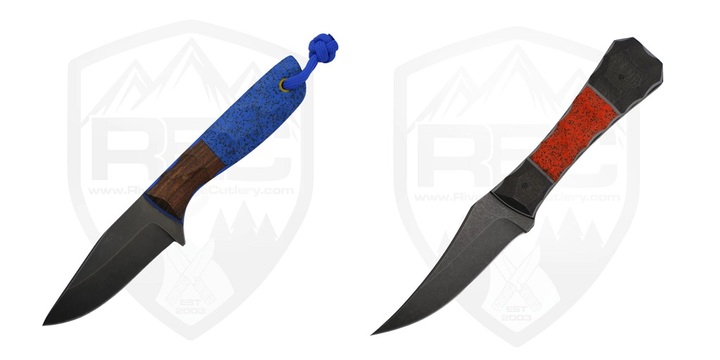
Don’t assume that just because your knife came with a sheath rigged for tip-down carry on the belt, you’re locked into that.
If it’s a Kydex sheath with a perforated margin, you actually have quite a bit of flexibility in how you can carry.
So, let’s take a closer look at 7 other (albeit somewhat uncommon) ways you can carry fixed blade knives.
Scout Carry
In scout carry, the knife sheath is mounted to your belt at the small of your back, with the edge down and the handle pointing off to your dominant side.
Some advantages of scout carry:
- It’s better for larger knives that would be hard to carry tip down on the belt.
- It’s discreet and keeps the knife out of the way.
- Sitting down is more comfortable than with tip-down belt carry.
At the same time, it can be a little bit more difficult to resheath a knife in scout carry configuration.
Cross Draw
In cross draw, the knife is carried on the non-dominant side of your body, with the handle pointed towards the dominant side. So for a right-handed user, the sheath would be on the left up with the handle pointing towards the right.
- Cross draw is comfortable.
- Like scout carry it can also be practiced with some larger blades.
- If you’re carrying something else on your right hip, like a gun, it frees up space.
Neck Carry
In neck carry, the sheath is suspended by the point end via a cord, around the neck, as the name suggests.
Neck carry:
- Is discreet, since the knife can be carried under your clothes.
- Is easy to access, and generally can be drawn with one hand.
With that said, neck carry is only practical with smaller, lighter knives, requires a specific sheath that offers a friction fit, and requires two hands for resheathing.
Boot Carry
In boot carry, the knife sheath is either tucked into the boot’s laces, or else into the boot’s shaft or vamp.
Boot carry:
- Can be discreet.
- Offers some flexibility.
But, there are several drawbacks here:
- It only works with smaller knives.
- It requires a special sheath.
- Some users find boot carry uncomfortable.
- It can be very difficult to access a boot knife from some positions.
Static-Line Carry
In static line carry, a fixed blade knife, typically a smaller one, is carried within a pocket, or sometimes within a waistband, and the end of the sheath is secured to the person via a small length of cord.
Some advantages of static line carry include the following:
- It is highly discreet and enables complete concealment.
- It improves knife retention.
At the same time:
- Static-line carry is only practical with smaller knives.
- Drawing and resheathing may require both hands.
- Access to the knife is not always ideal with this discipline.
Shoulder Carry
In shoulder carry, typically the knife sheath is lashed to a pack, or to a D-ring on a jacket, typically on the left shoulder, for a right-handed user.
Some benefits:
- Shoulder carry offers excellent access to the knife.
- It is ergonomic and comfortable, even when sitting down.
At the same time, shoulder carry is not discreet.
Dangle Carry
Lastly, we have dangle carry, which is effectively the same as tip-down carry on a belt, with the sole distinguishing difference being that the sheath itself is attached to the belt loop via a D-ring or other ring or loop. This allows the sheath to dangle freely, hence the name.
Dangle carry:
- Is more comfortable than tip-down carry on the belt as it allows the knife to ride in the most comfortable position, especially with larger knives.
- Is more practical when carrying a larger knife.
On the flipside, even though dangle carry is relatively comfortable, it should be noted that typically two hands are required both to draw and to sheath the knife.
Shop Fixed Blade Knives at River’s Edge Cutlery
Hopefully you found this short guide for alternative methods for carrying fixed blade knives useful. If you’re in the market for something new to refresh your EDC loadout and are considering a fixed blade for that, visit River’s Edge Cutlery.
They represent some of the top brands and most popular models and would be more than happy to help you out if you have any questions.
For more information about Pro-Tech Knives and American Made Knives Please visit: River’s Edge Cutlery.