How Does Snowflake Help Automakers Manage Vehicle Data?
Posted by Arnika Arni
Filed in Technology 19 views
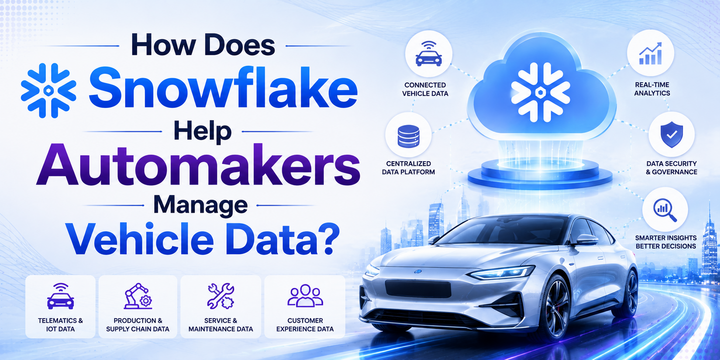
Modern vehicles generate far more data than many people realize. From connected-car features and navigation systems to manufacturing equipment and customer interactions, automakers collect information from many different sources. As vehicles become more connected and software-driven, managing this growing volume of information has become an important part of the automotive industry.
The challenge is not just storing vehicle data. Automakers also need to bring information together, process it efficiently, analyze trends, and make useful insights available to the right teams. This is where cloud data platforms such as Snowflake can play an important role.
For learners exploring real-world cloud data engineering applications, Snowflake Training in Chennai can provide practical exposure to SQL, data pipelines, cloud warehousing, data transformation, and analytics workflows that are relevant across industries.
Why Is Vehicle Data Important for Automakers?
A modern vehicle can generate information from many different systems and sensors.
Depending on the vehicle and connected services, data may come from:
-
Vehicle sensors
-
GPS and navigation systems
-
Infotainment systems
-
Connected-car applications
-
Manufacturing equipment
-
Dealer systems
-
Customer applications
-
Service and maintenance systems
-
Warranty systems
Each source can produce different types of information.
For example, vehicle sensors may generate technical information, while a mobile application may provide customer interaction data.
Bringing these sources together can help automakers understand both the vehicle and the customer experience.
How Does Snowflake Support Automotive Data?
Snowflake can provide a centralized cloud environment where automakers can store and analyze information from multiple sources.
A simplified workflow could look like:
Vehicle and Business Systems → Data Ingestion → Snowflake → Data Transformation → Analytics
Data engineers can build pipelines that collect information from different systems and prepare it for analytics.
Instead of maintaining isolated datasets for every department, organizations can create a more connected data environment.
1. Managing Connected Vehicle Data
Connected vehicles can continuously generate information.
For example, a connected vehicle may provide information related to:
-
Vehicle performance
-
Battery status
-
Location
-
Driving patterns
-
System alerts
-
Software status
The exact data collected depends on the vehicle, technology, and applicable privacy requirements.
Snowflake can be used as part of the analytical infrastructure for handling this information at scale.
Data engineers can ingest incoming data, clean it, and create structured datasets for authorized analytics teams.
2. Vehicle Performance Analytics
Automakers can analyze vehicle information to identify patterns in performance.
For example, engineers might analyze historical data to understand how vehicles behave under different operating conditions.
Analytics could help teams study:
-
System performance
-
Component behavior
-
Error patterns
-
Maintenance trends
-
Vehicle usage
Instead of examining individual records manually, teams can query large datasets and identify broader trends.
This can support engineering and product teams when evaluating vehicle performance.
3. Predictive Maintenance
Predictive maintenance is another important automotive use case.
Traditional maintenance may follow fixed schedules.
With suitable data and analytical models, automakers can explore whether vehicle behavior indicates that maintenance may be required.
For example, historical sensor information could be analyzed to identify patterns associated with component issues.
A simplified workflow could be:
Vehicle Data → Snowflake → Data Preparation → Analytics or ML Model → Maintenance Insight
The goal is to identify potential issues earlier and support more proactive maintenance strategies.
Any production use of such models would require appropriate validation and safety considerations.
4. Manufacturing Data
Vehicle data doesn't begin when the car reaches the road.
Automakers also generate huge amounts of information during manufacturing.
Factories may have data from:
-
Production machines
-
Assembly lines
-
Quality checks
-
Robotics
-
Inventory systems
-
Manufacturing execution systems
Snowflake can help bring relevant manufacturing information into a centralized analytical environment.
Data engineers can combine production data with quality information to identify patterns and investigate manufacturing performance.
5. Quality Control
Quality is critical in the automotive industry.
Manufacturers can analyze production and inspection data to identify recurring issues.
For example, an organization might examine:
-
Defect rates
-
Production batches
-
Component failures
-
Inspection results
-
Manufacturing locations
If a particular issue appears repeatedly, analytical systems can help teams identify where and when the problem occurs.
This can support quality teams in investigating potential causes.
6. Software and Connected Vehicle Analytics
Modern vehicles increasingly depend on software.
Automakers may need to understand how software features are being used and whether systems are performing as expected.
Data from connected applications and vehicle systems can help teams analyze:
-
Feature usage
-
Software errors
-
System performance
-
Update activity
-
User interactions
Snowflake can provide a centralized platform for analyzing these datasets alongside other business information.
7. Customer Experience Analytics
Vehicle data is only one part of the automotive data landscape.
Automakers also need to understand customers.
Customer-related information may come from:
-
Websites
-
Mobile applications
-
Dealerships
-
Service centers
-
Customer support
-
Marketing systems
Combining these datasets with vehicle and service information can help organizations understand the customer journey.
For example, an automaker could analyze how customers interact with digital services before and after purchasing a vehicle.
This can help teams identify areas where the customer experience could be improved.
8. After-Sales and Service Analytics
Vehicle ownership continues long after the initial purchase.
Service departments generate information about:
-
Repairs
-
Parts
-
Maintenance
-
Warranty claims
-
Service appointments
-
Vehicle history
Snowflake can help consolidate this information for analytical use.
For example, an automaker could analyze warranty claims to identify frequently reported issues across vehicle models or production periods.
This information can be useful for service, quality, and engineering teams.
9. Supporting Electric Vehicle Analytics
Electric vehicles introduce new types of data.
Battery-related information can include areas such as:
-
Charging behavior
-
Battery performance
-
Energy consumption
-
Charging patterns
-
Battery health indicators
When handled appropriately, analyzing this information can help automakers understand how EVs are being used in real-world conditions.
It can also support product development and operational planning.
Data engineers can prepare these datasets for analytics and machine learning workloads.
10. Building Data Pipelines for Automotive Data
Automotive data can arrive continuously from many sources.
Data engineers can use Snowflake features and cloud services to build automated workflows.
A pipeline might look like:
Source Systems → Cloud Storage → Snowflake Stage → Raw Data → Transformation → Analytics Layer
Depending on the architecture, technologies such as Snowpipe, Streams, Tasks, or Dynamic Tables can be incorporated into the workflow.
This allows teams to automate ingestion and transformation rather than depending entirely on manual processes.
11. Supporting AI and Machine Learning
Automotive organizations are increasingly exploring AI for areas such as predictive maintenance, manufacturing analytics, customer insights, and vehicle-related applications.
However, AI systems depend heavily on data quality.
Before data reaches an AI or machine learning workflow, data engineers may need to:
-
Clean the data
-
Remove duplicates
-
Standardize formats
-
Validate records
-
Combine multiple sources
-
Create analytical features
Snowflake can serve as part of the data foundation used to prepare these datasets.
12. Data Security and Governance
Vehicle and customer information can contain sensitive data.
For example, location-related information, customer details, or connected-vehicle records may require careful handling.
Automakers therefore need strong data governance practices.
Snowflake provides capabilities for access management, security, and governance that can be incorporated into an organization's overall data strategy.
However, technology alone is not enough. Automakers must also follow applicable privacy regulations, internal policies, and data-handling requirements.
Why Is Snowflake Useful for Automakers?
The automotive industry has a wide variety of workloads.
One team might analyze vehicle sensor information while another works with manufacturing data. A separate team may focus on customer analytics or service operations.
A cloud data platform can provide a common analytical foundation for these different workloads.
Snowflake's separation of storage and compute can also allow organizations to create different compute environments for different workloads.
This can be useful when engineering, analytics, reporting, and data science teams have different processing requirements.
What Role Does a Data Engineer Play?
Data engineers are essential to making automotive data useful.
Their responsibilities may include:
-
Building data ingestion pipelines
-
Designing data models
-
Writing SQL transformations
-
Monitoring data quality
-
Automating workflows
-
Managing data access
-
Preparing datasets for analytics
-
Supporting AI and machine learning workflows
For someone planning a career in data engineering, automotive use cases provide an excellent example of how technical skills can solve practical business problems.
Final Thoughts
Snowflake can help automakers create a centralized analytical environment for vehicle, manufacturing, customer, service, and connected-car data. From predictive maintenance and quality analytics to EV data and AI-ready workflows, the platform can support many modern automotive data use cases.
The real value comes from combining Snowflake with well-designed data pipelines, strong data engineering practices, appropriate security controls, and meaningful analytics. Qmatrix Technologies helps learners develop practical Snowflake and data engineering skills through hands-on projects, SQL exercises, real-world workflows, expert guidance, and structured interview preparation.