Self-Centering vs. Independent Lathe Chucks
Posted by TMT Toolbox
Filed in Business 5 views
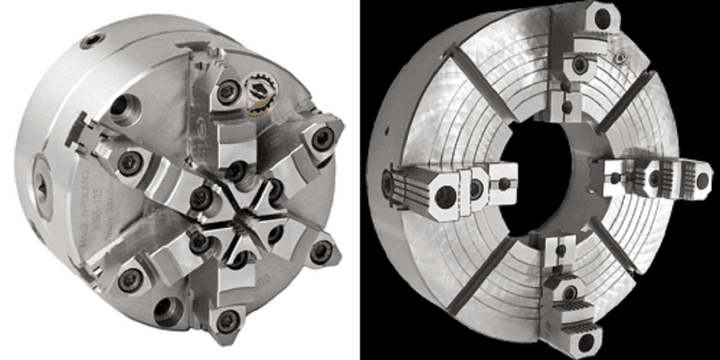
Lathes, also referred to as turning machines, are metalworking machines that rotate a metal workpiece at a high speed, applying a stationary cutting tool to it to remove stock material so that it can be shaped. They are highly effective at producing cylindrical objects, but in addition to turning, they can also be used for other processes like shaping, knurling, drilling, and boring. For this reason, and for the versatility they offer, they are sometimes referred to as the “mother of machining tools,” especially since they are sometimes used to produce parts for other metalworking machines.
One vital part of the lathe that is occasionally overlooked is the lathe chuck, which is the part that interfaces between the lathe itself and the workpiece, securely clamping the workpiece in place.
There are many different types of lathe chucks, but in this short post, we will look at two different basic types.
Self Centering Lathe Chucks
Some lathe chucks are called “self-centering” chucks because when you adjust the jaws, all of the jaws (regardless of number) adjust automatically and evenly at the same rate. Self-centering chucks are best for concentric or symmetrical pieces because they allow for easy, precise adjustments very quickly. Sometimes they are referred to as scroll chucks because the chuck uses a scroll gear to synchronize the movement of the jaws.
Turning a single adjustment screw causes all of the jaws to move either inward or outward at the same rate, bringing the workpiece into perfect alignment with the lathe’s spindle. It is also important to note that the number of jaws does not necessarily determine whether or not a lathe chuck is self-centering or not.
Independent Lathe Chucks
Another broad class of lathe chucks are referred to as independent chucks because the jaws can all be moved independently of one another. In a lathe chuck with independent jaws, each jaw has its own adjustment screw, so each one must be adjusted independently.
While it is the case that it takes considerably more time and attention to properly adjust an independent lathe chuck, chucks with independent jaws offer greater versatility and are generally better suited for irregular or eccentric workpieces with a low degree of symmetry.
A Note on Number of Jaws
While the number of jaws does not determine (necessarily) whether or not a lathe chuck is self-centering or independent, there are some special considerations to be taken based on the number of jaws, especially if the chuck is a self-centering version:
- 2 jaw chucks are ideal for rectangular parts.
- 3 jaw chucks are ideal for round workpieces like bars and pipes because there is a third point of contact.
- 4 jaw chucks are good for square parts.
- 6 jaw chucks are better for thin-walled parts because there are additional points of contact that enable the pressure on the workpiece to be evenly distributed.
As a general rule, the more fragile or eccentric the workpiece is, the more jaws are necessary to properly and securely hold it without damaging it. As a result, thin-walled parts and eccentric workpieces are best used with lathe chucks that have several jaws, and independent chucks tend to be preferable in these scenarios.
Where to Learn More About Lathe Chucks
Do you want to learn more about the different types and styles of lathe chucks that are available? Make your first stop online at TMT Toolbox. They carry a wide range of metal cutting tools and machine tool accessories and lathe chucks are only some of them. Visit their website and if you have any questions about tool specifications, use cases or compatibility, get in touch with them directly.
For More Information About Machine Tool Accessories and Carbide Drills Please Visit: TMT Toolbox.