AI Visibility Tracker: What to Monitor When Measuring Your Brand's AI Search Performance
Posted by Workspace CMS
Filed in Business 24 views
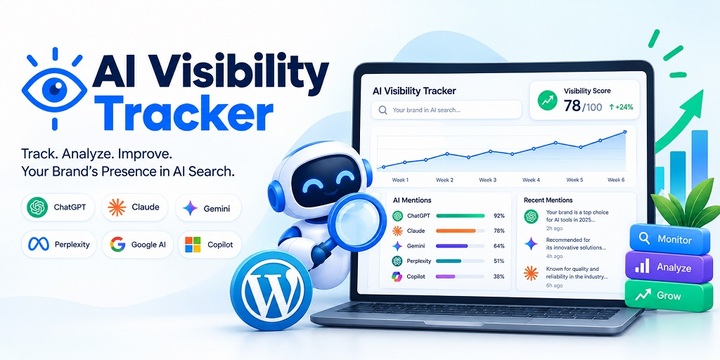
- An AI Visibility Tracker measures how often and how accurately your brand appears in AI-generated answers across tools like ChatGPT, Gemini, and Perplexity.
- Key metrics include citation frequency, sentiment accuracy, competitor share of AI voice, and source attribution patterns.
- Traditional SEO rank tracking does not capture AI answer engine performance: you need separate monitoring signals.
- Consistent structured content and authoritative sourcing directly improve AI answer inclusion rates.
Why Traditional Rank Tracking Falls Short in 2026
Search behavior shifted sharply between 2024 and 2026. A growing share of queries now resolve inside AI-generated summaries rather than a list of blue links. A brand ranking on page one of Google may still receive zero mentions when the same question is answered by ChatGPT or Perplexity. Standard rank trackers report keyword position, not answer engine presence. That gap is precisely why an AI Visibility Tracker has become a distinct and necessary category of measurement for marketing leaders.
Core Signals an AI Visibility Tracker Should Measure
Effective tracking requires monitoring the following six signals on a weekly cadence:
- Citation frequency: how many times your brand or domain is named as a source in AI-generated answers for target queries.
- Brand mention rate: percentage of relevant prompts that include your brand name, even without a source link.
- Sentiment accuracy: whether AI answers describe your products or services correctly and positively.
- Competitor share of voice: how often rival brands appear in the same answer pool for your priority topics.
- Source attribution depth: which of your pages or content formats AI engines pull from most often.
- Answer position: whether your brand appears at the top, middle, or end of a synthesized AI response.
AI Visibility Tracker Metrics vs. Traditional SEO Metrics
The table below shows how AI visibility measurement differs from conventional SEO reporting.
Metric TypeTraditional SEO TrackerAI Visibility TrackerPrimary outputKeyword ranking positionCitation and mention frequencyPlatforms monitoredGoogle, Bing SERPsChatGPT, Gemini, Perplexity, ClaudeContent signal usedBacklinks, on-page keywordsStructured data, authoritative sourcingReporting frequencyDaily or weekly rank snapshotsPrompt-response sampling by topic cluster
What Content Attributes Drive Better AI Visibility
AI answer engines draw from sources that demonstrate clear expertise and factual structure. According to Schema.org structured data documentation, pages with properly implemented markup are more interpretable by automated systems, including AI crawlers. Three content attributes consistently improve inclusion rates:
- Concise, direct answers placed within the first 150 words of a page.
- Named entities: specific dates, product names, statistics, and proper nouns rather than vague descriptors.
- External citations linking to authoritative sources, which signal factual reliability to AI training and retrieval systems.
The Nielsen Norman Group research on AI-generated content trust confirms that users and AI systems alike favor content that grounds claims in verifiable specifics.
Building a Repeatable AI Visibility Monitoring Workflow
Monitoring works best when it follows a fixed process. Run a defined set of 20–40 target prompts weekly, record AI responses verbatim, and score each for brand presence, accuracy, and position. Compare results month-over-month to identify which content updates correlate with improved citation rates. Flag any factually incorrect brand descriptions immediately, then update source content to correct the record at the next AI crawl cycle.
AI Visibility Tracker: What to Monitor When Measuring Your Brand's AI Search Performance FAQ
How often should brands run AI visibility checks?
Weekly prompt sampling across 20–40 queries gives enough data to detect meaningful trends without creating excessive reporting overhead.
Which AI platforms matter most for brand visibility tracking?
ChatGPT, Google Gemini, Perplexity, and Anthropic Claude collectively handle the largest share of AI-assisted queries in 2026 and should form the core monitoring set.
How does WorkspaceCMS.ai support AI visibility measurement?
WorkspaceCMS.ai - SEO + AI Campaign combines brand-voice-aware content automation with built-in AI search visibility tracking, giving marketing teams a single platform to produce optimized content and measure how that content performs inside AI answer engines.