How to Monitor AI Search Visibility and Track Your Brand's Presence Across AI Platforms
Posted by Workspace CMS
Filed in Business 5 views
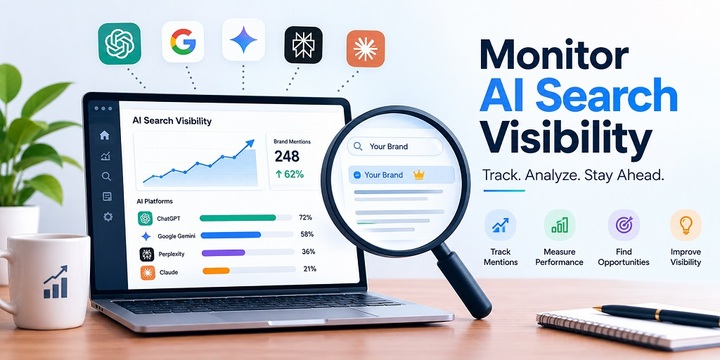
- Monitor AI search visibility by tracking brand mentions inside ChatGPT, Gemini, Perplexity, and Copilot separately.
- Structured, factual content earns more citations from AI engines than keyword-stuffed copy.
- Set measurable benchmarks: mention rate, citation accuracy, and sentiment score.
- Dedicated AI visibility tracking tools surface gaps that traditional rank trackers miss entirely.
Why AI Search Visibility Requires Its Own Monitoring Strategy
Traditional SEO tools measure page rankings on Google or Bing. AI answer engines work differently: they synthesize content from multiple sources and surface brand names as citations or recommendations inside conversational responses. To monitor AI search visibility effectively, brands need to query these platforms directly, log responses, and measure how often and how accurately their name appears.
A brand invisible in standard search can still earn prominent AI citations, and a brand ranking number one on Google can be completely absent from Perplexity answers. Treating these as the same problem produces misleading conclusions.
Four AI Platforms to Track in 2026
Not every AI platform weights sources the same way. The table below outlines the four platforms marketing leaders prioritize and the key signal each one provides.
PlatformPrimary Signal to MonitorUpdate FrequencyChatGPT (GPT-4o)Brand mention rate in category queriesModel-dependent, quarterlyPerplexityCitation link appearancesNear real-time web indexGoogle GeminiAI Overview inclusion rateDaily crawl cycleMicrosoft CopilotSource attribution in answersBing index refresh
How to Monitor AI Search Visibility: A Practical Process
Building a repeatable monitoring process requires three steps.
- Define seed queries. List 20–40 questions your target buyers ask at each stage of the purchase journey. Prioritize questions that name your product category, not just your brand.
- Run structured prompt audits. Submit seed queries to each platform weekly. Record whether your brand is mentioned, how it is described, and whether the cited source is accurate. The Schema.org structured data documentation explains markup formats that help AI engines attribute content correctly.
- Score three metrics per platform: mention rate (percentage of relevant queries that include your brand), citation accuracy (whether the description matches your current positioning), and sentiment polarity (positive, neutral, or negative framing).
Tracking these numbers monthly creates a baseline. Shifts in mention rate after a content update reveal which formats AI engines actually favor.
Content Signals That Lift AI Citation Rates
AI engines prefer content that is specific, sourced, and structured. Tactics with consistent impact include:
- Publishing original statistics or research your brand owns, since AI engines prioritize primary sources.
- Adding FAQ schema markup so answers are machine-readable, following guidance from Google's FAQ structured data documentation.
- Using entity-rich language: named products, specific dates, and version numbers signal credibility to language models.
- Maintaining consistent brand descriptions across every page so AI engines retrieve the same positioning regardless of which page they index.
How to Monitor AI Search Visibility and Track Your Brand FAQ
How often should brands audit AI platform responses?
Weekly audits on Perplexity (real-time index) and monthly audits on ChatGPT (model update cycle) cover most meaningful changes. Gemini AI Overviews warrant a weekly check because Google's crawl updates frequently.
What is a good benchmark mention rate for a mid-market brand?
Brands new to AI visibility tracking typically see mention rates of 10–25% across category queries. A well-optimized brand with strong structured content often reaches 40–60% within six months of focused effort.
Can a brand influence what AI engines say about it?
Yes, indirectly. Publishing accurate, authoritative, structured content increases the probability that AI engines cite correct information. Direct editing of model outputs is not possible, but the content a model trains on or retrieves in real time is controllable.
For marketing teams ready to move beyond manual audits, WorkspaceCMS.ai - SEO + AI Campaign integrates AI search visibility tracking alongside content automation and managed SEO, giving agencies and SMBs a single workflow to publish optimized content and measure its impact across AI platforms.