How Supermarket Billing Software Simplifies Daily Store Operations
Posted by Marg Books
Filed in Business 74 views
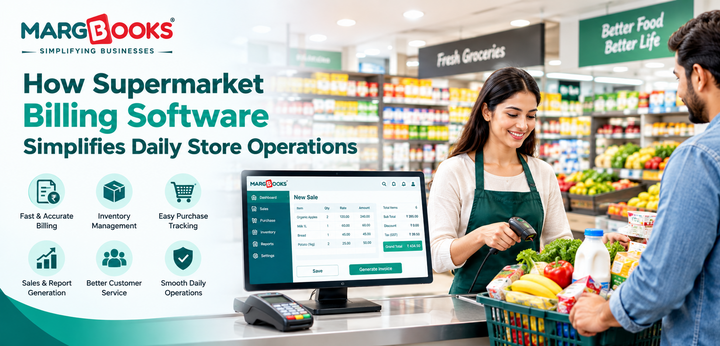
Supermarket billing software helps simplify daily store operations by automating billing, inventory updates, GST invoicing, payment recording, and sales reporting. For supermarkets handling a large number of products and daily transactions, these tools can reduce manual work and make routine processes more organized.
From scanning products and generating accurate invoices to monitoring stock levels and tracking purchases, supermarket billing software connects important retail activities in one place. When combined with Inventory Management Software and Accounting Software, it can also help businesses maintain better control over stock, sales, purchases, and financial records.
As supermarkets become more dependent on technology for faster checkout and efficient inventory control, choosing the right billing system can help improve operational accuracy, save time, and provide useful information for everyday business decisions.
What Is Supermarket Billing Software?
Supermarket billing software is a digital solution designed to manage retail billing and related store operations. It can handle product billing, barcode scanning, GST invoices, inventory tracking, purchases, payments, customer records, and business reports.
Unlike a basic invoice generator, supermarket billing software connects different business processes. For example, when a cashier scans a product, the software can generate the bill while simultaneously reducing the available stock and recording the sale.
Common features include:
-
Barcode-based billing
-
GST invoicing
-
Product and price management
-
Inventory tracking
-
Purchase management
-
Supplier management
-
Multiple payment modes
-
Sales and purchase reports
-
Accounting integration
-
Multi-counter or multi-store management
Faster and More Accurate Billing
Supermarkets often process a large number of transactions, especially during weekends, holidays, and peak shopping hours. Manually entering product details and prices can slow down checkout and increase the possibility of mistakes.
With barcode billing, employees can scan products and retrieve stored information automatically. Product names, prices, tax details, and other configured information can appear on the billing screen.
This can make checkout faster and more consistent while reducing repetitive data entry.
A supermarket billing system can also record different payment methods such as cash, UPI, debit cards, credit cards, and other supported digital payments.
Better Inventory Management
Inventory is one of the most important parts of supermarket operations. A typical store may have thousands of products across categories such as groceries, beverages, personal care, household products, packaged foods, and more.
Manually checking stock can become difficult as the number of products increases.
Supermarket billing software can automatically update inventory whenever a sale or purchase is recorded. This provides a clearer picture of current stock levels.
For example, if a store has 100 units of a product and sells 25 units, the system can update the available quantity to 75 units.
This helps businesses identify:
-
Low-stock products
-
Fast-moving products
-
Slow-moving products
-
Overstocked items
-
Products requiring replenishment
This is where Inventory Management Software becomes particularly useful. Connecting billing with inventory means that sales information does not need to be entered separately into a stock register.
Simplifies Purchases, Suppliers and GST Billing
Supermarkets regularly purchase products from multiple suppliers. Keeping track of purchase quantities, supplier prices, invoices, and outstanding payments can become complicated when records are maintained manually.
Integrated software can maintain purchase and supplier information alongside sales and inventory data. Store owners can review purchase transactions, supplier balances, product costs, and purchasing patterns more easily.
GST billing is another important requirement for many Indian retailers. Billing software can help generate invoices with configured tax information and maintain transaction records for reporting.
However, businesses should ensure that GST rates, HSN details, invoice settings, and other tax configurations are correctly maintained according to applicable requirements.
Connects Billing With Accounting
Billing and accounting are closely connected. Every sale affects the financial records of a business, while purchases and expenses also influence its overall financial position.
With integrated Accounting Software, sales and purchase transactions can flow into financial records without requiring employees to enter the same information repeatedly.
This can help businesses maintain records related to:
-
Sales
-
Purchases
-
Receivables
-
Payables
-
Cash transactions
-
Expenses
-
Profit and loss
-
Business balances
Connecting billing and accounting can therefore reduce duplicate data entry and make financial record-keeping more organized.
Makes Pricing, Discounts and Payments Easier
Supermarkets frequently change prices and offer discounts or promotional deals. Managing these changes manually can result in incorrect pricing at the checkout counter.
Billing software can store product prices and configured discounts centrally. When an item is scanned, the applicable price or discount can be applied according to the settings.
This can reduce common problems such as incorrect prices, calculation mistakes, or forgotten promotional offers.
Payment management also becomes easier because transactions can be recorded according to the payment method used. This makes it simpler to review total collections at the end of the day.
Provides Useful Sales and Business Reports
A supermarket generates a large amount of data every day. Simply recording transactions is not enough; store owners also need to understand what the data indicates.
Billing software can provide reports related to:
-
Daily sales
-
Product-wise sales
-
Category-wise sales
-
Purchase transactions
-
Stock movement
-
Payment methods
-
Cashier-wise sales
-
Customer transactions
-
Financial performance
For example, sales reports can help identify products that sell quickly and those that remain in stock for longer periods.
These insights can support better purchasing, pricing, and inventory decisions.
Helps Reduce Stockouts and Overstocking
Maintaining the right amount of inventory is a constant challenge for supermarkets.
Too little stock can result in products being unavailable when customers need them. Too much stock can tie up working capital and create storage problems. This can be especially important for products with limited shelf life.
Inventory Management Software can help monitor stock quantities and identify products that are approaching predefined reorder levels.
By reviewing stock movement and sales trends, store owners can plan purchases more systematically instead of depending entirely on manual stock checks.
Improves Multi-Counter and Daily Store Management
Larger supermarkets may have several billing counters operating at the same time. Managing each counter separately can make it difficult to get a complete picture of daily sales.
Centralized billing software can bring transactions from multiple counters into one system. Management can then review counter-wise sales, cashier transactions, payment collections, returns, and overall revenue.
For businesses operating more than one outlet, multi-store capabilities can also provide centralized visibility across locations, depending on the software.
How MargBooks Can Support Supermarket Operations
When choosing supermarket software, businesses should look for more than just a billing function. Connecting billing, inventory, accounting, purchases, and reporting can make daily operations more organized.
MargBooks is one option businesses can evaluate when looking for an integrated platform covering billing, GST invoicing, inventory, accounting, and business records.
The right solution ultimately depends on the supermarket's size, number of products, billing counters, inventory requirements, accounting workflow, staff, and future growth plans. Businesses should compare these requirements before selecting software.
Frequently Asked Questions
1. What is supermarket billing software?
Supermarket billing software is a digital system used to manage retail billing, barcode scanning, GST invoices, payments, inventory, purchases, and sales records.
2. How does supermarket billing software help manage inventory?
It can automatically update stock when products are purchased or sold. This helps businesses monitor available quantities, identify low-stock products, and understand stock movement.
3. Can supermarket billing software generate GST invoices?
Yes, many modern billing systems support GST invoicing. Businesses should configure tax rates, HSN details, and invoice settings correctly according to applicable GST requirements.
4. Is accounting software useful for supermarkets?
Yes. Accounting Software can help supermarkets maintain sales, purchase, expense, receivable, payable, and other financial records in a more organized manner.
5. Does billing software support barcode scanning?
Many supermarket billing systems support barcode scanning, allowing employees to quickly identify products and generate bills without manually entering product information.
6. Can billing software manage multiple counters?
Many systems support multiple billing counters and can provide counter-wise or cashier-wise transaction reports. The exact functionality depends on the software.
7. How does billing software reduce manual work?
It can automatically perform tasks such as bill generation, stock updates, tax calculations, transaction recording, and report generation, reducing repetitive data entry.
8. What should I check before choosing supermarket billing software?
Consider billing speed, barcode support, inventory management, GST functionality, accounting integration, reporting, payment options, ease of use, data security, scalability, and customer support.
9. Can supermarket billing software help prevent stock shortages?
It can help by monitoring stock levels and identifying products that reach predefined reorder points. This allows businesses to plan replenishment more systematically.
10. Is supermarket billing software suitable for small stores?
Yes. Small supermarkets and grocery stores can also benefit from digital billing, inventory tracking, accounting, and reporting. The ideal software should match the store's size and operational requirements.
Conclusion
Supermarket billing software can simplify several day-to-day activities by bringing billing, inventory, purchases, accounting, payments, and reporting into a connected workflow.
Barcode billing can make checkout faster, automatic inventory updates can improve stock visibility, and integrated accounting can reduce duplicate data entry. Reports can also provide useful information for purchasing and business planning.
Rather than selecting software based only on the number of features, supermarket owners should evaluate how well a solution fits their actual workflow. An integrated platform such as MargBooks can be considered by businesses looking to manage billing, Inventory Management Software, Accounting Software, and related retail operations within a connected system.
The ultimate goal is simple: reduce manual work, improve accuracy, maintain organized records, and make everyday supermarket management easier.