Why Is Social Media Marketing So Time-Consuming for Small Businesses?
Posted by Super Buddy
Filed in Other 47 views
"I only post a few times a week. Why does this take hours?"
Almost every small business owner has had that thought, usually on a Sunday evening.
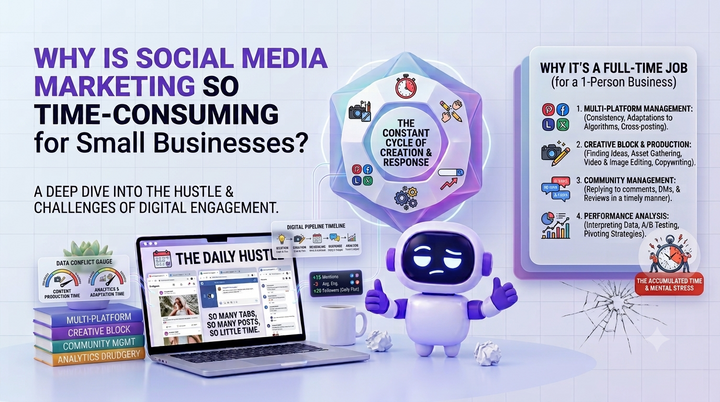
Social media marketing is time-consuming for small businesses because publishing is only one step in a much longer chain. A single post involves research, ideation, copywriting, design, platform adaptation, caption writing, hashtag selection, scheduling, publishing, replying and performance tracking. Those eleven steps are then spread across several disconnected tools.
The important point is that this is not a discipline problem. Small business owners are not bad at time management, and working faster is not the fix. The workflow itself creates the friction, and a fragmented workflow costs more than the sum of its parts.
Why Social Media Takes So Much Time
The biggest time drains are rarely the ones people expect. Writing is a small fraction of it.
Creating Content From Scratch
Every post begins with a blank page, and deciding what to say is harder than saying it. A café owner sits down on Monday with no idea what to post and loses twenty minutes before typing a word. Because nothing carries over from last week, that cost repeats every single time. Starting from a prompt or an existing idea rather than nothing removes most of it.
Managing Multiple Social Platforms
Four platforms means four logins, four apps, four sets of rules and four places to check. A florist posting to Instagram, Facebook, Pinterest and Google Business Profile is not doing one job, but four versions of the same job. Publishing everything from one calendar collapses that back into a single task.
Recreating Content for Different Formats
The same photograph needs a square crop for one platform, a portrait for another, and a different crop again for a third. A gym owner makes one graphic and then spends longer resizing it than creating it. Generating each version at the correct size, rather than exporting and re-exporting, removes an entire step.
Switching Between Too Many Tools
Notes app for ideas. Document for captions. Spreadsheet for hashtags. Design tool for images. Cloud storage for files. Scheduler for publishing. That is six tools for one post, and none of them talk to each other. Having planning, writing, design and scheduling on one surface eliminates the handoffs rather than speeding them up.
Writing Captions Again and Again
A caption written for Instagram reads wrong on LinkedIn. A consultant rewrites the same insight three times: casual for Instagram, professional for LinkedIn, condensed for X. The thinking happened once, the writing happened three times. Adapting one caption per platform is far quicker than writing three from scratch.
Scheduling Content Manually
Posting live means remembering, at the right moment, on the right platform, every time. A restaurant owner posts at 11pm because that was when they remembered. Queueing posts in advance turns a daily obligation into a decision made once.
Managing Approvals and Revisions
Even a two-person business has a review step, and it usually happens over messages and screenshots. A clinic manager sends a draft caption to the owner on WhatsApp, waits, then makes the edit somewhere else entirely. Keeping drafts, comments and approvals beside the calendar removes the round trip.
Tracking Performance Across Platforms
Each platform reports differently, so comparing them means opening several dashboards and normalising numbers that do not quite match. Most small businesses skip it, which means next month gets planned blind. One view across every connected account makes the check quick enough to actually do.
The Hidden Cost of Tool Switching
The problem is not only how many tools you use. It is what happens in between them.
Consider a realistic sequence. Find an idea in a notes app. Write the content using an AI tool. Design the image somewhere else. Download it. Resize it. Open the social platform. Write the caption. Schedule it. Come back later for analytics. Copy the numbers into a spreadsheet.
Each of those steps might take only a few minutes. The switching is what costs you.
Every time you move between tools, you lose the thread of what you were doing, and picking it back up takes longer than the move itself. You reopen the document and spend half a minute remembering which caption you were working on. That gap is invisible, unbilled and repeated dozens of times a week.
There is a second cost that never shows up in any single post's timing. Six tools means six subscriptions, six logins, six things that can break, and six places to search when you cannot find the image you made last month.
Why Re-Creating the Same Content Is a Major Time Sink
This is the largest avoidable cost, and it is rarely counted separately.
You do not make one post. You make the same post several times, once for Instagram, once for Facebook, once for LinkedIn, and again for X, TikTok, YouTube, Pinterest or Threads depending on where you publish.
The idea stays the same. What changes is the format, the length, the tone and the creative treatment. Those differences are real and they matter, which is why publishing identical content everywhere performs badly. A caption written for one audience reads awkwardly to another.
So businesses face an apparent choice: spend several times as long doing it properly, or copy and paste and accept weaker results.
That choice is false. The goal is not identical content everywhere, and it is not building each version from zero. It is creating one strong core idea and adapting it efficiently for each channel, which is a fundamentally cheaper operation than starting again.
The One-Workspace Approach
Small businesses can save time by reducing the distance between the steps rather than trying to perform each step faster.
This is the idea behind a unified workspace, and it is the approach Super Buddy takes. Rather than treating planning, creation, adaptation, scheduling and measurement as separate products, they sit together in one place, connected by the content itself.
In practice that means generating captions, hooks and calls to action where you plan rather than in a separate tool, adapting one idea into platform-native versions instead of rewriting it repeatedly, scheduling everything from a single calendar across your connected accounts, and reviewing performance in one view rather than four dashboards.
The benefit is not that any individual step becomes dramatically faster. It is that the gaps between them disappear, and the gaps were most of the cost.
What a More Efficient Social Media Workflow Looks Like
Step 1: Plan. Choose your themes and topics for the period ahead, so no post starts from a blank page.
Step 2: Create. Develop the core post, caption and creative once, properly.
Step 3: Adapt. Adjust that core idea for each platform rather than rebuilding it from zero.
Step 4: Schedule. Queue everything in advance so publishing stops being a daily decision.
Step 5: Review. Check the calendar, edit what needs editing, approve what is ready.
Step 6: Analyze. Look at what performed, and let that shape the next round of planning.
Six clear stages, in one place, instead of eleven scattered tasks across six tools.
How Much Time Can Small Businesses Actually Save?
Honestly, it depends, and anyone quoting you a guaranteed figure is guessing.
The saving scales with how much repetition exists in your current process. The factors that matter most are the number of platforms you post to, how often you post, how complex your content is, how many people are involved, whether you have an approval step, which tools you already use, and how much of your content could be adapted rather than created fresh.
A sole trader posting twice a week to one platform has relatively little repetition to remove. A business publishing daily across five platforms with a review step has a great deal. The more fragmented and repetitive your current workflow, the more there is to recover.
Social Media Should Support the Business, Not Become the Business
This is the part worth holding onto.
Small businesses need social media. They do not need social media to consume the hours that belong to customers, sales, product development, operations, the team, and actually growing the business.
The goal is not to remove human creativity from the process. Judgement about what matters this week, knowledge of your customers, and the real photographs of your premises and people are exactly what make your content worth following. Those should stay with you.
What should go is the repetition: the resizing, the rewriting of the same idea, the copying between tools, the remembering to post.
A Smarter Way to Manage Social Media
One idea, adapted into several, organised in one workflow, scheduled in advance, and measured in one place.
That is the whole argument. Social media marketing is time-consuming for small businesses because the workflow is fragmented, not because the work is hard. Reduce the fragmentation and most of the hours come back.
If your current process involves more tools than platforms, that is the place to start looking.
Frequently Asked Questions About Social Media Marketing for Small Businesses
1. Why does social media marketing take so much time?
Because one post is really eleven steps: research, ideation, copywriting, design, platform adaptation, caption writing, hashtag selection, scheduling, publishing, replying and tracking. Those steps are usually spread across several disconnected tools, so the switching between them costs as much as the work itself. The fragmentation is the problem, not the posting.
2. How much time should a small business spend on social media?
There is no universal figure, and it depends on how many platforms you post to and how often. What matters more is whether the time is concentrated or scattered. One focused weekly session almost always produces more than the same hours broken into daily fragments, because each restart carries its own cost.
3. How can small businesses save time on social media marketing?
Reduce repetition rather than working faster. Plan themes in advance so posts do not start from blank pages, create one core idea and adapt it per platform instead of rebuilding it, schedule in advance so publishing stops being a daily decision, and keep the whole process in as few tools as possible.
4. What is the most time-consuming part of social media marketing?
Two things, and neither of them is writing. Deciding what to post costs more than people expect, because every post starts from nothing and no momentum carries over from last week. Recreating the same idea for each platform costs the most overall, because the thinking happens once while the production work repeats for every channel you publish to.
5. How can I manage multiple social media accounts efficiently?
Publish from one calendar rather than app by app, adapt a single core idea for each platform instead of writing separately for each, and bring replies into one place so you are not checking several apps a day. Super Buddy connects ten platforms to one workspace for exactly this reason.
6. Can AI help small businesses create social media content?
Yes, for the production half of the work. AI removes the blank page by drafting captions, hooks and calls to action, and it adapts one idea into platform-appropriate versions quickly. It cannot decide what your business needs to say this week, and it should not replace genuine photographs of your products and team.
7. How can businesses repurpose one piece of content across multiple platforms?
Start with one strong idea, then break it into its component parts: the claim, the reason behind it, the example, the objection, and the practical step. Each of those becomes a different post, written for the platform it appears on rather than copied across unchanged. That distinction is what makes repurposing genuinely useful instead of simply repetitive.
8. Is social media scheduling worth it for small businesses?
Yes, particularly for businesses with unpredictable weeks. Scheduling removes the daily decision to post, and that decision is usually the first thing to break when the business gets busy. Publishing through official platform connections is the method the platforms themselves provide, so there is no credible basis for scheduled posts being penalised on reach.
9. What tools can help small businesses manage social media?
The useful question is how many tools rather than which ones. A stack of six specialised tools often costs more time than one connected workspace covering planning, creation, scheduling and analytics. Look for the smallest number of tools that covers your workflow, not the best tool for each individual step.
10. How can a small business create a consistent social media workflow?
Build it around a repeatable weekly or monthly session rather than daily effort. Plan your themes, create the core ideas, adapt each one per platform, schedule everything in advance, then review performance so it informs the next round. Consistency comes from removing decisions from the day, not from applying stronger discipline to an expensive process.