India’s Four Labour Codes: A Practical Guide for Employers, HR
About
India’s labour law framework plays an important role in determining how businesses manage wages, employee benefits, industrial relations, and workplace safety. For employers and HR professionals, understanding these requirements is essential for maintaining accurate payroll processes, appropriate employment records, and effective workforce management.
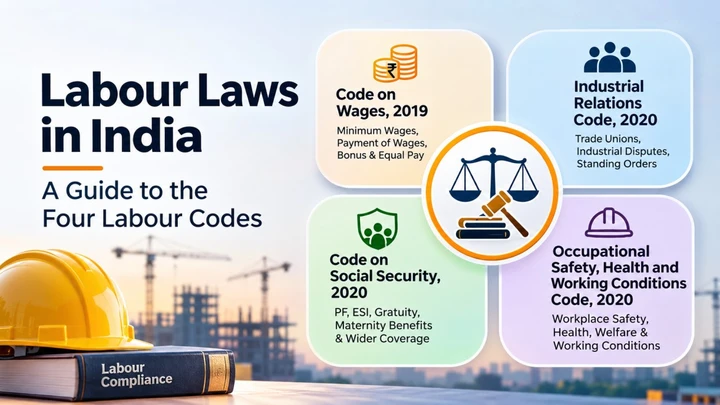
On 21 November 2025, the Government of India announced that the four Labour Codes had come into effect, consolidating 29 existing Central labour laws. The framework covers wages, industrial relations, social security, and occupational safety and working conditions. Relevant existing rules, notifications, standards, schemes, and other transitional provisions may continue to apply as specified by the government. <Cite refs={["turn475246search1","turn475246search2"]}/>
Understanding the four Codes can help businesses identify the areas that need attention and establish a more systematic approach to labour compliance.
What Are the Four Labour Codes in India?
The four Labour Codes address different aspects of employment and workplace regulation. Each Code has a distinct focus, although their practical implications can overlap in areas such as payroll, HR administration, and employee documentation.
1. Code on Wages, 2019
The Code on Wages consolidates provisions relating to minimum wages, payment of wages, bonus, and equal remuneration.
For businesses, this Code makes payroll review an important part of compliance planning. Employers should examine wage calculations, salary structures, payment timelines, applicable minimum wages, and permitted deductions.
HR and payroll teams should also ensure that payroll software and internal processes reflect the applicable statutory requirements.
Practical steps for employers:
Review salary structures and wage components.
Verify applicable minimum-wage rates.
Check wage-payment procedures and statutory deductions.
Maintain accurate payroll records.
Review relevant policies and payroll calculations when requirements change.
2. Industrial Relations Code, 2020
The Industrial Relations Code covers matters relating to trade unions, industrial disputes, and standing orders.
These provisions are relevant to how employers manage employee relations, workplace disputes, and certain employment policies. The specific requirements depend on the applicable provisions and the characteristics of the establishment.
Practical steps for employers:
Review employee grievance procedures.
Assess disciplinary and dispute-resolution policies.
Maintain appropriate employment documentation.
Review standing-order requirements where applicable.
Ensure HR teams understand relevant industrial-relations obligations.
Clear procedures and consistent documentation can help organisations manage workplace issues more effectively.
3. Code on Social Security, 2020
The Code on Social Security provides a framework for social security benefits, including provisions relating to provident fund, employee insurance, gratuity, and other covered benefits.
Social security compliance requires businesses to understand which employees and establishments fall within the applicable provisions and schemes. Employers should not assume that identical contribution or eligibility rules apply to every workforce category.
Practical steps for employers:
Verify applicable provident fund and employee insurance obligations.
Review gratuity eligibility and related processes.
Maintain employee and contribution records.
Assess requirements relevant to contract and fixed-term workers.
Monitor applicable schemes and official notifications concerning gig and platform workers.
Accurate employee records and timely reviews can help payroll and HR teams identify potential gaps.
4. Occupational Safety, Health and Working Conditions Code, 2020
This Code addresses occupational safety, workplace health, employee welfare, and working conditions.
Its practical implications vary according to the type of establishment, industry, workforce, and applicable statutory requirements. Factories, manufacturing facilities, and businesses using contract labour may need to assess specific workplace obligations.
Practical steps for employers:
Review workplace safety procedures.
Assess applicable health and welfare requirements.
Check working-hour and leave-related obligations.
Maintain relevant workplace and employment records.
Review contractor management and safety arrangements where applicable.
Workplace compliance should be treated as an ongoing operational responsibility rather than a one-time documentation exercise.
How Do the Four Labour Codes Affect Businesses?
The impact of the Labour Codes depends on the nature of the business, the employees engaged, the establishment's location, and the provisions applicable to its operations.
However, several areas deserve attention during a compliance review.
Payroll and salary administration
Payroll teams should evaluate wage structures, calculations, deductions, payment schedules, and applicable statutory contributions. Any changes should be implemented only after confirming the relevant legal requirements.
Employee benefits and social security
Employers should verify employee coverage, contribution obligations, eligibility conditions, and benefit-related documentation under applicable provisions and schemes.
HR policies and employment records
Employment contracts, appointment letters, grievance procedures, registers, and other records should be reviewed for compliance with applicable requirements.
Contract labour management
Businesses engaging contractors should examine contractual arrangements, documentation, and statutory responsibilities. The allocation of responsibilities between contractors and principal employers must be assessed under the applicable legal framework.
Workplace safety and welfare
Employers should evaluate whether their existing safety procedures, workplace facilities, and employee welfare arrangements meet the requirements applicable to their establishments.
A Labour Compliance Checklist for 2026
Businesses can begin with a structured review covering the following areas:
Identify applicable legislation: Determine which provisions, rules, registrations, and obligations apply to each establishment.
Review payroll processes: Check wage calculations, salary components, deductions, and payment procedures.
Verify social security obligations: Review applicable PF, ESI, gratuity, and other statutory requirements.
Update employment documentation: Check appointment letters, employment contracts, policies, and required records.
Assess contractor compliance: Review contractor documentation and applicable statutory responsibilities.
Evaluate workplace conditions: Check safety, health, and welfare requirements relevant to the establishment.
Maintain a compliance calendar: Assign responsibility for relevant filings, payments, renewals, and other deadlines.
Monitor official updates: Track applicable Central and State notifications, rules, schemes, and transitional arrangements.
Document corrective actions: Record identified gaps, responsible team members, and completion status.
Conduct periodic reviews: Reassess compliance when the workforce, establishment, or applicable regulations change.
This checklist is a starting point, not a definitive list of legal obligations for every employer.
Common Labour Compliance Mistakes Employers Should Avoid
Even organisations with established HR teams can experience compliance gaps when responsibilities, records, and regulatory updates are not managed systematically.
Common issues include:
Applying the same compliance checklist to establishments with different legal requirements.
Using outdated wage rates or payroll assumptions.
Overlooking employee eligibility and coverage conditions.
Maintaining incomplete employment or contractor records.
Missing relevant filing or renewal deadlines.
Implementing regulatory changes without confirming their applicability.
Treating outsourced compliance as a complete transfer of legal responsibility.
A documented review process helps businesses address these risks and establish clearer accountability.
How Can Businesses Manage Labour Compliance More Effectively?
Effective labour compliance combines legal awareness, accurate records, clear responsibilities, and consistent monitoring.
Businesses can improve their processes by maintaining a central compliance calendar, standardising documentation, reviewing payroll data regularly, and assigning clear ownership to HR, finance, payroll, and operational teams.
Organisations operating across multiple States may need additional coordination because establishment-specific and State-level requirements can differ.
Where internal resources or specialist knowledge are limited, businesses may also consider professional support for compliance reviews, statutory documentation, payroll compliance coordination, and regulatory tracking.
For organisations seeking external assistance, Futurex Management Solutions Limited provides labour compliance services to support business compliance processes.
Outsourcing can support administration and monitoring, but employers should clearly define responsibilities and continue to oversee their statutory obligations.
Final Thoughts
India’s four Labour Codes bring together major areas of employment regulation: wages, industrial relations, social security, and workplace safety and working conditions.
For employers, the priority is to understand the provisions applicable to their establishments and review the related payroll, HR, documentation, and operational processes.
A structured compliance calendar, accurate records, regular internal reviews, and monitoring of official notifications can help businesses manage their responsibilities more consistently.
Rather than relying on assumptions or generic checklists, employers should adopt an establishment-specific approach supported by current official information and qualified professional guidance where necessary.
Official reference: Ministry of Labour & Employment announcement on the Four Labour Codes.
Disclaimer: This article is for educational purposes only and does not constitute legal advice. Applicability and implementation details depend on the relevant legislation, notifications, rules, schemes, and establishment-specific circumstances. Verify current requirements through official government sources or a qualified professional.
- Location 198 & 199, Pocket-3, Sector 24 [map]
- Website https://futurexsolutions.com/
- Phone 09810923731