Monolithic vs Headless Commerce: Deployment Strategy Explained
Posted by John Walker
512 views
The commerce technology stack is no longer just an IT decision — it’s a revenue strategy.
As digital channels expand and customer journeys fragment across web, mobile, marketplaces, and social commerce, deployment architecture directly impacts scalability, speed to market, and long-term profitability.
For companies evaluating eCommerce marketplace solutions or planning to build your own ecommerce marketplace, the critical question becomes:
Should you choose a monolithic commerce architecture or adopt a headless approach?
Let’s break this down strategically.
What Is Monolithic Commerce?
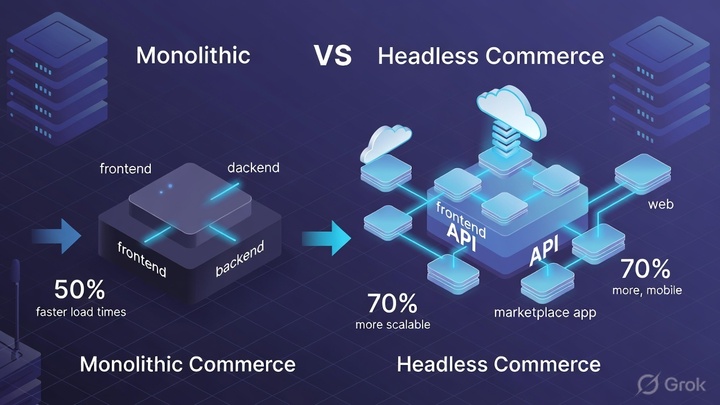
Monolithic commerce platforms combine:
-
Frontend (presentation layer)
-
Backend (business logic)
-
Database
-
Admin system
…into a single, tightly integrated system.
How It Works
All components operate as one unified application. Changes in frontend often require backend modifications. Deployment happens as a single unit.
Advantages
-
Faster initial deployment
-
Lower upfront complexity
-
Easier vendor-managed hosting
-
Suitable for standard retail use cases
Limitations
-
Limited frontend flexibility
-
Slower innovation cycles
-
Scaling constraints
-
Difficult omnichannel expansion
For businesses launching a basic store, monolithic systems work. But when scaling toward an advanced eCommerce marketplace platform, constraints surface quickly.
What Is Headless Commerce?
Headless commerce decouples the frontend from the backend using APIs.
The backend manages:
-
Products
-
Vendors
-
Orders
-
Payments
-
Business logic
The frontend (website, app, marketplace interface) communicates via APIs.
Why It Matters
This architecture supports:
-
Omnichannel distribution
-
Custom UI/UX
-
Faster feature deployment
-
Independent scaling
Headless is particularly powerful for companies pursuing Multi vendor marketplace development or advanced eCommerce marketplace solutions.
Core Problem: Deployment Strategy Impacts Growth
The real issue isn’t “which is better?”
It’s:
Which architecture supports your growth model?
If you're planning to:
-
Integrate third-party vendors
-
Launch multiple storefronts
-
Expand globally
-
Add AI-driven personalization
-
Connect to ERP, CRM, or PIM systems
Then architectural flexibility becomes a revenue enabler — not a technical preference.
Feature-to-Benefit Comparison
Monolithic Commerce
Integrated codebase
→ Simplifies setup
→ Reduces time to launch
Single deployment structure
→ Easier maintenance
→ Lower initial operational overhead
Vendor-managed updates
→ Less DevOps burden
→ Predictable infrastructure costs
Headless Commerce
API-first infrastructure
→ Decoupled frontend/backend
→ Faster innovation cycles
Composable architecture
→ Microservices flexibility
→ Easier third-party integrations
Frontend freedom
→ Custom UX across channels
→ Higher conversion rates
Independent scaling
→ Backend handles complex vendor logic
→ Supports large-scale marketplace growth
Strategic Fit: When to Choose What
Choose Monolithic If:
-
You’re launching a single storefront
-
Vendor management is minimal
-
Customization needs are low
-
Budget constraints are tight
This approach works for early-stage projects that do not require complex Multi vendor marketplace development.
Choose Headless If:
-
You plan to build your own ecommerce marketplace
-
Vendor onboarding and management are core
-
You require omnichannel presence
-
You expect high traffic and global expansion
-
You need seamless ERP/CRM integrations
Headless architecture is increasingly the foundation for scalable eCommerce marketplace platforms.
Use Case: Marketplace-Driven Businesses
Marketplace models introduce complexity:
-
Multiple vendors
-
Commission structures
-
Custom pricing logic
-
Separate dashboards
-
Advanced order routing
Monolithic systems often struggle with these layered workflows.
Headless or composable systems support:
-
Workflow orchestration
-
API-driven vendor modules
-
Modular checkout flows
-
AI-powered recommendations
For serious eCommerce marketplace solutions, flexibility is not optional.
ROI & Strategic Impact
Choosing the right deployment model affects:
1. Revenue Growth
Faster experimentation → Higher conversion optimization.
2. Operational Efficiency
Automation-first backend → Reduced manual vendor management.
3. Scalability
Modular scaling → No full-system rebuild at peak traffic.
4. Innovation Speed
Independent frontend updates → Faster campaign launches.
Long term, headless architecture often delivers higher ROI for marketplace-driven growth models.
Addressing Common Concerns
Is headless more complex?
Yes — initially. But complexity enables flexibility.
Is monolithic outdated?
Not necessarily. It’s suitable for straightforward commerce needs.
Is migration difficult?
Migration requires planning, but phased API integration reduces risk.
Final Strategic Takeaway
Monolithic commerce supports controlled growth.
Headless commerce supports accelerated growth.
If your goal is to launch a simple store, monolithic works.
If your objective is to build your own ecommerce marketplace, expand globally, and deploy enterprise-grade eCommerce marketplace solutions, a headless deployment strategy positions you for long-term scalability.
The architecture you choose today determines the ceiling of your growth tomorrow.
Companies that align deployment strategy with business ambition gain structural competitive advantage.