How Refurbished Motion Stages Can Deliver OEM-Level Performance
Posted by Kensington Laboratories
285 views
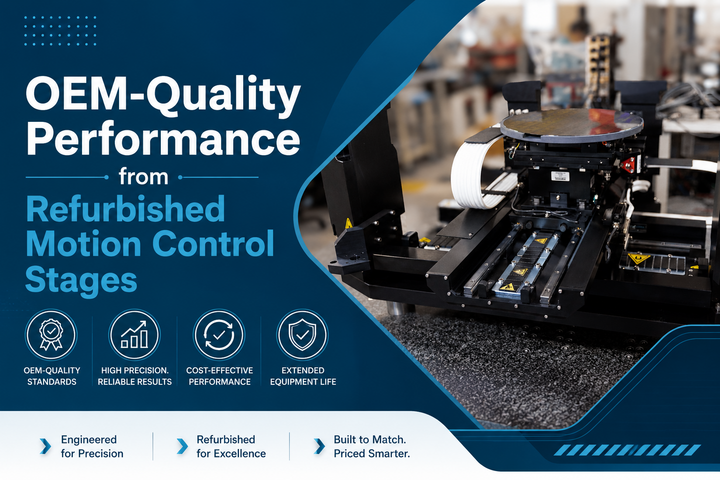
The case for refurbished motion stages has changed. What used to be viewed as a budget-only option is now part of a smarter equipment strategy, especially in semiconductor and precision automation environments where uptime, accuracy, and replacement lead times all matter. The real question today is not whether a motion stage is new, but whether it has been properly restored, tested, and calibrated to meet the performance requirements of the application.
As semiconductor manufacturing continues to demand higher precision, faster turnaround, and tighter control over capital spend. Refurbished motion stages and cost-effective upgrades are becoming a practical way to extend asset life without sacrificing process confidence.
What “OEM-Level” Really Means
In a properly refurbished system, the system is brought back to operational condition and checked against the original performance specifications. Depending on the condition of the equipment and the application requirements, this process could include a combination of new and existing components. This distinction is important because refurbishment is not just resale of used equipment; it is a systematic process of restoration that aims to achieve reliable and measurable performance.
In other words, OEM-level performance is not a slogan. It is the result of careful teardown, inspection, replacement of worn components, recalibration, and final qualification against the stage’s original performance targets. For semiconductor stage repair and other high-precision applications, that process is what separates a cosmetic rebuild from true equipment restoration.
Why Refurbishment Works in Precision Systems
High-end stages are built around measurable motion behavior - range of motion, precision, and bandwidth are core performance metrics for advanced nano positioning systems. That means a stage does not have to be brand-new to be effective, it has to be mechanically sound, electronically stable, and properly requalified.
Extreme precision motion control in semiconductor motion systems relies on stable mechanics, responsive feedback and careful calibration. Even in high-performance applications, a refurbished stage with verified sensors and tight control tuning can still meet demanding motion requirements.
Where Refurbished Motion Stages Create Value
A quality refurbishment program is most valuable when it supports both performance and budget discipline. In practice, the strongest gains usually come from these areas:
-
Restoring motion accuracy without replacing the whole platform
-
Replacing only worn subassemblies instead of discarding the full system
-
Extending the service life of precision positioning equipment
-
Reducing downtime while waiting for long-lead OEM replacements
-
Enabling cost-effective upgrades during planned maintenance windows
The industry is slowly moving towards repair-aware design with the extension of equipment life being identified as a critical part of operational strategy. That increased use of refurbished parts is really a broader focus on maintainability, sustainability, and getting more value from existing assets, rather than replacing everything with new ones.
What Has to Be Checked Before the Stage Goes Back into Service
A refurbished stage should never be judged by appearance alone. The critical checks are the ones that prove behavior under load, at speed, and over time.
Key verification points
-
Encoder accuracy and repeatability
-
Servo tuning and control stability
-
Bearing, drive, and cable condition
-
Thermal drift and contamination risk
-
Alignment across the full travel range
-
Documentation against original performance specs
This is where semiconductor stage repair becomes more than maintenance. It turns into a controlled restoration process, supported by metrology and acceptance testing rather than guesswork. If the motion profile is clean and the results remain within specification, the refurbished unit can function like a well-managed OEM asset.
Latest Trends Shaping Refurbishment
Today refurbishment is much more than just replacing worn components. Manufacturers are taking a more strategic approach to asset recovery with detailed inspections, precision recalibration and targeted component replacement that restores performance and extends the life of equipment. This enables existing systems to continue to operate reliably without the disruption and cost of a full equipment replacement.
In the semiconductor industry, where accuracy, uptime and process consistency are critical, refurbished equipment is increasingly being factored into long-term operational planning. A properly restored asset can be a reliable performer, helping organizations extract the most value from their existing infrastructure, manage their capital investments more effectively, and get greater value from their existing infrastructure.
Bottom Line
Refurbished motion stages can deliver OEM-level performance when they are restored, tested, and requalified with precision rather than treated as a simple used-parts option. For semiconductor and automation teams, that makes them a practical path to preserve accuracy, reduce downtime, and manage capital more efficiently. Kensington Laboratories supports this approach as a trusted leader in precision robotics and automation solutions for the semiconductor industry, with wafer handling robots, precision stages, and repairs and refurbishment services designed to extend equipment life and maintain performance.