How to Prevent Moisture and Oxygen Damage in Products
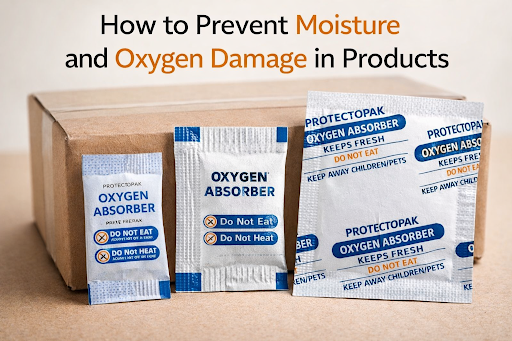
Whatever product you have, oxygen and moisture can adversely affect its quality, shelf life, and safety. Without proper packaging, your product will end up damaged. But surely, you don't want to disappoint customers, right? This is why preventing moisture and oxygen damage in products is compulsory. How to do this? Let's find out.
What Can Cause Oxygen & Moisture Damage in Packaging?
Yes, packaging influences the product's quality throughout its journey to customers.
Although you have packaged your product correctly, it doesn't guarantee that it will remain excellent. Moisture and oxygen damage might still happen. What causes it?
Unexpected environmental factors like high humidity, temperature shifts causing condensation (container rain/cargo sweat), and external water (rain, floods).
Unfortunately, damage can also come from the packaging itself—poor seals, permeable materials (plant-based ones), and inherent air/moisture transmission through microleaks. The result? Product spoilage, rust, mold, or loss of quality (texture, flavor).
Here are some common damages your product might experience due to moisture and oxygen:
-
Product degradation: Mold, discoloration, flavor/aroma, and oxidation in food products.
-
Functional issues: Malfunctions in delicate electronics and compromised sterility in sensitive medical devices.
Overall, oxygen and moisture are the most common causes of product returns. Whether it's condensation during transit, warehouse humidity, or exposure during storage, they can quietly damage packaging (and your products). When customers receive damaged or spoiled goods, the result is returns, write-offs, and more logistics costs that hurt your business margins.
What Can I Use to Prevent Moisture?
A big question, isn't it?
Protecting your products from moisture and oxygen is all about combining high-tech materials with a personal touch. And this is where custom made mylar bags come as a savior. They are primarily made from Biaxially-oriented Polyethylene Terephthalate (BoPET), a specialized polyester. Hence, ideal for extreme durability, blocking 99% of light and oxygen. Meanwhile, the interior is finished with a food-grade polyethylene sealant layer, allowing you to heat-seal the bags and effectively block humidity.
What Are Some Ways You Can Reduce Moisture Levels in Food?
There are some practical ways to reduce moisture levels in your food items.
Here’s what to do.
-
Add more salt or sugar: Yes, these substances bind water and prevent microbial growth.
-
Freeze the food: Use methods such as freeze concentration or osmotic concentration to reduce water content.
-
Include desiccants or oxygen absorbers: Desiccants remove moisture, while oxygen absorbers remove oxygen, thereby extending shelf life.
How about reducing moisture levels and preserving food inside the packaging?
The answer? Again, mylar bags. They are champions of food preservation in the packaging industry. Designed to stop humidity, these bags are the ultimate tool for crushing moisture levels.
Here’s how the bags reduce moisture levels and preserve food.
-
Aluminum shield: The metalized barrier slows moisture and blocks 99% of water, light, and oxygen.
-
Custom-fit efficiency: Using bags tailored to your product's exact dimensions eliminates gaps where moisture can hide and cause spoilage.
-
Air-tight fusion: Mylar uses a food-grade sealant layer that heat-seals into a permanent, hermetic bond, locking the good stuff in and the moisture out.
-
The paired solution: When paired with a desiccant or oxygen absorber, Mylar creates a closed-loop environment that traps and removes moisture, keeping your food excellent for years.
Overall, these bags are the gold standard for protecting against moisture and oxygen.
How to Avoid Moisture in Electronics?
Need to ship electronics? These delicate items can be easily damaged by moisture. Thus, shipping electronics is a high-stakes battle against invisible corrosion.
Even a tiny amount of humidity can cause microscopic rust on circuit boards, leading to "dead on arrival" tech.
Here are some ways to help avoid moisture in electronics:
-
Anti-Static Bags: Specialized, foil-lined pouches act as a metallic shield, reflecting heat and blocking 99% of water vapor.
-
Sieve dessicants: Use molecular sieve desiccants, which are engineered to "grab" moisture more aggressively, even in the extreme heat of a shipping container.
-
Vacuum sealer: Add a vacuum sealer to suck the air out of your packaging before shipping, ensuring there is no moisture left to condense on your circuits.
-
Thermal liners: Use insulated box liners to maintain a steady internal temperature, preventing condensation from forming on metal surfaces.
Treat your electronic components as high-value assets by wrapping them in a specialized moisture-blocking enclosure.
How to Prevent Condensation in Packaging?
Are there other packaging options that prevent condensation?
Condensation is the "hidden enemy" of shipping—appearing out of nowhere when warm, moist air inside your box hits a cold surface. This rapid cooling creates liquid droplets, leading to soggy boxes and moldy products. To keep your goods dry, you have to control the "dew point." How? By managing both the air inside the package and the temperature shifts it encounters during transit.
Here is how.
-
Use right-sized packaging: Accurately measured packaging removes excess space. Less air inside means less room for moisture to condense.
-
Cooling your products: Never seal products while they are still warm from the production line.
-
Insulation: Use thermal bubble liners or insulated box inserts to slow temperature change within the packaging.
-
Strategic ventilation: Use perforated films or anti-fog coatings that allow vapor to escape or spread.
-
Desiccants: Add high-capacity desiccants (bentonite clay or silica gel) to keep the internal environment sufficiently dry, preventing condensation.
In Summary
No doubt, oxygen and moisture can adversely affect its quality, shelf life, and safety. Without proper packaging, your product will end up damaged.
Protecting your products from moisture and oxygen is about combining high-tech materials with a personal touch, and Mylar bags are a lifesaver.
To prevent condensation in packaging, use right-sized packaging, cool your products, add insulation, strategic ventilation, and add high-capacity desiccants.
Well then, now you're ready to ship your products and protect them from moisture and oxygen damage!