Fermentation Products Market Size, Share, Trends & Forecast 2034
-
November 5, 2026 1:51 AM PST
What Is the Current Overview of the Fermentation Products Market?
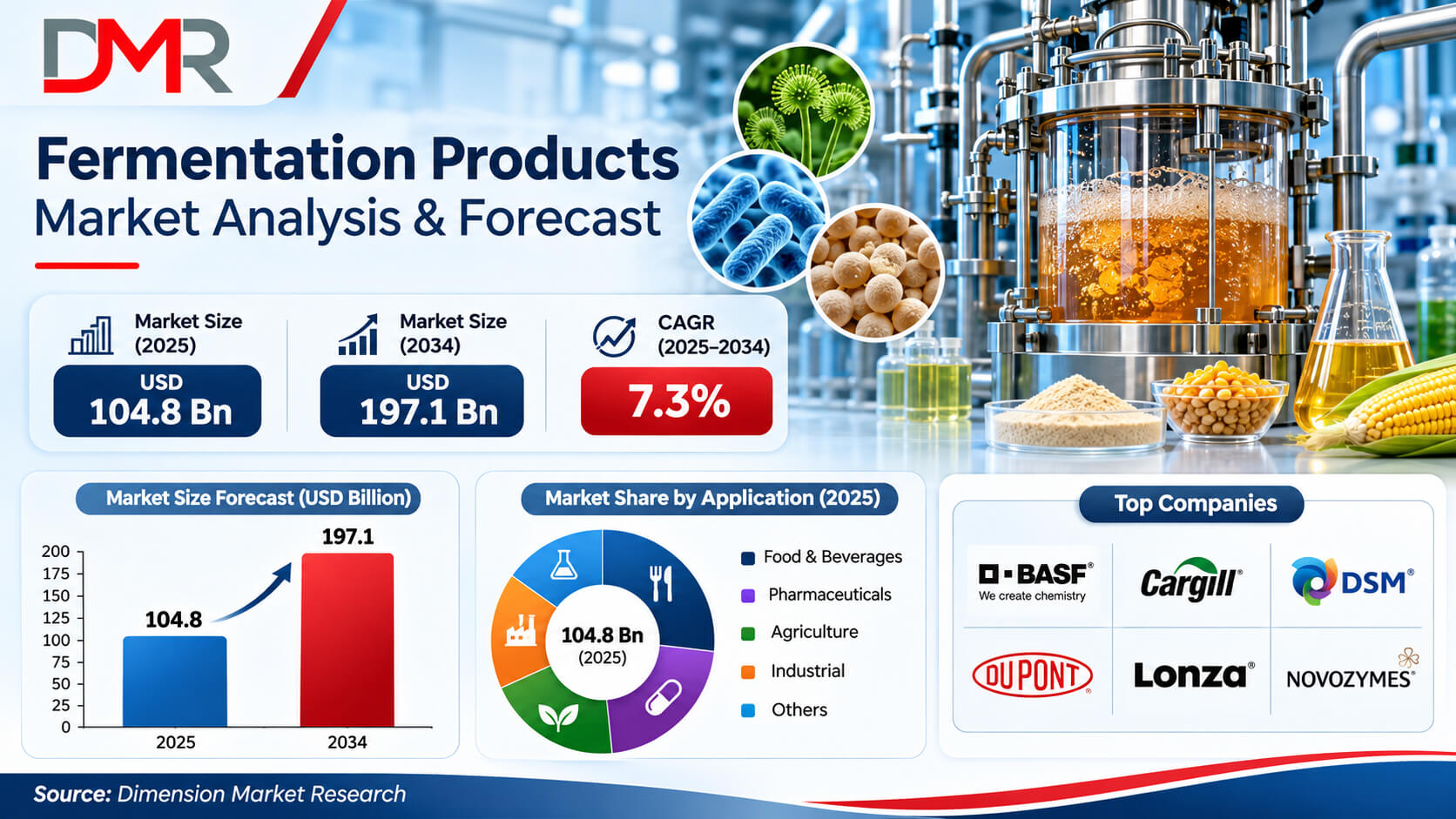
The Fermentation Products Market is experiencing considerable expansion, supported by increasing demand for sustainable manufacturing, bio-based chemicals, renewable energy, and functional food ingredients. According to Dimension Market Research, the global market is estimated at USD 104.8 billion in 2025 and is projected to reach USD 197.1 billion by 2034, registering a CAGR of 7.3% during 2025-2034.
Fermentation uses microorganisms such as bacteria, yeast, and fungi to convert organic materials into commercially valuable products. These outputs include alcohols, amino acids, organic acids, enzymes, vitamins, antibiotics, polymers, and biogas. Their applications extend across food and beverages, pharmaceuticals, agriculture, industrial manufacturing, animal feed, and biofuels.
Growing interest in environmentally responsible production is encouraging manufacturers to replace conventional chemical processes with fermentation-based alternatives. Advances in biotechnology, metabolic engineering, and genetically modified microorganisms are also improving production efficiency and expanding commercial applications.
However, high manufacturing investments, operational expenses, and complex regulatory approval procedures remain important challenges. Continued technological improvements and broader industrial adoption are expected to support long-term market development.
Get free sample of this report (with custom data option): https://dimensionmarketresearch.com/request-sample/fermentation-products-market/
What Is the Expected Value of the Fermentation Products Market by 2034?
The global fermentation products industry is positioned for substantial growth throughout the forecast period, supported by expanding industrial applications and demand for bio-based alternatives.
â— The global market reached an estimated USD 104.8 billion in 2025.
â— The market is projected to reach USD 197.1 billion by 2034.
â— The industry is expected to register a 7.3% CAGR through 2034.
â— North America accounted for approximately 37.6% share in 2025.
â— The US market was valued at USD 33.1 billion in 2025.
â— The US market is projected to reach USD 60.2 billion by 2034.
â— Europe is expected to grow from USD 18.4 billion in 2025.
â— Japan is projected to reach USD 11.0 billion by 2034.
â— Historical market data covers the period from 2019 to 2024.
What Are the Latest Fermentation Products Market Research Findings?
The market research highlights the increasing importance of fermentation across energy, healthcare, food processing, and industrial manufacturing. Alcohol, particularly ethanol, is expected to maintain its leading product position in 2025 because of its extensive use in renewable fuels, beverages, solvents, and pharmaceutical applications. Grains, especially corn, wheat, and barley, are anticipated to remain the dominant feedstock category because of their availability and suitability for large-scale production. North America is projected to maintain the largest regional market share at approximately 37.6% in 2025, while Asia Pacific is expected to record the fastest regional growth. Technological improvements, sustainable production requirements, and expanding biotechnology applications remain important industry development factors.
Why Is the Fermentation Products Market Growing?
Increasing demand for renewable energy, growing biotechnology applications, and changing consumer preferences are supporting market expansion. Bioethanol production is gaining importance as governments encourage alternatives to petroleum-based fuels. At the same time, pharmaceutical manufacturers increasingly depend on microbial fermentation to produce antibiotics, vaccines, therapeutic proteins, and other biologics. Food manufacturers are also adopting fermentation-derived enzymes, organic acids, and probiotics to meet demand for natural and functional ingredients. Furthermore, agricultural applications involving microbial fertilizers, animal feed additives, and bio-based crop protection solutions are creating additional commercial opportunities. These factors collectively strengthen the demand for fermentation technologies across established and emerging industries.
What Are the Key Growth Drivers of the Fermentation Products Market?
â— Rising global demand for renewable biofuels and sustainable energy.
â— Expanding pharmaceutical and biopharmaceutical manufacturing.
â— Increasing consumer preference for probiotics and functional foods.
â— Growing adoption of bio-based chemicals and industrial ingredients.
â— Advancements in microbial engineering and fermentation technology.
â— Increasing demand for sustainable agricultural inputs and animal feed.
â— Government initiatives supporting renewable energy production.
Which Region Is Expected to Witness the Fastest Market Growth?
Asia Pacific is expected to witness the fastest growth in the global fermentation products market. Increasing industrialization, expanding biotechnology capabilities, rising disposable incomes, and growing demand for fermented food products are supporting regional development. China and India are strengthening their fermentation-based manufacturing capabilities across pharmaceuticals, chemicals, biofuels, and food processing. Japan also represents an established market with strong technological expertise and traditional fermented food consumption.
North America is expected to retain its leading regional position, accounting for approximately 37.6% of global market revenue in 2025. The region benefits from established biotechnology infrastructure, substantial ethanol production, agricultural feedstock availability, and strong pharmaceutical manufacturing capabilities.
Regional and Country Market Outlook
â— North America: Approximately 37.6% market share in 2025.
â— United States: USD 33.1 billion in 2025, reaching USD 60.2 billion by 2034, at a 6.9% CAGR.
â— Europe: USD 18.4 billion in 2025, reaching USD 28.5 billion by 2034, at a 5.3% CAGR.
â— Japan: USD 6.29 billion in 2025, reaching USD 11.0 billion by 2034, at a 6.3% CAGR.
â— Asia Pacific: Expected to register the fastest regional growth.
Which Segment Shows the Highest Growth Potential Within the Fermentation Products Market, and Why?
Alcohol Segment
Alcohol, particularly ethanol, is projected to maintain the highest market share within the product type segment in 2025. Its widespread application across renewable energy, food and beverages, pharmaceuticals, and industrial manufacturing makes it an important contributor to market revenue. Ethanol is produced through the fermentation of sugars and starches, making it particularly relevant to countries expanding renewable fuel programs. Its use as a gasoline blending component also supports large-scale commercial demand. Additionally, ethanol and other fermentation-derived alcohols are used as solvents, disinfectants, and industrial ingredients.
â— Growing demand for ethanol-based renewable transportation fuels.
â— Increasing gasoline blending requirements in several countries.
â— Broad industrial applications in solvents and disinfectants.
â— Established production infrastructure and agricultural feedstock supply.
Grains Feedstock Segment
Grains, including corn, wheat, and barley, are expected to dominate the feedstock segment in 2025. Their availability, starch content, established agricultural supply chains, and suitability for industrial fermentation make them preferred raw materials for several production applications. Corn is particularly important for ethanol manufacturing in the United States, while wheat and barley support food and beverage fermentation. Their versatility allows manufacturers to produce alcohols, food ingredients, and other fermentation-derived products efficiently. Continued demand for biofuels and industrial ingredients is expected to support the importance of grain-based feedstocks.
â— High availability of corn, wheat, and barley.
â— Efficient starch conversion during fermentation.
â— Established agricultural and industrial processing infrastructure.
â— Strong demand from biofuel and food manufacturing industries.
Read more about this market: https://dimensionmarketresearch.com/report/fermentation-products-market/
Fermentation Products Market Dynamics
What Are the Major Trends Shaping the Market?
Sustainability and biotechnology innovation are among the major trends transforming the fermentation products industry. Manufacturers are increasingly adopting bio-based production processes to reduce dependence on petroleum-derived materials and improve environmental performance. The growing popularity of probiotics, fermented beverages, and functional foods is also influencing product development. Meanwhile, advances in metabolic engineering, microbial strain development, and process optimization are helping improve fermentation yields. Industrial applications are expanding into bio-based chemicals, specialty ingredients, bioplastics, and pharmaceutical manufacturing. These developments are encouraging companies to invest in advanced fermentation facilities and explore new commercial applications.
What Are the Future Growth Opportunities in the Fermentation Products Market?
Future opportunities are emerging from the development of novel fermentation-derived ingredients, agricultural applications, and next-generation bio-based materials. Advances in synthetic biology and genetic engineering can help manufacturers develop specialized enzymes, vitamins, proteins, and organic acids for high-value applications. Demand for lactic acid, succinic acid, and other bio-based chemicals is creating opportunities in bioplastics and industrial manufacturing. Agriculture also offers considerable potential through microbial fertilizers, biopesticides, and fermentation-enhanced animal feed additives. Additionally, the use of agricultural waste as fermentation feedstock can support circular economy initiatives while creating new opportunities for renewable chemical and biofuel production.
What Challenges Are Affecting the Market?
High capital expenditure and production costs remain significant challenges for fermentation product manufacturers. Industrial fermentation facilities require specialized bioreactors, microbial cultures, processing infrastructure, and continuous quality monitoring. Raw material price fluctuations can further affect production economics, particularly for grain- and sugar-based feedstocks. Regulatory requirements surrounding genetically modified microorganisms and fermentation-derived products can also increase development timelines and market entry costs. Companies operating in food, pharmaceuticals, and biotechnology must comply with strict safety and quality standards. Furthermore, scaling laboratory-developed fermentation processes into commercially viable industrial production can involve considerable technical complexity. Addressing these challenges through process optimization, infrastructure investment, and regulatory compliance will be important for sustained industry development.
Which Country Is Expected to Witness the Fastest Market Growth?
The supplied market research identifies Asia Pacific as the fastest-growing region but does not provide comparable country-level CAGR figures to establish which individual country will grow fastest. Among the countries with disclosed forecasts, the United States is projected to expand from USD 33.1 billion in 2025 to USD 60.2 billion by 2034, registering a 6.9% CAGR. Japan is projected to grow at a 6.3% CAGR, while the European market is projected to register a 5.3% CAGR.
Who Are the Leading Companies in the Fermentation Products Market?
The competitive landscape includes established chemical manufacturers, biotechnology companies, agricultural ingredient suppliers, and specialized fermentation technology providers. Market participants focus on research and development, production capacity expansion, product innovation, and strategic partnerships to strengthen their positions across food, pharmaceutical, biofuel, and industrial applications.
â— BASF SE
â— Dow Inc.
â— Cargill, Incorporated
â— DuPont de Nemours, Inc.
â— Koninklijke DSM N.V.
â— Evonik Industries AG
â— Novozymes A/S
â— Chr. Hansen Holding A/S
â— AB Enzymes GmbH
â— Archer Daniels Midland Company (ADM)
â— Lonza Group AG
â— Ajinomoto Co., Inc.
â— Kyowa Hakko Bio Co., Ltd.
â— Fuso Chemical Co., Ltd.
â— Lallemand Inc.
â— Corbion N.V.
â— Fermentalg
â— Roquette Frères
â— Tate & Lyle PLC
â— Eastman Chemical Company
Get 10% instant discount on report purchase
Explore more related market research finding:
â— Singapore Alternative Protein Ingredients Market
â— Germany Bakery Ingredients Market
â— France Dairy Ingredients Market
â— United States Food Ingredients Market
â— India Dairy Ingredients Market
Frequently Asked Questions About the Fermentation Products Market
1. What is the current size of the global Fermentation Products Market in 2025?
2. What will be the projected Fermentation Products Market value by 2034?
3. What CAGR is expected for the Fermentation Products Market during 2025-2034?
4. Which factors are driving global demand for fermentation-derived products?
5. Which product type is expected to dominate the Fermentation Products Market?
6. Why are grains considered the leading feedstock for industrial fermentation?
7. Which region is expected to experience the fastest Fermentation Products Market growth?
8. What role do biofuels play in the global fermentation products industry?
9. Who are the major companies competing in the Fermentation Products Market?
10. What challenges and opportunities will shape the future of fermentation technology?
About Us
Dimension Market Research (DMR) is a global market intelligence and consulting firm delivering data-driven insights that help organizations make informed strategic decisions. With expertise across 12+ industries and global markets, DMR provides syndicated reports, custom research, competitive analysis, white space analysis, and business strategy consulting.
Our research solutions combine analytical rigor, industry expertise, and forward-looking intelligence to identify opportunities, reduce risks, and support sustainable growth. Trusted by clients across diverse sectors, DMR is committed to delivering accurate, actionable insights that enable businesses to navigate evolving market landscapes with confidence.
Contact Us
Phone USA: +17323699777
Phone India: +919310023843
E-mail: enquiry@dimensionmarketresearch.com
Address USA: 957 Route 33, Suite 12 #308, Hamilton Square, NJ-08690
Address India: D44, Sector 6, Noida 201301, India