Antimicrobial Hospital Textiles Market Forecast 2026 to 2035: Growth, Trends and Opportunities
-
November 11, 2026 3:55 AM PST
Antimicrobial Hospital Textiles Market to Reach USD 25.48 Billion by 2035, Growing at 12.2% CAGR
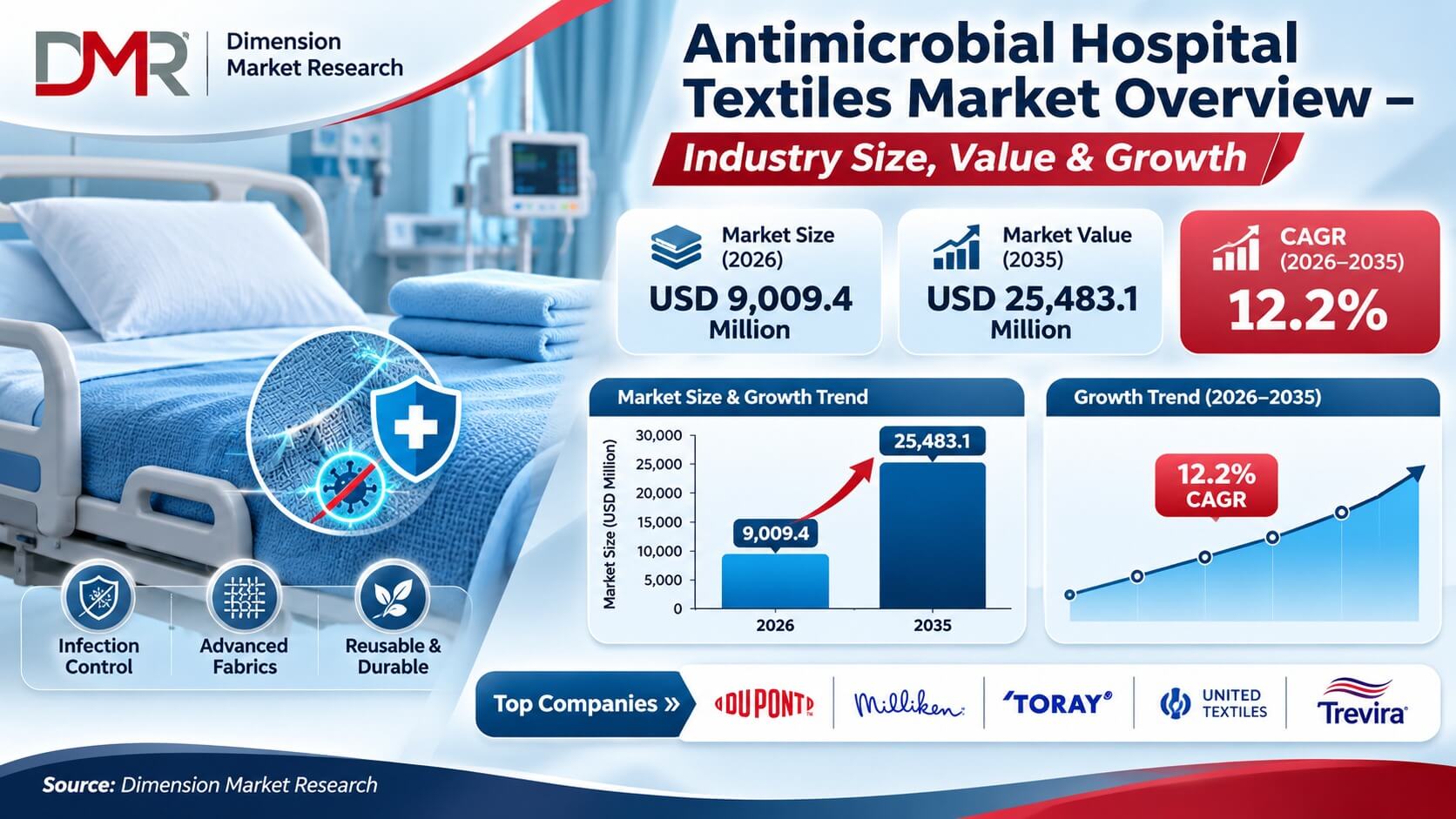
The Antimicrobial Hospital Textiles Market is gaining momentum as healthcare facilities increasingly prioritize infection prevention, patient safety, and advanced textile technologies. According to Dimension Market Research, the global market is valued at USD 9,009.4 million in 2026 and is projected to reach USD 25,483.1 million by 2035, expanding at a CAGR of 12.2% during 2026 to 2035. Growing concerns about healthcare-associated infections (HAIs), rising hospital admissions, and investments in healthcare infrastructure are creating new opportunities for antimicrobial medical textile manufacturers worldwide.
What Is the Current Overview of the Antimicrobial Hospital Textiles Market?
The Antimicrobial Hospital Textiles Market represents a growing segment of the medical textiles industry, focusing on fabrics designed to inhibit or reduce microbial growth on textile surfaces. These materials are increasingly used in hospital bed linens, surgical gowns, patient apparel, privacy curtains, medical uniforms, and other healthcare textile products.
Healthcare providers are adopting silver-ion treatments, copper-infused fibers, quaternary ammonium coatings, and nanotechnology-based antimicrobial finishes to strengthen hygiene practices. These technologies support infection prevention programs by helping reduce microbial contamination between routine cleaning and laundering cycles.
Increasing awareness of hospital-acquired infections, stricter hygiene protocols, and demand for reusable healthcare textiles are strengthening market adoption. Technological advancements in durable antimicrobial finishes and sustainable textile materials are further improving the long-term commercial potential of this industry.
Request Sample PDF of This Report: https://dimensionmarketresearch.com/request-sample/antimicrobial-hospital-textiles-market/
What Is the Expected Value of the Antimicrobial Hospital Textiles Market by 2035?
The global market is expected to reach approximately USD 25,483.1 million by 2035, supported by increasing demand for infection-resistant fabrics and healthcare infrastructure modernization.
Antimicrobial Hospital Textiles Market Statistics Snapshot
â— The global market is valued at USD 9,009.4 million in 2026.
â— The market is projected to reach USD 25,483.1 million by 2035.
â— The industry is expected to expand at a 12.2% CAGR from 2026 to 2035.
â— North America is projected to hold a 34.1% share in 2026.
â— The U.S. market is estimated at USD 2,583.7 million in 2026.
â— The U.S. market is forecast to reach USD 6,855.6 million by 2035.
â— Europe is projected to reach USD 6,553.7 million by 2035.
â— Japan is expected to reach USD 449.5 million by 2035.
â— Historical market data covers the 2020 to 2025 period.
What Are the Latest Antimicrobial Hospital Textiles Market Research Findings?
The market research identifies bed linens as the leading product category because of their extensive use across hospitals and long-term care facilities. Cotton-polyester blends with antimicrobial treatment are expected to dominate the fabric segment due to their balance of comfort, durability, and laundering performance. Acute care hospitals represent a major application area, while hospitals and health systems remain the primary end users. North America maintains the largest regional revenue share, whereas Asia-Pacific offers the fastest growth potential. Silver-ion treatments, copper-based technologies, smart textile management, and sustainable antimicrobial finishes are emerging as important innovation areas. These findings highlight the growing integration of infection prevention technologies into modern healthcare textile procurement strategies.
Why Is the Antimicrobial Hospital Textiles Market Growing?
The increasing burden of healthcare-associated infections is one of the most important factors supporting market growth. Hospitals are continuously seeking solutions that complement conventional cleaning, sterilization, and infection control procedures. Antimicrobial textiles offer an additional layer of microbial reduction on frequently handled materials, including bedding, uniforms, curtains, and surgical apparel.
Another important growth factor is the expansion of healthcare infrastructure across emerging economies. Rising surgical procedures, increasing inpatient admissions, aging populations, and investments in modern hospital facilities are creating consistent demand for advanced medical textiles. Manufacturers are also introducing reusable fabrics, sustainable antimicrobial treatments, and multifunctional textile products to meet changing healthcare procurement requirements.
What Are the Key Growth Drivers of the Antimicrobial Hospital Textiles Market?
â— Rising prevalence of healthcare-associated infections worldwide.
â— Increasing hospital investments in infection prevention technologies.
â— Growing demand for antimicrobial bed linens and patient apparel.
â— Advancements in silver-ion and copper-based textile treatments.
â— Expansion of healthcare infrastructure in emerging economies.
â— Increasing adoption of reusable and durable medical textiles.
â— Stricter patient safety and hospital hygiene requirements.
Which Region Is Expected to Witness the Fastest Market Growth?
Asia-Pacific is expected to witness the fastest market growth, supported by healthcare infrastructure expansion, rising healthcare expenditure, and increasing awareness of infection prevention. China, India, Japan, and Southeast Asian economies are investing in hospital modernization and improved patient safety standards. Government-backed healthcare initiatives and growing local textile manufacturing capabilities are also supporting regional adoption.
North America is expected to maintain its leading position, accounting for approximately 34.1% of global revenue in 2026. Its established healthcare infrastructure, high healthcare spending, and strong focus on infection control support widespread adoption of antimicrobial hospital fabrics.
Which Segment Shows the Highest Growth Potential Within the Antimicrobial Hospital Textiles Market, and Why?
Bed Linens and Antimicrobial Cotton-Polyester Blends
Bed linens are projected to dominate the product type segment because sheets, pillowcases, and mattress covers are essential across nearly every healthcare facility. Patients maintain prolonged contact with bedding, making these products important components of hospital hygiene and infection prevention programs. The widespread use of bed linens across acute care hospitals, rehabilitation centers, and long-term care facilities creates consistent demand for antimicrobial treatments.
Cotton-polyester blends with antimicrobial treatment are also expected to lead the fabric type segment. These materials combine cotton's softness and absorbency with polyester's durability and dimensional stability. Their suitability for repeated industrial laundering makes them attractive for healthcare facilities seeking cost-effective textile solutions.
â— High utilization across hospitals and healthcare facilities.
â— Demand for durable and washable antimicrobial bedding.
â— Compatibility with silver-ion and copper-based treatments.
â— Balanced comfort, breathability, and fabric performance.
Read More About This Market: https://dimensionmarketresearch.com/report/antimicrobial-hospital-textiles-market/
Acute Care Hospitals and Hospitals & Health Systems
Acute care hospitals represent a leading application segment because intensive care units, surgical departments, and inpatient wards require consistent hygiene management. Vulnerable patients, frequent medical procedures, and high textile turnover increase demand for antimicrobial bed linens, patient gowns, surgical drapes, and staff uniforms. These products can complement established hospital infection control procedures.
Hospitals and health systems are also the primary end users because they manage substantial textile inventories and operate under strict patient safety requirements. Their purchasing capacity, standardized procurement practices, and growing interest in evidence-based infection prevention technologies support the adoption of advanced antimicrobial fabrics.
â— Increasing demand from intensive care and surgical departments.
â— Higher utilization of patient gowns and antimicrobial bedding.
â— Growing focus on hospital-wide hygiene management.
â— Rising investments in advanced healthcare textile procurement.
Antimicrobial Hospital Textiles Market Dynamics
What Are the Major Trends Shaping the Market?
Technological innovation is transforming the Antimicrobial Hospital Textiles Market, with manufacturers focusing on multifunctional fabrics that combine antimicrobial performance with fluid repellency, durability, and improved patient comfort. Silver-ion encapsulation, copper-infused fibers, organosilane treatments, and advanced nanotechnology-based finishes are gaining attention because they can support long-lasting textile performance. Another important trend is the integration of smart textile management systems. RFID tracking, automated laundry monitoring, and predictive replacement analytics are helping hospitals manage textile inventories more efficiently. Sustainable antimicrobial solutions, including bio-based treatments and recyclable textile materials, are also gaining importance as healthcare providers increasingly consider environmental performance alongside infection prevention.
What Are the Future Growth Opportunities in the Antimicrobial Hospital Textiles Market?
Emerging healthcare economies offer significant opportunities as governments and private healthcare providers expand hospital capacity and upgrade infection prevention infrastructure. Increasing investments in modern medical facilities across Asia-Pacific, the Middle East, and Latin America are creating new demand for antimicrobial bedding, surgical textiles, and protective healthcare apparel. Manufacturers can benefit from regional production partnerships, affordable product portfolios, and technology licensing arrangements. Sustainable antimicrobial technologies represent another promising opportunity. Bio-based agents such as chitosan and plant-derived antimicrobial compounds, together with recyclable textile platforms, could help manufacturers address environmental concerns. Smart healthcare textiles featuring contamination monitoring and RFID-enabled inventory management may also create additional commercial opportunities.
What Challenges Are Affecting the Market?
High initial procurement costs remain a significant challenge, particularly for public hospitals and healthcare facilities operating under restricted budgets. Antimicrobial textiles often require specialized materials, treatments, testing, and manufacturing processes, increasing their prices compared with conventional fabrics. Hospitals must also evaluate laundering performance, treatment durability, and replacement costs before large-scale adoption. Regulatory and environmental compliance creates additional complexity because antimicrobial agents and biocidal treatments are subject to different requirements across international markets. Concerns regarding chemical exposure, environmental persistence, and antimicrobial resistance are encouraging manufacturers to invest in safer alternatives. Variations in industrial laundering practices and textile maintenance can also influence long-term product performance.
Which Country Is Expected to Witness the Fastest Market Growth?
Japan's antimicrobial hospital textiles market is projected to grow at an 11.3% CAGR from 2026 to 2035. The market is estimated at USD 173.0 million in 2026 and is expected to reach USD 449.5 million by 2035. Its aging population, advanced textile manufacturing capabilities, and strong emphasis on hospital hygiene are supporting demand for antimicrobial fabrics across hospitals, rehabilitation centers, and long-term care facilities.
Who Are the Leading Companies in the Antimicrobial Hospital Textiles Market?
The competitive landscape includes established textile manufacturers, specialty antimicrobial technology developers, chemical companies, and healthcare textile service providers. Market participants are focusing on product innovation, durable antimicrobial finishes, strategic partnerships, and sustainable material development to strengthen their competitive positions.
â— Toray Industries, Inc.
â— Teijin Limited
â— Parkland Corporation
â— Microban International (Barrier Group)
â— Sciessent LLC
â— PurThread Technologies, Inc.
â— BASF SE
â— DuPont de Nemours, Inc.
â— Milliken & Company
â— Trevira GmbH
â— Thai Acrylic Fiber Co., Ltd. (TCG Group)
â— Unitex Group
â— Standard Textile Co., Inc.
â— Angelica Corporation
â— Elis SA
â— Alsco Inc.
â— Medline Industries, LP
â— Cardinal Health, Inc.
â— Honeywell International Inc.
â— Kimberly-Clark Corporation
Get 10% instant discount on report purchase
Related Reports:
â— Electrosurgical Devices Market
â— Sterilization Equipment Services Market
â— Instrumentation Sterilization Containers Market
â— Medical Device Reprocessing Market
â— Gcc Africa Medical Gauze Market
Frequently Asked Questions (FAQs)
1. What is the projected size of the global Antimicrobial Hospital Textiles Market by 2035?
2. What is the expected CAGR of the Antimicrobial Hospital Textiles Market from 2026 to 2035?
3. Which factors are driving demand for antimicrobial hospital fabrics worldwide?
4. Which product category dominates the global Antimicrobial Hospital Textiles Market?
5. Why are cotton-polyester blends widely used in antimicrobial hospital textiles?
6. Which region is expected to hold the largest share of the antimicrobial textile market?
7. Why is Asia-Pacific emerging as a high-growth market for antimicrobial healthcare textiles?
8. What role do silver-ion and copper-based technologies play in medical textile production?
9. Who are the major manufacturers and competitors in the Antimicrobial Hospital Textiles Market?
10. What opportunities and challenges will influence the market through 2035?
About Us
Dimension Market Research (DMR) is a global market intelligence and consulting firm delivering data-driven insights that help organizations make informed strategic decisions. With expertise across 12+ industries and global markets, DMR provides syndicated reports, custom research, competitive analysis, white space analysis, and business strategy consulting.
Our research solutions combine analytical rigor, industry expertise, and forward-looking intelligence to identify opportunities, reduce risks, and support sustainable growth. Trusted by clients across diverse sectors, DMR is committed to delivering accurate, actionable insights that enable businesses to navigate evolving market landscapes with confidence.
Contact Us
Phone USA: +17323699777
Phone India: +919310023843
E-mail: enquiry@dimensionmarketresearch.com
Address USA: 957 Route 33, Suite 12 #308, Hamilton Square, NJ-08690
Address India: D44, Sector 6, Noida 201301, India