Posted
China Supply Chain Resilience Automation Market Snapshot
China Supply Chain Resilience Automation Market&nb...


Nothing has been posted here yet - be the first!
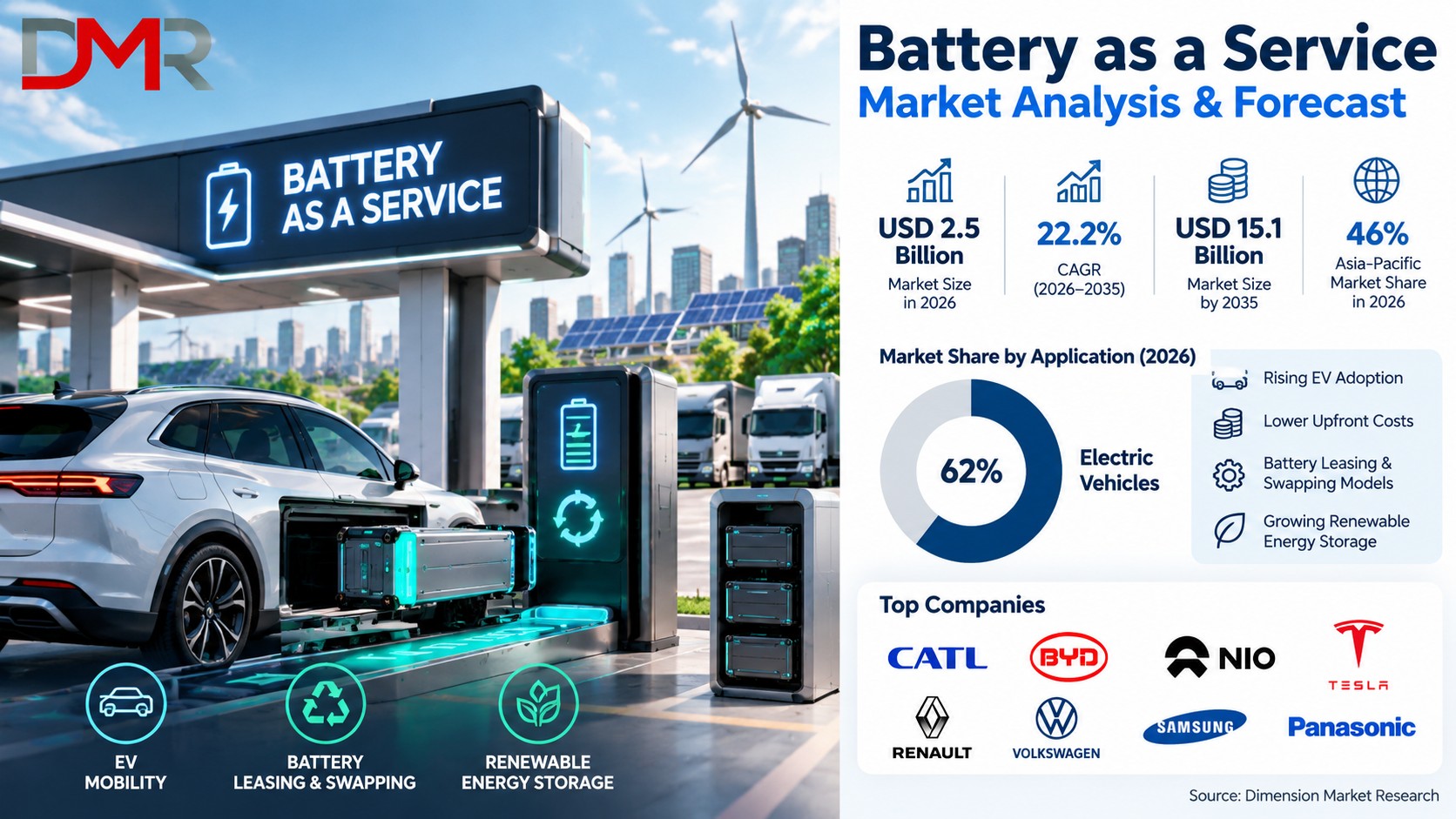
According to Dimension Market Research, the Battery as a Service Market size is projected to grow from USD 2.5 billion in 2026 to USD 15.1 billion by 2035, registering a compound annual growth rate (CAGR) of 22.2%. Increasing electric vehicle adoption, renewable energy deployment, and demand for flexible battery ownership models are expected to support market expansion.
Battery as a Service (BaaS) enables consumers and businesses to lease, subscribe to, or pay for battery usage rather than purchase batteries outright. This approach can lower initial vehicle costs, improve expenditure planning, and transfer selected maintenance and battery management responsibilities to service providers. As electric mobility and energy storage become more important, BaaS is emerging as an alternative model for accessing battery technology without assuming full ownership.
The market is also evolving through battery swapping infrastructure, digital monitoring, predictive maintenance, and lifecycle management. These services can improve battery utilization and support applications ranging from electric two-wheelers and commercial fleets to stationary energy storage. However, infrastructure costs, battery compatibility, and regional operating conditions remain important considerations for market participants.
Get free sample of this report (with custom data option): https://dimensionmarketresearch.com/request-sample/battery-as-a-service-market/ lang="EN" style="font-size: 14.0pt; line-height: 115%; font-family: Roboto; mso-fareast-font-family: Roboto; mso-bidi-font-family: Roboto;">
● Market size: USD 2.5 billion projected for 2026.
● Forecast value: USD 15.1 billion expected by 2035.
● Growth rate: 22.2% CAGR during 2026 to 2035.
● Leading region: Asia-Pacific, with a 46% share in 2026.
● Leading battery type: Lithium-ion, with an estimated 68% share in 2026.
● Leading service model: Battery leasing, with around 36% share in 2026.
● Leading application: Electric vehicles, with a projected 62% share in 2026.
● Leading component: Charging and swapping infrastructure, at about 34% in 2026.
● Leading end user: Mobility and automotive, with around 48% share in 2026.
The market research identifies electric mobility as a primary application for battery services. Electric vehicles are projected to account for 62% of the market in 2026, while the mobility and automotive industry is expected to represent approximately 48% by end-user category. Lithium-ion batteries remain the leading battery technology, supported by established supply chains and widespread use in EVs and energy storage. Battery leasing is projected to lead service models because it can reduce upfront expenditure and provide predictable payments. Charging and swapping infrastructure remains essential to service availability, while monitoring, analytics, and predictive maintenance are creating additional opportunities. The research also assesses regional conditions, competitive activity, and the factors influencing long-term adoption.
Demand is increasing as electric vehicle buyers and commercial operators seek more affordable ways to access battery technology. Separating battery costs from vehicle purchases can reduce initial expenditure, while leasing and subscription models may provide maintenance, monitoring, and replacement services under agreed terms.
Renewable energy integration is another growth factor. Solar and wind generation can create fluctuations in electricity supply, increasing demand for flexible energy storage. Battery service providers can help businesses and utilities manage storage assets, monitor performance, and plan maintenance. Digital technologies also enable better battery utilization, although the financial benefits depend on infrastructure readiness, usage levels, and service pricing.
● Lower upfront battery costs can improve electric vehicle affordability.
● EV adoption increases demand for flexible battery ownership models.
● Fleet electrification creates demand for predictable operating expenses.
● Battery swapping can reduce downtime in suitable vehicle applications.
● Renewable energy deployment supports managed battery storage demand.
● AI and IoT improve battery monitoring and maintenance planning.
● Battery reuse and recycling create additional lifecycle opportunities.
The report examines battery type, service model, application, service component, end-user industry, and regional markets. This segmentation provides a framework for understanding customer demand, technology adoption, and the business models shaping the industry.
Lithium-ion batteries are projected to hold approximately 68% of the Battery as a Service Market in 2026. Their energy density, established manufacturing capacity, and widespread use in electric vehicles and energy storage make them central to current service deployments. An established supply chain also supports their availability across multiple applications.
Lithium iron phosphate batteries are attracting interest because of their cost and safety characteristics. Other chemistries, including nickel manganese cobalt, nickel cobalt aluminum, solid-state, and sodium-ion batteries, offer different performance and cost considerations. Their future contribution will depend on commercial readiness, manufacturing scale, safety, and application requirements.
● Lithium-ion technology benefits from established supply chains.
● LFP batteries offer cost and safety advantages for selected uses.
● Emerging chemistries may diversify future battery service options.
Battery leasing is expected to account for around 36% of the market in 2026. It allows customers to access battery capacity without bearing the entire initial purchase cost. Commercial fleet operators may benefit from more predictable expenditure and service agreements that include maintenance or replacement provisions.
Subscription models offer recurring payments, while pay-per-use plans connect charges to consumption or distance. Swapping-as-a-service focuses on rapid battery exchange and may appeal to high-utilization fleets. Its effectiveness depends on compatible batteries, station availability, and sufficient local demand.
● Leasing can reduce initial investment requirements.
● Subscriptions can combine battery access with maintenance.
● Swapping supports faster turnaround in suitable applications.
Read more about this market: https://dimensionmarketresearch.com/report/battery-as-a-service-market/
Digitalization is changing battery operations through connected sensors, cloud analytics, battery management systems, and artificial intelligence. These tools can monitor battery health, improve charging decisions, detect faults, and support predictive maintenance. Better data can help service providers reduce downtime and improve asset utilization. Modular and swappable batteries are also gaining attention in electric two-wheelers, three-wheelers, and commercial fleets. However, interoperability across manufacturers remains essential for scaling swapping networks. Renewable energy storage and circular economy practices offer additional growth opportunities. Managed battery services can provide access to storage capacity for residential, commercial, industrial, and utility applications. Second-life batteries may support less demanding storage uses after assessment of their condition and safety. Recycling can recover valuable materials and improve end-of-life management. Government incentives, partnerships, and supportive regulations may encourage adoption where the business case is viable. Developing battery swapping networks requires investment in facilities, grid connections, inventory, software, and maintenance. These costs can limit expansion where customer demand is insufficient. Battery designs and technical specifications also differ between manufacturers, complicating interoperability and network development. Providers must manage battery degradation, warranties, safety, and residual value while maintaining competitive prices. Standardization, reliable service agreements, and strong partnerships can help address these barriers. Asia-Pacific is projected to hold around 46% of the global market in 2026, supported by urban mobility demand, EV manufacturing, domestic battery supply chains, and electrification initiatives. The United States Battery as a Service Market is estimated at USD 500 million in 2026, with a projected CAGR of 22.0%. Europe is estimated at USD 550 million in 2026, with a projected CAGR of 21.0%. Japan is expected to reach USD 175 million in 2026, with a projected CAGR of 19.9%. EV adoption, battery innovation, energy storage demand, and sustainability initiatives influence these country and regional outlooks. The competitive landscape includes battery swapping providers, vehicle manufacturers, battery technology companies, and mobility service operators. Companies identified in the report include: ● NIO Inc. ● Gogoro Inc. ● XPeng Inc. ● SAIC Motor Corporation Limited ● VinFast ● Ample Inc. ● SUN Mobility ● Battery Smart ● Bounce Infinity ● Swobbee GmbH ● Oyika Pte. Ltd. ● Immotor Technology ● KYMCO (Ionex) ● VoltUp ● Spiro Mobility ● Selex Motors ● Aulton New Energy ● CATL (EVOGO) ● Yadea (Energy Cubes) ● Amara Raja Energy & Mobility ● Others In March 2026, TVS Motor Company introduced a Battery as a Service model for electric scooters, separating battery costs from the vehicle purchase price. The reported offering included scooter prices starting at INR 49,999 and battery usage plans starting at INR 862 per month. The model illustrates how subscription-based battery access can address upfront affordability, subject to plan conditions. In April 2026, Alsym Energy highlighted a physics-informed artificial intelligence platform supporting development of its sodium-ion batteries. The approach combines physics-based models, AI, autonomous testing, and diagnostics to accelerate research. Although this is a battery development initiative rather than a direct BaaS service launch, advances in battery technology could influence future service offerings. The projected increase from USD 2.5 billion in 2026 to USD 15.1 billion in 2035 highlights the potential of battery leasing, swapping, EV services, and managed energy storage. Growth will depend on customer economics, infrastructure deployment, battery compatibility, technology improvements, and regulation. Businesses evaluating the sector can use segment-level and regional analysis to understand competitive conditions and identify areas for investment. Get 10% instant discount on report purchase ● Long-Duration Energy Storage Market ● Lithium-Ion Battery Recycling Market It covers battery leasing, subscriptions, pay-per-use services, battery swapping, monitoring, maintenance, and lifecycle management. The market is projected to reach USD 2.5 billion in 2026, according to Dimension Market Research. The market is projected to reach USD 15.1 billion by 2035, based on the supplied report forecast. The Battery as a Service Market is expected to register a CAGR of 22.2% between 2026 and 2035. Asia-Pacific is projected to lead with approximately 46% of global market share in 2026. Lithium-ion batteries are projected to account for around 68% of market share in 2026. Battery leasing is projected to lead, with approximately 36% of market share in 2026. EV adoption, lower upfront costs, fleet electrification, renewable storage, and battery lifecycle services support growth. Infrastructure investment, battery compatibility, safety requirements, and battery degradation can constrain market expansion. Leading companies listed in the report include NIO, Gogoro, Ample, SUN Mobility, Battery Smart, CATL (EVOGO), and VinFast. Dimension Market Research (DMR) is a global market intelligence and consulting firm delivering data-driven insights that help organizations make informed strategic decisions. With expertise across 12+ industries and global markets, DMR provides syndicated reports, custom research, competitive analysis, white space analysis, and business strategy consulting. Our research solutions combine analytical rigor, industry expertise, and forward-looking intelligence to identify opportunities, reduce risks, and support sustainable growth. Trusted by clients across diverse sectors, DMR is committed to delivering accurate, actionable insights that enable businesses to navigate evolving market landscapes with confidence. Contact Us Phone USA: +17323699777 Phone India: +919310023843 E-mail: enquiry@dimensionmarketresearch.com Address USA: 957 Route 33, Suite 12 #308, Hamilton Square, NJ-08690 Address India: D44, Sector 6, Noida 201301, IndiaBattery as a Service Market Dynamics
Market Trends
Market Opportunities
Market Challenges
Battery as a Service Market Regional and Country Outlook
Battery as a Service Market Key Competitor Companies
Recent Developments in the Battery as a Service Ecosystem
Battery as a Service Market Outlook Through 2035
Explore more reports:
FAQ's
1. What is the Battery as a Service Market?
2. What is the Battery as a Service Market size in 2026?
3. What is the Battery as a Service Market forecast for 2035?
4. What is the expected market CAGR?
5. Which region leads the Battery as a Service Market?
6. Which battery type dominates the market?
7. Which service model leads the market?
8. What drives Battery as a Service Market growth?
9. What challenges affect the market?
10. Who are the key Battery as a Service Market players?
About Us
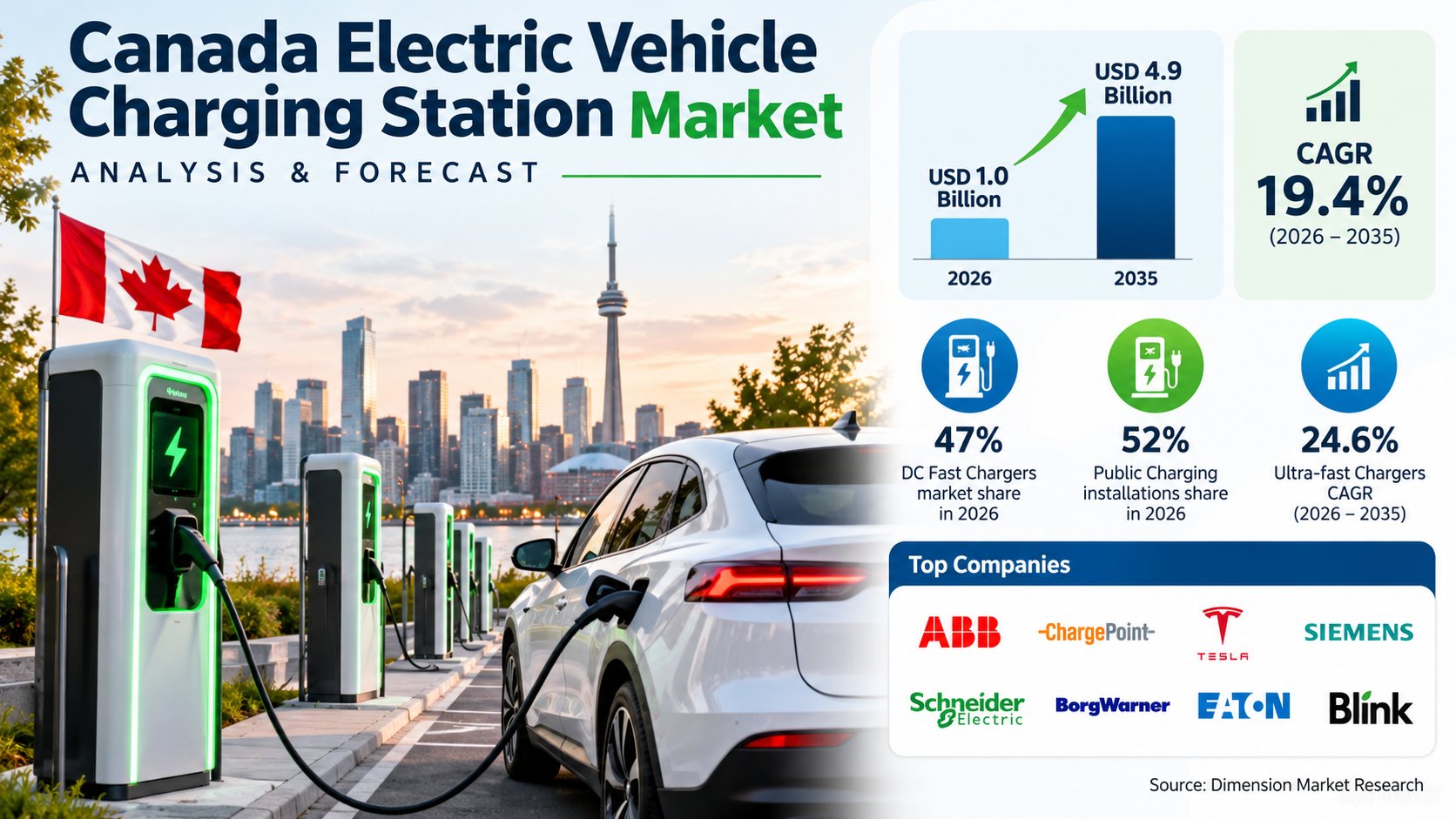
According to Dimension Market Research, the Canada Electric Vehicle Charging Station Market is projected to grow from USD 1.0 billion in 2026 to USD 4.9 billion by 2035, registering a compound annual growth rate (CAGR) of 19.4%. Increasing electric vehicle adoption, expanding public charging networks, and growing investments in sustainable transportation infrastructure are supporting this development.
Canada's transition toward electric mobility is creating opportunities for charging equipment manufacturers, network operators, utilities, and infrastructure developers. Public charging stations, residential charging solutions, workplace installations, and commercial fleet charging facilities are becoming important components of the country's transportation ecosystem. Demand for DC fast chargers and ultra-fast charging equipment is strengthening as drivers seek convenient charging experiences and shorter waiting periods. Meanwhile, government infrastructure programs and private investments are encouraging deployment across major cities, highways, commercial properties, and underserved communities.
Advancements in charging technology, intelligent energy management, and connector compatibility are also reshaping the competitive environment. Companies offering reliable charging infrastructure, efficient network management, and flexible installation solutions are positioned to benefit from Canada's evolving electric vehicle ecosystem.
Get insight you need (request free sample)
● Market size in 2026: USD 1.0 billion.
● Forecast market value by 2035: USD 4.9 billion.
● Canada Electric Vehicle Charging Station Market CAGR: 19.4%.
● DC fast chargers lead with approximately 47% share in 2026.
● Public charging installations hold nearly 52% share in 2026.
● Ultra-fast chargers forecast CAGR: 24.6%.
● Fleet and depot charging forecast CAGR: 26.3%.
● NACS connector segment forecast CAGR: 29.8%.
● Forecast period: 2026 to 2035.
The research identifies public charging infrastructure and DC fast charging technology as important contributors to market revenue. DC fast chargers are expected to represent approximately 47% of the market by charger type in 2026, supported by demand for shorter charging sessions. Public charging installations are projected to contribute nearly 52% of revenue. Ultra-fast chargers exceeding 150 kW are forecast to expand at a 24.6% CAGR, while fleet and depot charging installations could grow at 26.3%.
North American Charging Standard adoption is another notable development, with projected growth of 29.8% annually through 2035. These findings highlight opportunities across charging hardware, installation services, software platforms, and network operations.
Market expansion reflects the increasing need for accessible, dependable, and efficient electric vehicle charging infrastructure. As EV adoption develops, drivers require charging facilities beyond residential locations, while commercial operators need scalable charging systems supporting fleet operations. Public infrastructure investment, charging technology improvements, and expanding vehicle compatibility are strengthening the industry's long-term outlook.
● Increasing electric vehicle adoption across Canada.
● Expansion of highway DC fast charging networks.
● Government support for EV charging infrastructure.
● Growing commercial fleet electrification investments.
● Rising demand for workplace and residential charging.
● Adoption of intelligent charging management systems.
● Development of high-power charging equipment.
DC fast chargers are projected to dominate charger-type revenue with approximately 47% share in 2026. Their ability to recharge compatible vehicles significantly faster than conventional AC equipment makes them suitable for highway corridors, commercial charging hubs, and fleet applications. Ultra-fast chargers above 150 kW represent an important emerging segment as network operators upgrade existing infrastructure to support newer electric vehicles.
● DC fast chargers lead with approximately 47% market share.
● Ultra-fast chargers are projected to grow at 24.6% CAGR.
Public charging is expected to contribute approximately 52% of market revenue in 2026. Investments in urban charging hubs, highway installations, and destination charging facilities support its leading position. Fleet and depot charging represents a particularly attractive growth opportunity as transit agencies, delivery companies, and logistics providers transition toward electric vehicles requiring dedicated infrastructure.
● Public charging holds approximately 52% revenue share.
● Fleet and depot charging is forecast to grow at 26.3% CAGR.
CCS Combo 1 connectors are expected to account for approximately 51% of the connector segment in 2026. However, increasing North American Charging Standard adoption is changing equipment procurement and network planning. Operators are considering dual-connector installations and compatible charging hardware to serve a broader vehicle population.
● CCS Combo 1 remains the leading connector category.
● NACS adoption is projected to expand at 29.8% CAGR.
A significant market trend involves the adoption of higher-power chargers, smart charging software, and intelligent load management. Operators are prioritizing charging reliability, payment convenience, and improved station utilization. Predictive analytics can support maintenance scheduling and demand forecasting, while dynamic power management helps distribute electricity efficiently across multiple charging bays. These technologies are improving infrastructure performance and supporting more commercially sustainable charging operations.
Commercial fleet electrification and multi-unit residential charging offer attractive investment opportunities. Delivery operators and municipal transit agencies increasingly require depot-based charging solutions capable of supporting multiple vehicles. Meanwhile, apartment buildings and condominiums need cost-effective charging infrastructure suited to shared parking facilities. Companies combining hardware, installation, monitoring software, and maintenance services can address these requirements while developing recurring service revenue.
Read more about this market: https://dimensionmarketresearch.com/report/canada-electric-vehicle-charging-station-market/ lang="EN" style="font-family: Roboto; mso-fareast-font-family: Roboto; mso-bidi-font-family: Roboto;">
High installation costs, utility interconnection delays, and uncertain charging utilization remain major challenges. Fast charging sites often require electrical upgrades, transformers, and additional grid capacity. These requirements can increase project costs and extend installation schedules. Rural and northern communities face additional obstacles because lower traffic volumes may limit near-term charging revenue. Addressing these barriers requires coordinated infrastructure planning, reliable funding, and efficient electricity distribution.
● FLO (AddEnergie Technologies)
● ChargePoint
● Tesla Supercharger Network
● Electrify Canada
● ABB E-mobility
● Siemens eMobility
● Schneider Electric
● Petro-Canada (Suncor Energy)
● SWTCH Energy
● Ivy Charging Network
● Kempower
● BC Hydro
Get 10% instant discount on report purchase
● Italy Electric Vehicle Charging Station Market
● Spain Electric Vehicle (EV) Charging Infrastructure Market
● Canada Electric Vehicle (EV) Charging Infrastructure Market
The market is estimated at USD 1.0 billion in 2026.
It is forecast to reach USD 4.9 billion by 2035.
The projected CAGR is 19.4% from 2026 to 2035.
DC fast chargers lead with approximately 47% revenue share in 2026.
Public charging leads with approximately 52% share in 2026.
Ultra-fast chargers above 150 kW are projected to grow at 24.6% CAGR.
EV adoption, infrastructure investment, and fleet electrification support growth.
NACS connectors are forecast to grow at 29.8% CAGR through 2035.
Grid connection delays, installation costs, and uncertain utilization create barriers.
Prominent participants include FLO, ChargePoint, Tesla, Electrify Canada, and ABB E-mobility.
The Canada Electric Vehicle Charging Station Market is positioned for substantial expansion as investment shifts toward faster, smarter, and more accessible charging solutions. Public networks, fleet depots, residential installations, and charging software will remain important areas of development. Businesses prioritizing network reliability, convenient access, and infrastructure efficiency will be better positioned to capture opportunities through 2035.
Dimension Market Research (DMR) is a global market intelligence and consulting firm delivering data-driven insights that help organizations make informed strategic decisions. With expertise across 12+ industries and global markets, DMR provides syndicated reports, custom research, competitive analysis, white space analysis, and business strategy consulting.
Our research solutions combine analytical rigor, industry expertise, and forward-looking intelligence to identify opportunities, reduce risks, and support sustainable growth. Trusted by clients across diverse sectors, DMR is committed to delivering accurate, actionable insights that enable businesses to navigate evolving market landscapes with confidence.
Contact Us
Phone USA: +17323699777
Phone India: +919310023843
E-mail: enquiry@dimensionmarketresearch.com
Address USA: 957 Route 33, Suite 12 #308, Hamilton Square, NJ-08690
Address India: D44, Sector 6, Noida 201301, India
YouTalent® is an online community of talent. If you have a talent, whether it’s singing, dancing, acting, modeling, drawing, or whatever talent it may be and you would like to share it with the world or to network with other talented individuals, then you've came to the right place.